
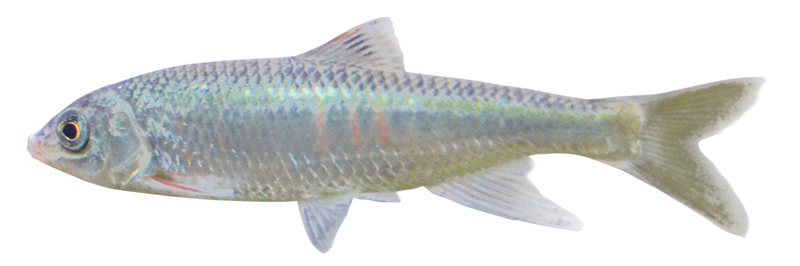
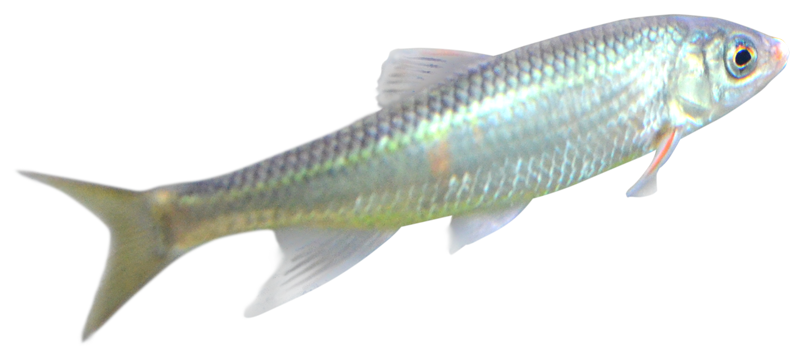
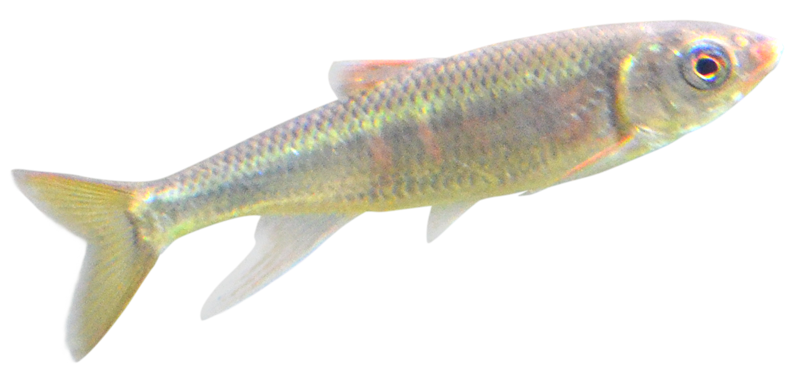
Opsariichthys platypus (Temminck & Schlegel, 1846)
雑魚とは呼ばせない、繁殖期の美しさ
Too Beautiful to Be Called “Zako”: Breeding Season Brilliance
体長15cmほど。コイ科に属する淡水魚で、東アジアの河川に広く分布します。日本ではもともと西日本に自然分布していましたが、現在では東北地方や四国の太平洋側、種子島、徳之島など本来の分布域外でも見られるようになっています。これは琵琶湖産アユの放流種苗に混入して各地へ運ばれたことが主な要因と考えられています。流れのある中~下流域を好み、群れで生活することが多く、雑食性で水生昆虫や藻類などを食べます。
体色は背部が灰青色、腹部が銀白色で、体側には淡いピンク色の横帯が数本入ります。普段は地味で、日本では小魚を総称する「雑魚」として扱われることもありますが、初夏から夏の繁殖期になると印象は一変します。オスは青緑色と朱色が鮮やかに発色する「婚姻色」と呼ばれる体色へと変化します。同時に頭部には白く硬い突起である「追い星」が現れ、各ひれも発達し、特に尻びれが大きく伸長します。この婚姻色の美しさは「川の宝石」と称され、メスへのアピールに重要な役割を果たします。一方で追い星はオス同士の闘争にも用いられ、体当たりによって相手を威嚇し、縄張りを守ります。
学名はかつて「Zacco platypus」とされていましたが、この属名はシーボルトが日本の川魚を紹介した際、小型魚を総称する「雑魚」という言葉に由来しています。現在では分類が見直され、本種はハス属に含められ、学名は「Opsariichthys platypus」とされています。これにより、名義上は「雑魚」の仲間ではなくなったともいえるでしょう。
Reaching about 15 cm in length, this freshwater fish belongs to the carp family and is widely distributed in rivers across East Asia. In Japan, it was originally native to western regions, but it is now also found in areas outside its natural range, including the Tohoku region, the Pacific side of Shikoku, Tanegashima, and Tokunoshima. This expansion is thought to be largely due to its unintentional introduction alongside stocked juvenile ayu from Lake Biwa. It prefers the middle to lower reaches of flowing rivers, often forming schools, and feeds omnivorously on aquatic insects and algae.
Its coloration is generally subdued, with a grayish-blue back, a silvery-white underside, and several faint pink horizontal bands along the sides. In Japan, small fish like this are often collectively referred to as “zako” (miscellaneous small fish), but its appearance changes dramatically during the breeding season from early summer to summer. Males develop brilliant nuptial coloration, displaying vivid blue-green and vermilion hues. At the same time, small, hard white projections called “breeding tubercles” appear on the head, and the fins become more developed, with the anal fin elongating in particular. The beauty of this nuptial coloration has earned it the nickname “jewel of the river,” serving as an important display to attract females. These tubercles are also used in combat between males, which ram into rivals to drive them away and defend their territory.
The scientific name was formerly Zacco platypus. The genus name “Zacco” originates from the word “zako,” which was used by Siebold when introducing Japanese freshwater fishes, referring to small fish in general. However, taxonomic revisions have since reclassified this species into the genus Opsariichthys, and its current scientific name is Opsariichthys platypus. In that sense, it could be said that, at least nominally, this fish is no longer a “zako.”
参考文献
国立環境研究所 | 侵入生物データベース | オイカワ 2025年1月19日閲覧
Hondaの社会貢献活動 | 森に行こうよ! | 繁殖期に変身するオイカワのなぜ?なに? 編 | 奥山 英治 2025年1月19日閲覧
TSURIHACK | オイカワの最大サイズを追い求めて……夏に美しい雑魚(ザコ)を釣り狙う!出るか?18㎝オーバー | 山根 央之 (2024年8月5日) 2025年1月19日閲覧
「シーボルトと三種の雑魚」川に学ぼうかい 第86回 (2019年10月5日) 2025年1月19日閲覧
ぼうずコンニャクの市場魚貝類図鑑 | オイカワ 2025年1月19日閲覧