
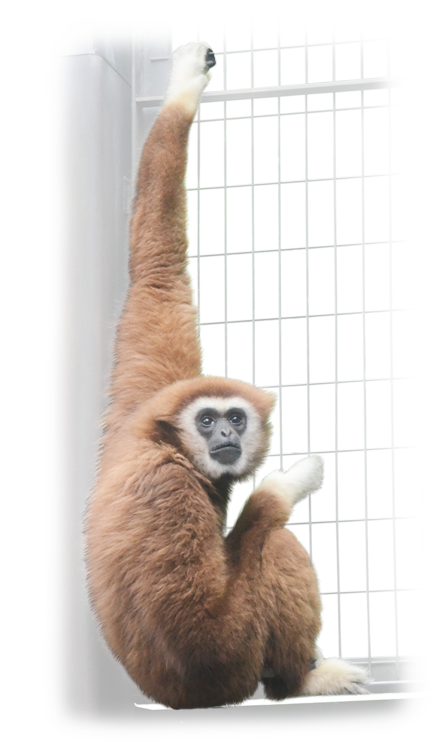
Hylobates lar (Linnaeus, 1771)
白き手で樹冠を渡る類人猿
The White-Handed Ape of the Forest Canopy
シロテナガザル(Lar Gibbon)は、体長45〜65cm、体重5.5〜6.7kgの小型の類人猿です。タイ、マレーシア、インドネシア、ミャンマー東部など東南アジアの熱帯雨林に生息し、ほとんどの時間を樹上で過ごします。体毛の色は淡褐色から黒色まで個体差がありますが、顔の周囲を縁取る白い毛と、手足の先端の白い毛が共通の特徴で、和名や英名「White-handed Gibbon(白い手のテナガザル)」の由来となっています。
テナガザル類は「歌う類人猿」として知られています。シロテナガザルも遠くまで響く大きな声で鳴き交わし、家族ごとに美しい合唱を行います。この「テリトリーソング」は縄張りを周囲に知らせるとともに、つがいや家族の結びつきを維持する役割も果たしています。熱帯雨林の朝には、その澄んだ歌声が森中に響き渡ります。
長い腕を利用したブラキエーション(腕渡り)は本種最大の特徴です。振り子のように枝から枝へ移動し、ときには8m以上も跳躍します。霊長類の中でも特に優れた樹上運動能力を持ちますが、それでも移動に失敗して落下することがあり、高所からの転落による骨折も報告されています。
シロテナガザルは、すべての類人猿と同様に尾を持ちません。その代わり臀部には硬く角質化したクッション状の皮膚が発達しており、細い枝の上でも安定して座ることができます。夜は樹上で体を起こしたまま休息し、ときにはその姿勢のまま眠ることもあります。長い腕と美しい歌声、そして樹上生活への巧みな適応は、アジアにのみ生息するテナガザル類の特徴をよく示しています。
The Lar Gibbon (Hylobates lar) is a small ape measuring 45–65 cm in body length and weighing 5.5–6.7 kg. It inhabits the tropical rainforests of Southeast Asia, including Thailand, Malaysia, Indonesia, and eastern Myanmar, and spends most of its life in the forest canopy. Its fur varies from light brown to black among individuals, but all share distinctive white fur surrounding the face and covering the hands and feet. These white extremities are the origin of its English name, “White-handed Gibbon.”
Gibbons are often called the “singing apes,” and the Lar Gibbon is no exception. Family members perform loud and melodious vocal duets that can be heard over long distances. These “territory songs” serve not only to advertise ownership of a home range but also to strengthen pair bonds and family relationships. In the early morning, their clear voices echo through the rainforest.
The species is best known for its remarkable brachiation, a form of locomotion in which it swings beneath branches using its exceptionally long arms. Moving like a pendulum through the canopy, it can leap more than eight meters between trees. Among primates, gibbons are regarded as some of the most accomplished arboreal movers. Even so, accidents do occur, and falls from great heights can sometimes result in broken bones.
Like all apes, the Lar Gibbon lacks a tail. Instead, it possesses hardened, cushion-like patches of skin on the buttocks that allow it to sit securely on narrow branches. It often rests high in the trees and may even sleep while maintaining an upright sitting posture. Its long arms, beautiful songs, and remarkable adaptations to life in the treetops exemplify the characteristics of the gibbons, a group of apes found only in Asia.
参考文献
岡 健司、熊倉 博雄『シロテテナガザルのブラキエーション時における大腿直筋の活動』大阪河﨑リハビリテーション大学紀要 7 (2), 67-76, 2013-03 2024年8月4日閲覧
Lar gibbon. Species of Thailand. Thai National Parks. 2024年8月4日閲覧
Worthington, Breton. (2024, May) White-handed Gibbon. New England Primate Conservancy 2024年8月4日閲覧
“Vocalizations” About Gibbons, Gibbon SSP. 2026年7月26日閲覧