
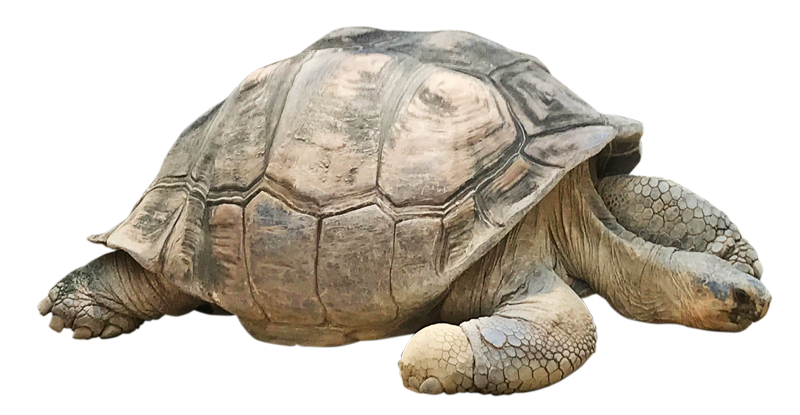
Chelonoidis niger species complex
島ごとに進化した巨大リクガメ
The Giant Tortoises That Evolved on Each Island
最大で甲長135cm、体重417kgに達する世界最大級のリクガメであるガラパゴスゾウガメは、エクアドル領東太平洋に位置するガラパゴス諸島にのみ生息する固有種です。長い首と高く盛り上がった甲羅を持ち、島ごとの環境に応じてドーム型やサドルバック型など多様な形態へ分化してきました。この違いは、乾燥地で高所の植物を採食する必要性や、湿潤環境での採食様式の差を反映した適応の結果と考えられています。
本種は伝統的に15の種(または亜種)に分類されてきましたが、そのうち5系統はすでに絶滅し、現在確認されているのは10系統です。各系統は主に一つの島、あるいは同一島内の火山ごとに分布しており、海による地理的隔離が進化的分化を促した典型例とされています。この現象は適応放散の代表例として知られ、チャールズ・ダーウィンが進化論の着想を得た重要な観察対象の一つでもありました。
食性は主に草食で、サボテンや草本、低木の葉や果実を食べます。乾季には体内に水分を蓄える能力により、長期間水を摂らずに生存することが可能です。代謝は低く成長も緩やかで、100年以上生きる個体も珍しくなく、記録上は150年以上と推定される例もあります。繁殖は主に雨季に行われ、雌は砂地に穴を掘って複数の卵を産み、孵化までに数か月を要しますが、幼体は外来捕食者の影響を受けやすく生存率は高くありません。
かつては捕鯨船や探検船による乱獲や、ヤギやブタなどの外来種の影響で個体数が激減しました。ピンタ島のロンサム・ジョージが2012年に死亡したことで一系統は絶滅しましたが、現在は保護政策や人工繁殖・再導入により回復が進み、イサベラ島アルセド火山の個体群を中心に、全体で約2万頭とされています。なお、外来種の駆除や生息地の回復、遺伝的多様性の維持などの課題は残されており、現在も保全活動が継続されています。
The Galápagos giant tortoise is one of the largest living species of tortoise, reaching a maximum carapace length of 135 cm and a weight of up to 417 kg. It is an endemic species found only in the Galápagos Islands, an archipelago in the eastern Pacific Ocean belonging to Ecuador. These tortoises have long necks and highly domed shells, and they have diversified into various forms such as dome-shaped and saddle-backed shells depending on the environment of each island. These differences are considered the result of adaptation to local conditions, reflecting the need to feed on higher vegetation in dry habitats or differences in foraging strategies in more humid environments.
Traditionally, the species has been classified into 15 species (or subspecies), although five of these lineages have already gone extinct, leaving 10 extant lineages currently recognized. Each lineage is mainly distributed on a single island or even restricted to a specific volcano within an island. This geographic isolation by the sea is regarded as a classic example of evolutionary divergence. The phenomenon is well known as a case of adaptive radiation and was one of the important observations that contributed to Charles Darwin’s formulation of the theory of evolution.
The species is primarily herbivorous, feeding on cacti, grasses, shrubs, leaves, and fruits. During the dry season, it can survive for long periods without drinking water due to its ability to store moisture within its body. Its metabolism is very slow, and growth is gradual; individuals commonly live for more than 100 years, with some recorded estimates exceeding 150 years. Reproduction takes place mainly during the rainy season, when females dig nests in sandy soil and lay multiple eggs. Incubation takes several months, and hatchlings face low survival rates due to predation by introduced species.
Historically, populations declined drastically due to overexploitation by whalers and explorers, as well as the impact of introduced species such as goats and pigs. With the death of the last known individual of the Pinta Island lineage, Lonesome George, in 2012, that lineage became extinct. However, conservation efforts including protection policies, captive breeding, and reintroduction programs have led to population recovery. Today, the largest population is found in the Alcedo Volcano region of Isabela Island, and the total population is estimated at around 20,000 individuals. Nevertheless, challenges remain, including invasive species control, habitat restoration, and the maintenance of genetic diversity, and conservation efforts continue.
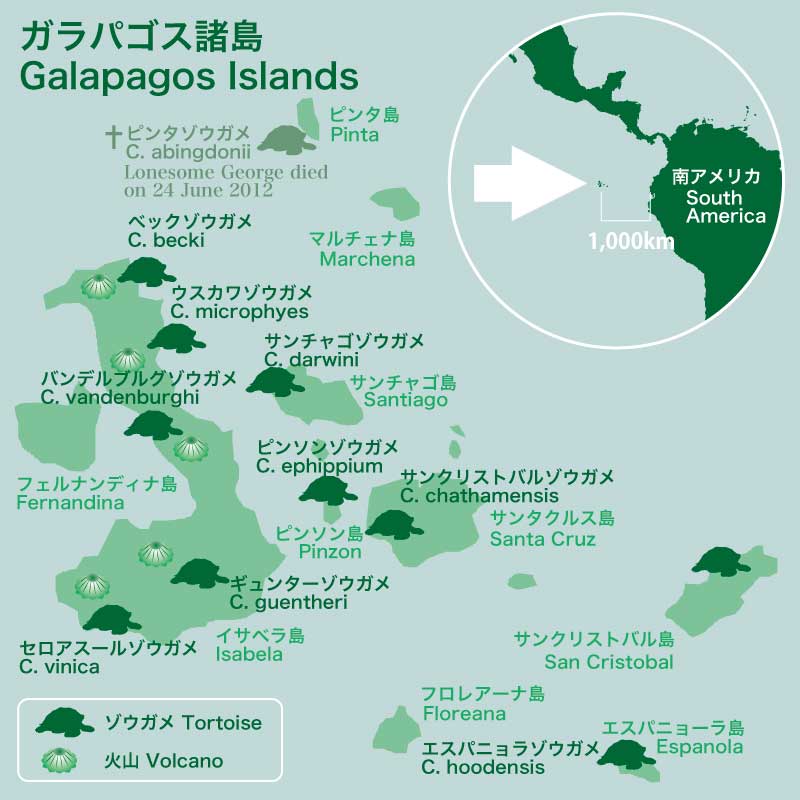
Galápagos giant tortoise species separated by volcanoes and islands.
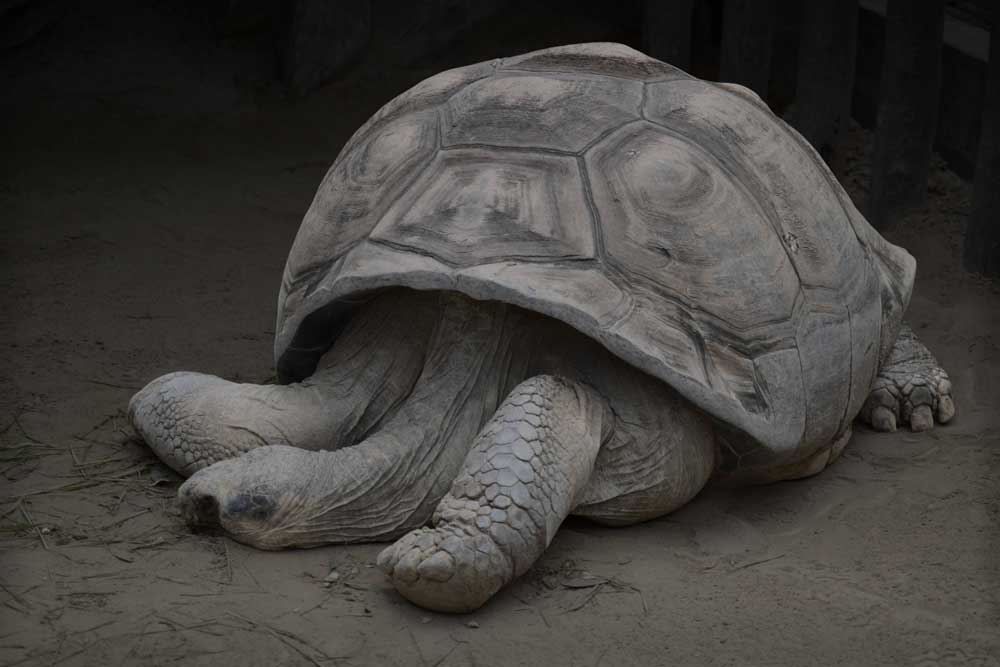
Ueno Zoo’s “Taro,” who has lived for nearly 100 years.
参考文献
Nicholls, H. The legacy of Lonesome George. Nature 487, 279–280 (2012). https://doi.org/10.1038/487279a 2024年9月14日閲覧
上野動物園 | 生き物図鑑 | ガラパゴスゾウガメ 2024年9月14日閲覧
日本ガラパゴスの会 | ガラパゴスゾウガメ 諸島の名になった代表的生物 | 奥野 玉紀 2024年9月14日閲覧
ナショナルジオグラフィック | 動物大図鑑 | ガラパゴスゾウガメ | (2014年12月1日) 2024年9月14日閲覧
“Biodiversity” Galápagos Conservancy. 2026年4月29日閲覧