
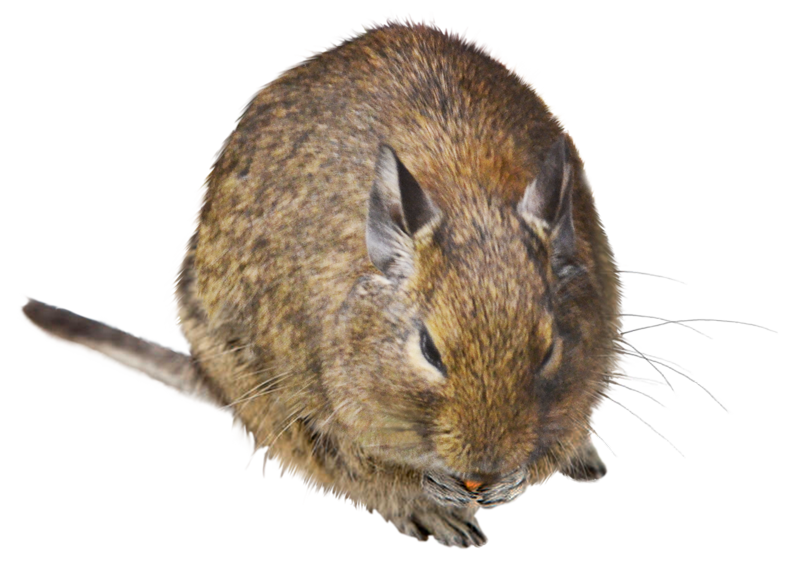
Octodon degus (Molina, 1782)
アンデスの麓で仲間と暮らす小さな知性
A Small Intelligence Living Among Companions in the Andes
チリ中部から西部の山麓や乾燥した低木地帯に生息する齧歯類です。デグー科に属し、モルモットやチンチラなどと同じく南米を起源とする齧歯類ですが、分類上は別の仲間です。野生ではアンデス山脈西側の半乾燥した低木地帯を中心に暮らしています。体長は約13~20cm、尾を含めると約33~44cm、体重は170~300gほどです。背中や頭部は黄褐色、腹面や足はクリーム色で、目の周囲には淡色の帯があります。個体によっては首にも淡い帯が見られます。尾の先には毛が集まった房があり、デグーらしい特徴のひとつです。雌雄の外見はよく似ていますが、オスのほうがメスより約10%大きい傾向があります。
デグーの大きな特徴は、非常に社会性の高い生活です。野生では複数の個体が集団で暮らし、地中に共同の巣穴を掘ります。仲間同士で毛づくろいをしたり、同じ場所で砂浴びをしたりするなど、互いの関係を保つ行動も盛んです。危険を察知すると警戒音を発するなど、鳴き声によるコミュニケーションも発達しています。鳴き声には警戒や繁殖、親子間の連絡など、さまざまな役割があります。昼行性で、朝夕を中心に活発に活動し、草や葉、種子、樹皮などを食べます。粗繊維の多い植物を消化するため、発達した盲腸で微生物による発酵を行い、さらに糞を再び食べる食糞も重要な消化行動です。
近年、デグーはペットとしても人気が高まっています。高い学習能力や認知能力を示し、飼育下では人の声や行動を覚え、簡単な行動を学習することがあります。社会性が高く、人との交流にもよく反応するため、飼い主との信頼関係を築きやすい動物です。飼育下では5~8年ほど生きるとされ、昼行性で人間の生活時間と重なりやすいことも、飼育しやすさの一因です。一方で、同種との交流を必要とする社会的な動物であることや、植物質中心の食生活など、その野生での生態を理解した飼育が大切です。
A rodent native to the foothills and dry shrublands of central and western Chile. It belongs to the family Octodontidae and, like guinea pigs and chinchillas, is a rodent of South American origin, although it belongs to a different taxonomic group. In the wild, degus mainly inhabit semi-arid shrublands on the western side of the Andes. They measure about 13–20 cm in body length, or approximately 33–44 cm including the tail, and weigh around 170–300 g. The back and head are yellowish-brown, while the underside and feet are cream-colored, with pale bands around the eyes. Some individuals also have a pale band around the neck. The tip of the tail bears a tuft of hair, one of the characteristic features of the degu. Males and females are similar in appearance, although males tend to be about 10% larger than females.
One of the degu’s most notable characteristics is its highly social lifestyle. In the wild, several individuals live together in groups and dig communal burrows underground. They frequently groom one another and bathe in sand together, behaviors that help maintain social bonds. Their vocal communication is also well developed, including alarm calls when danger is detected. Different calls serve various purposes, including warning, reproduction, and communication between parents and young. Degus are diurnal and are particularly active in the morning and evening. They feed on grasses, leaves, seeds, bark, and other plant material. To digest their fibrous diet, they ferment plant matter with microorganisms in their well-developed cecum. They also practice coprophagy, re-ingesting their feces as an important part of digestion.
In recent years, degus have become increasingly popular as pets. They show strong learning and cognitive abilities, and in captivity can learn to recognize human voices and behavior as well as perform simple learned actions. Their highly social nature also makes them responsive to interaction with people, allowing them to develop close bonds with their owners. They are generally reported to live for around five to eight years in captivity, and their diurnal activity pattern, which overlaps with human daily routines, is another factor that makes them relatively convenient to keep. At the same time, they are social animals that need interaction with other degus, and their plant-based diet requires careful management. Responsible care therefore depends on understanding and respecting their natural ecology.
参考文献
いきもののわ | 高い知能のスーパーネズミ:デグー【前編】デグーの知能とストレス | (2023年10月25日) 2024年7月28日閲覧
『ネズミの一種“デグー”を訓練して道具機能を理解させることに成功』独立行政法人 理化学研究所 (2008年3月26日) 2024年7月28日閲覧
“Octodon degus” Animal Diversity Web. 2025年5月25日閲覧