
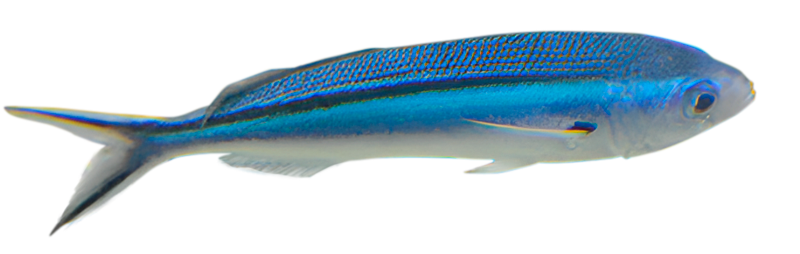
Pterocaesio tile (Cuvier, 1830)
危険を知らせる体色変化
Color Change Signaling Danger
体長は最大で約25cmに達する中型の海水魚で、インド洋から西太平洋にかけての熱帯・亜熱帯海域に広く分布しています。日本では志摩半島以南の太平洋岸、琉球列島、小笠原諸島などで見られ、主にサンゴ礁外縁や岩礁域の中層を群れで遊泳します。プランクトンを主食とし、流れに乗りながら効率よく餌を捕食する習性を持ちます。
体色は環境や状態によって大きく変化するのが特徴です。通常、水中では背側が青く腹側は白色に見え、体側には種名の由来ともなる暗色帯が確認できます。しかし釣り上げられると腹側が鮮やかな赤色へと変化し、印象が大きく異なります。この変色は色素胞(色細胞)の働きによるもので、水中でもストレスや興奮状態にある際には同様に赤みを帯びることがあります。
この赤色は水中では比較的目立ちやすく、外敵に対する警告色、あるいは群れ内で危険を知らせるシグナルとして機能している可能性が指摘されています。一方で、夜間や休息時にはさらに顕著な体色変化が見られ、腹部が赤くなるだけでなく、背部は青緑色へと変化します。その明確な理由は解明されていませんが、保護色や個体識別に関係しているとも考えられています。
このように本種は時間帯や生理状態によって大きく体色を変えるため、一見すると別種の魚のように見えることもあり、観察者に強い印象を与えます。群れで俊敏に泳ぐ姿と相まって、熱帯海域の中層を代表する存在のひとつといえるでしょう。
A medium-sized marine fish reaching up to about 25 cm in length, this species is widely distributed across tropical and subtropical waters from the Indian Ocean to the western Pacific. In Japan, it occurs along the Pacific coast south of the Shima Peninsula, as well as around the Ryukyu Islands and the Ogasawara Islands. It typically inhabits the midwater zone above coral reef slopes and rocky areas, forming schools. It feeds mainly on plankton, capturing prey efficiently while swimming in currents.
One of its most notable features is its ability to change coloration depending on conditions. Under normal circumstances underwater, the dorsal side appears bluish while the ventral side is white, with a characteristic dark band along the body that gives the species its common name. However, when caught, the belly turns a vivid red, dramatically altering its appearance. This color change is caused by chromatophores (pigment cells), and similar reddening can occur underwater when the fish is stressed or excited.
This red coloration is relatively conspicuous in water and may function as a warning signal to predators or as a means of alerting other members of the school to danger. Additionally, during nighttime or periods of rest, the fish exhibits even more striking changes: the belly becomes red while the dorsal area shifts to a bluish-green hue. Although the exact reason for this transformation remains unclear, it may be related to camouflage or intraspecific signaling.
Due to these dynamic color changes associated with time of day and physiological state, the species can appear almost like a completely different fish, leaving a strong impression on observers. Combined with its agile, schooling behavior, it is a characteristic presence in the midwater ecosystems of tropical seas.
参考文献
中日新聞 | <すいスイっと> (25)@名港水族館 クマザサハナムロ 体の色に感情出ます | (2021年9月6日) 2025年2月1日閲覧
構造色事始 | クマザサハナムロ(魚)の色変化 | (2013年3月24日) 2025年2月1日閲覧
鴨川シーワールド | Vol.282~体色が変わるクマザサハナムロ~ | (2021年8月17日) 2025年2月1日閲覧
“Pterocaesio tile (Cuvier, 1830) Dark-banded fusilier” FishBase. 2025年2月1日閲覧