
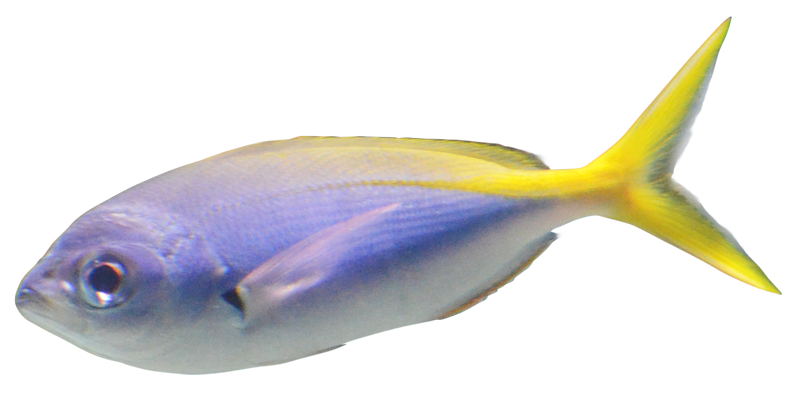
Caesio teres (Seale, 1906)
地方名で見分けるウメイロに似た魚たち
Identifying Umeiro-Like Fishes Through Local Names
体長は最大で約40cm。インド洋から西太平洋にかけての熱帯域に広く分布し、日本では主に南西諸島周辺で見られます。沿岸の岩礁域やサンゴ礁周辺に生息し、日中は中層を活発に遊泳しながら大規模な群れを形成します。動物プランクトンを主に捕食する、遊泳性の強い魚です。
フエダイ科のウメイロに体色が似ることからこの名がありますが、本種はタカサゴ科に属し、分類上は別のグループです。ウメイロに比べて黄色い帯が控えめで、背側の青色がより鮮やかな点が特徴です。学名 Caesio は青みがかった体色に由来するとされます。また、夜間や釣り上げられた際には体色が変化し、赤みを帯びた濃い紫色へと変わることが知られています。同じタカサゴ科のユメウメイロともよく似ていますが、ユメウメイロは体高が高く、やや丸みのある体形をしているため区別が可能です。
沖縄では「アカジューグルクン」と呼ばれ、食用魚として広く利用されています。「グルクン」はタカサゴ科魚類の総称で、「アカジュー」の語源には体色に由来するなど諸説があります。一方、ユメウメイロは「シチューグルクン」と呼ばれることがあり、「シチュー」はメジナ類を指す方言とされ、体形の類似に由来するとも考えられています。和名では混同されやすい両種ですが、体形や体色、地域名の違いに注目することで見分けることができます。
The yellow and blueback fusilier reaches a maximum length of about 40 cm. It is widely distributed throughout the tropical Indo-Pacific, from the Indian Ocean to the western Pacific, and in Japan it is mainly found around the Nansei Islands. This species inhabits coastal rocky areas and coral reefs, where it forms large schools actively swimming in the midwater during the daytime. It is a highly mobile fish that primarily feeds on zooplankton.
Its Japanese name derives from its resemblance in coloration to the snapper Lutjanus kasmira (commonly known as “umeiro”), although this species belongs to the family Caesionidae and is not closely related. Compared to the umeiro, it has less prominent yellow striping and a more vivid blue coloration along the back. The genus name Caesio is thought to refer to its bluish body coloration. It is also known to undergo a color change at night or when caught, turning a reddish to deep purplish hue. It closely resembles the related species Caesio teres, but that species has a deeper, more rounded body, allowing the two to be distinguished.
In Okinawa, this fish is commonly known as “Akajii-gurukun” and is widely used as a food fish. “Gurukun” is a general term for fishes of the family Caesionidae, while the origin of “Akajii” is uncertain, with several theories suggesting a connection to body coloration. Meanwhile, Caesio teres is sometimes called “Shichii-gurukun.” The term “Shichii” is said to refer to rudderfish or sea chub (genus Kyphosus), and may derive from a perceived similarity in body shape, although its exact origin remains unclear. Although the two are often confused under similar Japanese names, they can be reliably distinguished by differences in body shape, coloration, and regional naming traditions.
参考文献
東京ズーネット | どうぶつ図鑑 | ウメイロモドキ 2025年1月19日閲覧
南国 Diving World | ウメイロモドキ 2025年1月19日閲覧
“Caesio teres Seale, 1906 Yellow and blueback fusilier” FishBase 2025年1月19日閲覧
美ら海水族館 | 美ら海だより | 【黒潮水槽マスターになりたいな!第二弾】 | (2022年3月23日) 2025年1月19日閲覧
ぼうずコンニャクの市場魚貝類図鑑 | ウメイロモドキ 2025年1月19日閲覧