
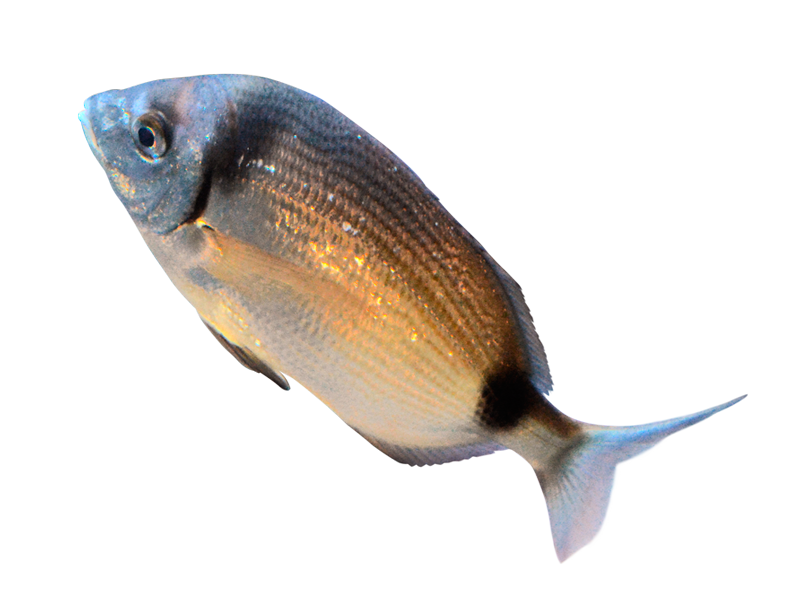
Diplodus vulgaris (E. Geoffroy, 1817)
地中海の重要な海洋資源となる魚
An Important Fish Supporting Mediterranean Seas
コモンツーバンデッドシーブリーム(Diplodus vulgaris)はタイ科に属する海水魚で、最大で全長45cmに達します。黒海、地中海、東部大西洋に広く分布し、ポルトガル沿岸から北アフリカ、カナリア諸島周辺まで見られます。日本では「アフリカチヌ」と呼ばれることがありますが、流通や飼育展示では英名の「コモンツーバンデッドシーブリーム」がそのまま用いられる場合もあります。体色は銀白色で、頭部後方と尾柄部にある2本の黒い帯模様が大きな特徴です。背側には金色を帯びた細い縦線が入り、光の加減によって鈍く輝いて見えます。
沿岸の岩礁域や砂地に生息し、若魚は浅場や海草藻場に群れを作ることがあります。幼魚の頃は動物プランクトンを中心に捕食しますが、成長すると甲殻類、軟体動物、多毛類、ウニなどの底生無脊椎動物を食べるようになります。奥歯状に発達した歯を持ち、硬い殻を砕いて食べられるのも特徴です。
本種は地中海沿岸諸国における重要な水産資源であり、ポルトガル南部などでは小規模沿岸漁業、いわゆる artisanal fishery(伝統的沿岸漁業)によって盛んに漁獲されています。また、成長が比較的早く環境適応力も高いため、養殖対象種としても注目されています。一方で、資源管理のため各地で最小漁獲サイズが定められており、ポルトガルでは15cm未満の個体の水揚げが禁じられています。研究者たちは幼魚に標識を付けて放流し、生態や回遊を調査していますが、標識付きの成魚が再捕獲される例は少なく、多くの個体が成熟前に漁獲されている可能性が指摘されています。
The Common two-banded seabream (Diplodus vulgaris) is a marine fish belonging to the seabream family and can reach up to 45 cm in length. It is widely distributed in the Black Sea, the Mediterranean Sea, and the eastern Atlantic Ocean, occurring from the coasts of Portugal to North Africa and around the Canary Islands. In Japan it is sometimes called “Africa-chinu,” though the English name is also commonly used in aquariums and the fish trade. Its body is silvery white with two distinctive black bands: one behind the head and another near the base of the tail. Faint golden vertical lines can also be seen along the back, shimmering subtly in sunlight.
This species inhabits coastal rocky reefs and sandy bottoms, while juveniles often form schools in shallow waters and seagrass beds. Young fish mainly feed on zooplankton, but adults prey on benthic invertebrates such as crustaceans, mollusks, polychaete worms, and sea urchins. Its molar-like teeth are adapted for crushing hard shells.
The species is an important fishery resource in Mediterranean countries. In southern Portugal, for example, it is commonly caught by small-scale traditional coastal fisheries known as artisanal fisheries. Because of its relatively fast growth and adaptability, it is also farmed commercially. To protect fish stocks, many regions regulate the minimum catch size, and in Portugal it is illegal to land individuals smaller than 15 cm. Researchers have conducted tagging studies in which local fishers capture, tag, and release juveniles to study their movements and ecology. However, reports of tagged adults being recaptured are rare, suggesting that many individuals are harvested before reaching maturity.
参考文献
“Diplodus vulgaris” Animalia 2025年2月2日閲覧
“Common two-banded seabream” Fishpedia 2025年2月2日閲覧
WEB魚図鑑 | アフリカチヌ 2025年2月2日
David Abecasis, Luís Bentes, Karim Erzini, “Home range, residency and movements of Diplodus sargus and Diplodus vulgaris in a coastal lagoon: Connectivity between nursery and adult habitats”, Estuarine, Coastal and Shelf Science, Volume 85, Issue 4, 2009, Pages 525-529. 2025年2月2日閲覧