
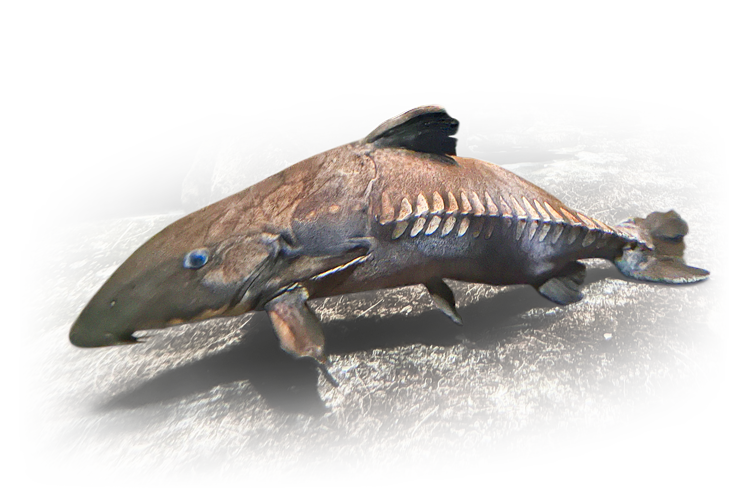
Oxydoras niger (Valenciennes, 1821)
棘で音を奏でるナマズ
A Catfish That Makes Music with Its Spines
南アメリカのアマゾン川、サン・フランシスコ川、エセキボ川などの水系に分布する大型のナマズです。全長1mほどに達することがあり、河川や湖などの泥底で暮らします。体は暗褐色から黒色で、幅広い頭部と口元に伸びるひげをもち、底生の小動物や有機物などを食べます。
体を覆うのは普通の鱗ではなく、硬い骨質板です。これらは頭部から尾に向かって列をつくり、その縁には鋭い突起が並んでいます。さらに背鰭と胸鰭の前方には硬い棘があり、いずれの棘にも鋸歯状の突起があります。こうした構造は捕食者から身を守るための防御に役立ちますが、胸鰭の棘は音を出すためにも使われます。
ドラス科のナマズには、胸鰭の棘と浮袋という二つの発音機構があります。ひとつは「ストライデュレーション」と呼ばれる発音で、胸鰭を動かすと、鋸歯状の胸鰭棘が肩帯の構造と擦れ合い、摩擦音を生じます。もうひとつは「ドラム音」で、発音筋が素早く収縮すると、弾性ばねを介して浮袋を振動させ、低い音を発します。オキシドラスではこの二つの音が確認されており、捕まえて持ち上げるなどの刺激を受けた際に発音することが知られています。外敵などに襲われた際の救難音としての役割が考えられていますが、自然な状況での詳しい機能はまだ十分に解明されていません。
棘のある身体的特徴は、名前の由来にもなっています。「オキシドラス」は特定の1種だけを指す名前ではなく、Oxydoras属に含まれるナマズの総称です。本種の学名はOxydoras nigerで、属名はギリシャ語のoxys(鋭い)とdoras(皮膚)に由来し、種小名nigerはラテン語で「黒」を意味します。英名「Ripsaw Catfish」のripsawは鋸の一種を意味し、体側に並ぶ鋭い骨質板が鋸の刃を思わせることから名付けられています。一方、こうした鋭い姿とは対照的に性質は穏やかで、観賞魚としても流通しています。ただし、成長すると非常に大型になるため、大型水槽での飼育が必要です。
The Ripsaw Catfish is a large catfish found in the river systems of South America, including the Amazon, São Francisco, and Essequibo. It can grow to around 1 meter in length and inhabits muddy bottoms in rivers and lakes. Its body is dark brown to black, with a broad head and barbels around the mouth. It feeds on small bottom-dwelling animals and organic matter.
Instead of ordinary scales, its body is covered with hard bony plates. These form rows running from the head toward the tail, with sharp projections along their edges. The leading rays of the dorsal and pectoral fins are also hard spines, and both have serrated projections. These structures help protect the fish from predators, but the pectoral spines are also used to produce sounds.
Thorny catfishes have two distinct sound-producing mechanisms involving the pectoral spines and swim bladder. One is called stridulation. When the pectoral fins are moved, the serrated pectoral spines rub against structures of the pectoral girdle, producing a friction sound. The other is a “drumming” sound. Rapid contractions of specialized drumming muscles cause the swim bladder to vibrate through an elastic spring, producing a low-frequency sound. Both types of sound have been recorded in the Ripsaw Catfish, which is known to vocalize when disturbed, such as when it is caught and lifted out of the water. These sounds are thought to function as distress signals when the fish is attacked by a predator, although their precise role under natural conditions remains unclear.
The spiny features of its body are also reflected in its name. “Oxydoras” is not the name of a single species but the common name for catfishes in the genus Oxydoras. The scientific name of this species is Oxydoras niger. The genus name comes from the Greek words oxys, meaning “sharp,” and doras, meaning “skin,” while the species name niger is Latin for “black.” Its English name, “Ripsaw Catfish,” refers to a type of saw called a ripsaw, reflecting the sharp, saw-like bony plates along its body. Despite its formidable appearance, it is generally peaceful and is also kept as an ornamental fish. However, it grows very large and therefore requires a large aquarium.
参考文献
FishBase — Oxydoras niger (Valenciennes, 1821), Ripsaw catfish 2026年9月27日閲覧