
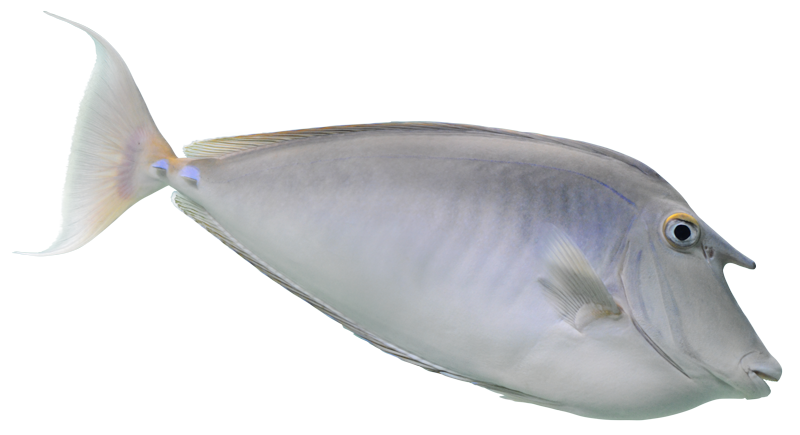
Naso unicornis (Forsskål, 1775)
ツノは何のためにあるのか?
What Is the Horn For?
体長50cm。インド太平洋の熱帯域に広く分布し、サンゴ礁や岩礁域に生息します。日本では黒潮に乗って北上し、本州中部以南の太平洋岸や琉球列島などで見ることができます。頭頂部から前方へ突き出した角のような突起が最大の特徴で、和名や英名(Unicorn Tang)の由来にもなっています。体色は灰色を基調とし、目の周囲は鮮やかな黄色、尾ビレの付け根には水色に縁取られた鋭い2本の棘があり、落ち着いた体色の中で印象的なアクセントとなっています。
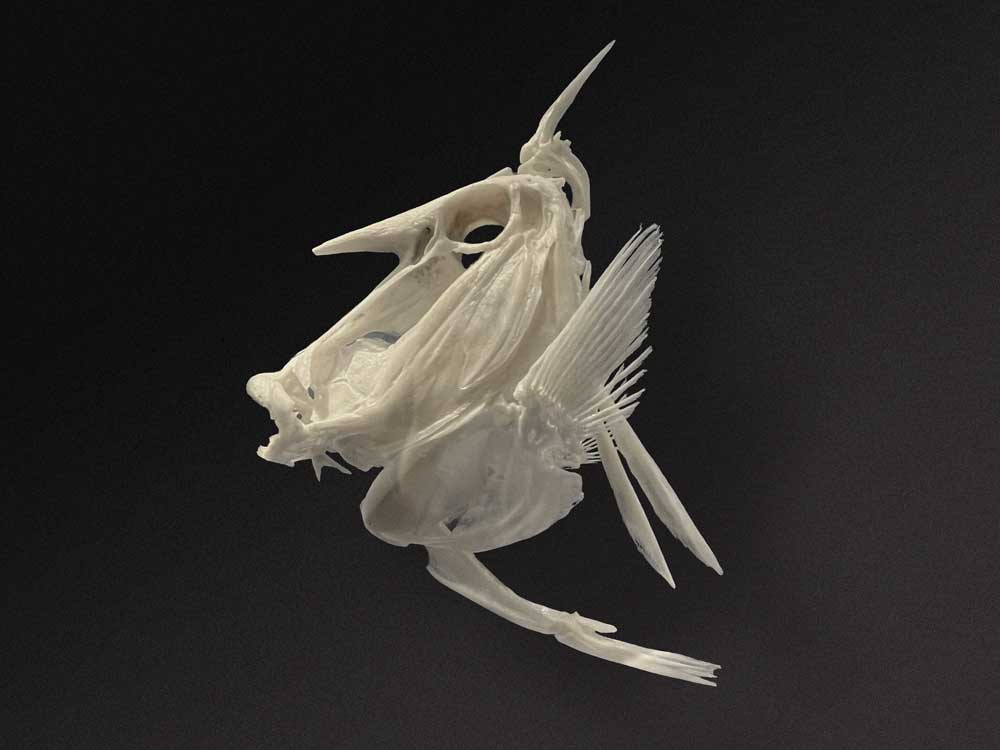
この特徴的なツノは幼魚には見られず、成長とともに徐々に伸びてきます。しかし、その役割は現在でも明確には解明されていません。有力な説の一つは繁殖期のディスプレイです。オスはメスに求愛する際、ツノを際立たせるように体色を急激に変化させます。この行動は主に夜間に観察されますが、昼間にも見られることがあります。ツノを誇示するような鮮やかな体色の変化は、仲間同士のコミュニケーションに重要な役割を果たしているのかもしれません。
一方で、ツノを攻撃や防御に利用する行動は現在のところ確認されていません。本種の武器となるのは、尾ビレの付け根にある鋭い2本の棘です。この棘は捕食者から身を守るだけでなく、餌場をめぐる争いで相手を威嚇する際にも用いられます。これはニザダイ科の魚に共通する特徴です。
ハワイではテングハギ属の魚を「カラ(kala)」と呼び、その語源は「ざらざらした皮膚」を意味すると考えられています。古くから重要な食用魚として親しまれる一方、丈夫な皮は伝統的な楽器のドラムヘッドにも利用されてきました。用途が解明されていないツノと、実用的な武器である尾の棘という対照的な特徴は、本種の進化の不思議さを象徴しています。
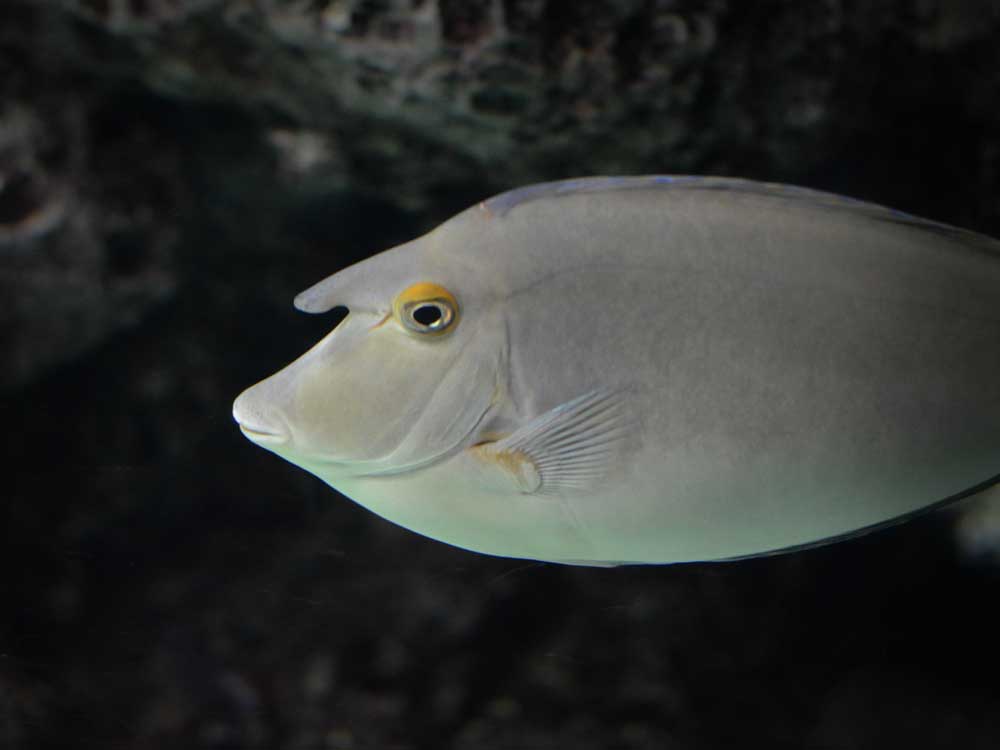
Reaching up to 50 cm in length, the Unicorn Tang is widely distributed throughout the tropical Indo-Pacific, where it inhabits coral reefs and rocky reefs. In Japan, it is carried northward by the Kuroshio Current and can be found along the Pacific coast of central and southern Honshu as well as throughout the Ryukyu Islands. Its most distinctive feature is the horn-like projection extending from the forehead, which inspired both its Japanese and English names. The body is generally gray, with bright yellow rings around the eyes, while the base of the tail bears two sharp, light blue-edged spines that stand out against its otherwise subdued coloration.
The characteristic horn is absent in juveniles and gradually develops as the fish matures. Despite its striking appearance, however, its exact function remains unknown. One leading hypothesis is that it plays a role in courtship displays. During the breeding season, males rapidly change their body coloration to emphasize the horn when displaying to females. This behavior is observed mainly at night, although it can occasionally be seen during the day as well. These dramatic color changes, together with the prominent horn, are thought to serve as an important means of communication between individuals.
Interestingly, the horn does not appear to be used for either attack or defense. Instead, the fish relies on the pair of sharp spines at the base of its tail as its primary weapon. These spines are used not only to deter predators but also to drive away rivals competing for food, a characteristic shared by many members of the surgeonfish family.
In Hawaii, species of the genus Naso are collectively known as kala, a name believed to refer to their rough skin. They have long been valued as food fish, and their tough skin was traditionally used as drumheads for Hawaiian musical instruments. The contrast between a mysterious horn of unknown purpose and the practical tail spines used for defense symbolizes the remarkable evolutionary history of this species.
参考文献
Spencer, Erin (2023, June 27) “The Unique Unicornfish” Ocean Conservancy. 2025年2月16日閲覧
“Unicorn Tang” Waikiki Aquarium. 2025年2月16日閲覧
荒井 寛, 佐藤 哲 (2008)「特異な突起と急激な色彩変化:テングハギ類は角を信号として使う」Ichthyological Research 54 巻 1 号, pp49 – 54. 2025年2月16日閲覧
“Whitemargin Unicornfish: The Fish With a Horn” Articles & Guides, Scuba. (2024, January 25) 2025年2月16日閲覧