
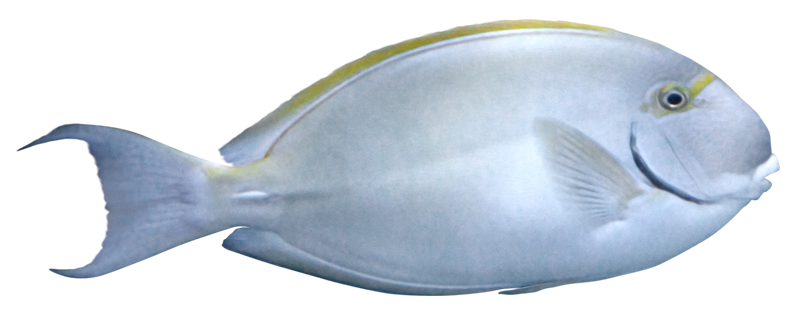
Acanthurus xanthopterus (Valenciennes, 1835)
水揚げ後に分かる名前の由来
The Name Explained After Landing
体長は最大で約35cmに達します。ニザダイ科に属する海水魚で、東アフリカやマダガスカルから太平洋を横断し、アメリカ西海岸からペルー北部に至るまで、インド太平洋の熱帯・亜熱帯域に広く分布しています。日本では本州中部以南の太平洋沿岸をはじめ、伊豆諸島、琉球列島、小笠原諸島などで見られ、沿岸の岩礁域やサンゴ礁周辺に生息します。藻類を主に食べる植食性の魚で、岩の表面に生えた付着藻類を歯で削り取るようにして摂餌し、サンゴ礁生態系のバランス維持にも一定の役割を果たしています。
体色は全体に灰色がかった青みのある色調で、体後半部から尾鰭にかけてはやや暗色を帯びます。また、胸鰭や眼を通る帯状の部分が黄色くなる点が大きな特徴で、同所的に見られる他種との識別に役立ちます。体は側扁しており、尾柄部にはニザダイ科特有の鋭い棘(いわゆる“メス状突起”)を備えており、外敵に対する防御や個体間の争いに用いられます。
本種の和名「クロハギ」は一見すると外見と一致しないように思われますが、その由来は水揚げ後の変化にあります。生時は明るい灰青色を呈する体色も、死亡後には急速に黒ずんでいき、全体が黒色に近い外観へと変化します。さらに皮膚は厚く丈夫で、カワハギ類のように比較的容易に剥ぐことができるため、「黒くなるハギ様の魚」という特徴からこの名が付けられたと考えられています。
食用魚としても知られ、特に南西諸島では一般的に流通しています。沖縄では近縁種とともに「トカジャー」と総称され、煮付けなどの家庭料理で親しまれています。身は白身で加熱すると適度に締まり、旨味が引き出されるとされます。一方で、内臓に独特の臭みを持つ個体もあるため、調理の際には下処理が重要とされています。
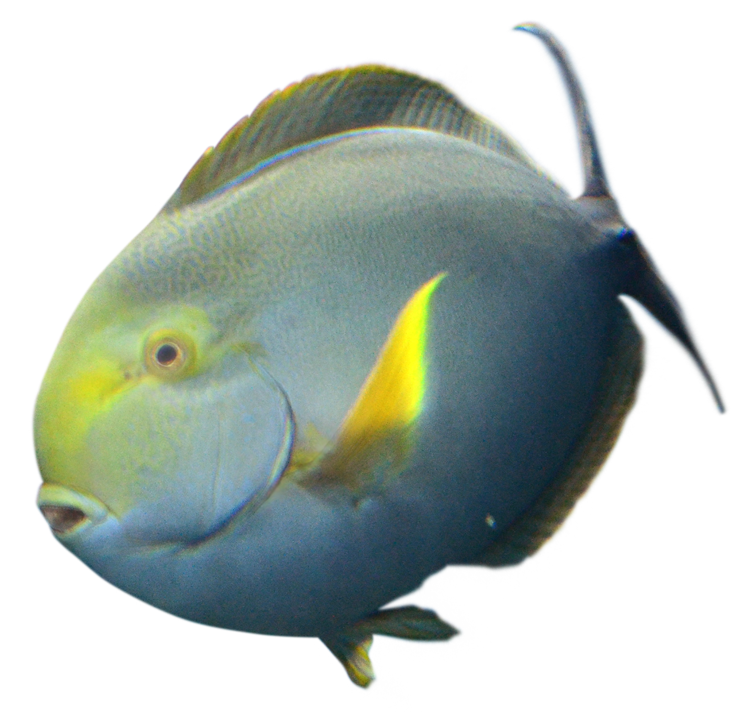
This species reaches a maximum length of about 35 cm. It is a marine fish belonging to the surgeonfish family (Acanthuridae), widely distributed across tropical and subtropical regions of the Indo-Pacific, ranging from East Africa and Madagascar across the Pacific to the west coast of the Americas and northern Peru. In Japan, it occurs along the Pacific coast south of central Honshu, including the Izu Islands, the Ryukyu Islands, and the Ogasawara Islands. It inhabits coastal rocky reefs and coral reef environments. Primarily herbivorous, it feeds by scraping attached algae from rock surfaces with its teeth, contributing to the maintenance of coral reef ecosystems.
The body is generally gray with a bluish tinge, becoming darker toward the posterior and caudal fin. A distinctive feature is the yellow coloration of the pectoral fin and the band running across the eye, which helps distinguish it from similar species occurring in the same habitats. The body is laterally compressed, and like other surgeonfishes, it possesses a sharp, scalpel-like spine on the caudal peduncle, used for defense against predators and in intraspecific interactions.
The Japanese name “Kurohagi” (literally “black filefish”) may seem inconsistent with its appearance, but its origin lies in postmortem changes. While alive, the fish exhibits a bright grayish-blue coloration; however, after death, the body rapidly darkens, eventually turning almost black. In addition, the skin is thick and tough and can be peeled relatively easily, reminiscent of filefishes. These characteristics are thought to have inspired its name.
This species is also used as food, particularly in the southwestern islands of Japan, where it is commonly distributed in local markets. In Okinawa, it is collectively known as “Tokajaa” along with related species and is often prepared in simmered dishes. The flesh is white and firms up when cooked, developing a rich flavor, although proper cleaning is important as some individuals may have a distinctive odor in the viscera.
参考文献
“Acanthurus xanthopterus Valenciennes, 1835 Yellowfin surgeonfish” FishBase. 2025年4月26日閲覧
“Acanthurus xanthopterus Valenciennes, 1835″ Marine Biodiversity Portal
of Bangladesh. 2025年4月26日閲覧
ぼうずコンニャクの市場魚貝類図鑑 | クロハギ 2026年4月29日閲覧