
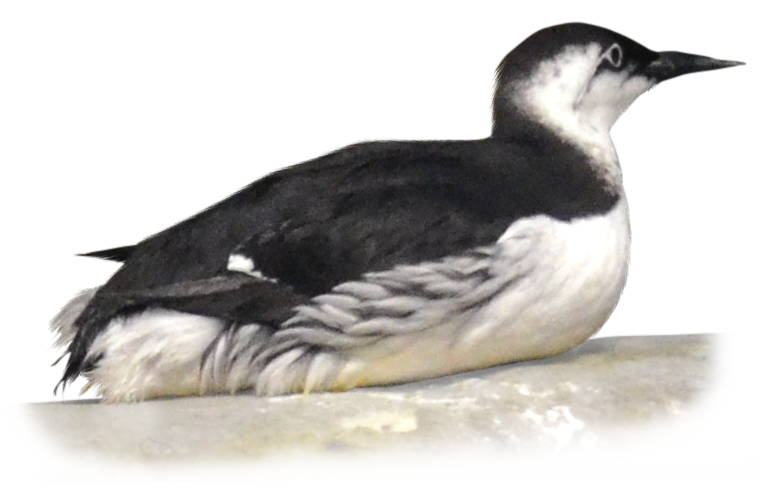
Uria aalge (Pontoppidan, 1763)
消えた「ペンギン」とその仲間
The Vanished “Penguin” and Its Relatives
体長40cm。カナダ西岸から日本沿岸にかけて分布します。黒く長いクチバシを持ち、頭部から背中にかけて黒く、腹部は白です。冬季には衣替えをして頬の部分まで白くなります。
陸上で歩く姿はペンギンに似ていますが、ペンギンに比べ前傾姿勢で歩きは得意ではありません。泳ぐのはペンギン同様に得意で、ウミガラスは羽をはばたかせるように泳ぐのが特徴です。そして、ペンギンとの大きな違いは飛ぶことです。飛翔するには助走が必要ですが、10 – 100kmの距離を移動することができ、最高時速80kmもの速さで飛ぶことができます。水陸空に適応する進化をしたウミガラスですが、かつては同じウミスズメ科の仲間で飛べないウミガラスもいました。それは体長80cmにもなるオオウミガラスで、実は元々ペンギンの名はこの種につけられていた名前です。ちなみに、Pinguinusとは、ラテン語で「脂肪が多い」という意味で、寒く厳しい環境の中で生き抜くために脂肪を蓄えた姿から名付けられたようです。脂があることで狩猟の対象となり、19世紀半ばに乱獲によって絶滅してしまいました。
ところでウミガラスにも個体数を大幅に減らす深刻な出来事がありました。2014年から2年ほど海面水温が平年を極端に上回った「海洋熱波」により、エサが減少しアラスカのウミガラス400万羽が大量死したことが判明しています。その数は全世界にいるウミガラスの12.5%にあたります。
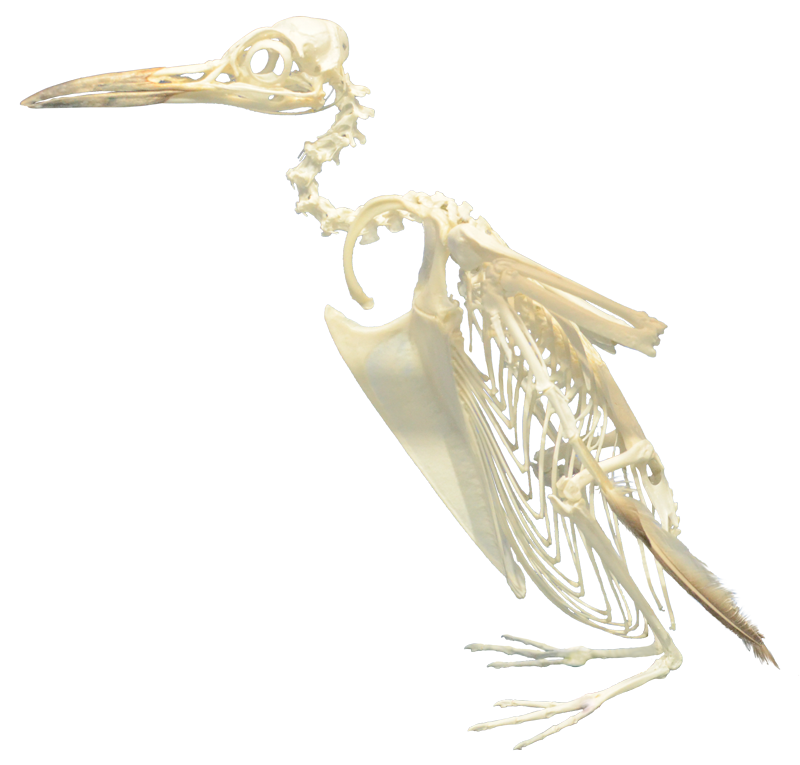
The common murre (Uria aalge) is a seabird measuring about 40 cm in length. It is widely distributed across the North Pacific, occurring from the west coast of Canada to the coasts of Japan. It has a slender black bill, with black plumage on the head and back and white underparts. In winter, its plumage changes, and the cheeks become white.
On land, it resembles a penguin in appearance, but it adopts a more forward-leaning posture and is not well adapted for walking. In contrast, it is an excellent swimmer, propelling itself underwater by flapping its wings. A key difference from penguins is its ability to fly. Although it requires a running start to take off, it can travel distances of tens of kilometers and reach speeds of up to 80 km/h.
While the common murre is well adapted to life in water, on land, and in the air, there were once flightless relatives within the same family. One such species was the great auk (Pinguinus impennis), which reached about 80 cm in length. In fact, the name “penguin” was originally applied to this species. The genus name Pinguinus derives from Latin meaning “fat,” referring to its well-insulated body adapted to cold environments. However, it was hunted extensively for its fat and became extinct in the mid-19th century.
In recent years, the common murre has also experienced severe population declines. A marine heatwave that persisted for about two years from 2014 led to a reduction in food availability, resulting in the deaths of approximately four million birds in Alaska. This figure represents about 12.5% of the global population.
参考文献
エコチル | 【新潟市水族館マリンピア日本海だより】飛べるペンギン?「ウミガラス」 | (2022年2月14日) 2025年1月19日閲覧
綿貫 豊 「北海道のウミガラス~生態と歴史~」開発こうほう (2025年1月号), 北海道開発協会 2025年1月19日閲覧
日本経済新聞 | 「海の温暖化」でウミガラス400万羽死ぬ アラスカ | (2025年1月13日) 2025年1月19日閲覧
WWFジャパン | スタッフブログ | 姿を消した「元祖」ペンギン | (2014年4月25日) 2025年1月19日閲覧