
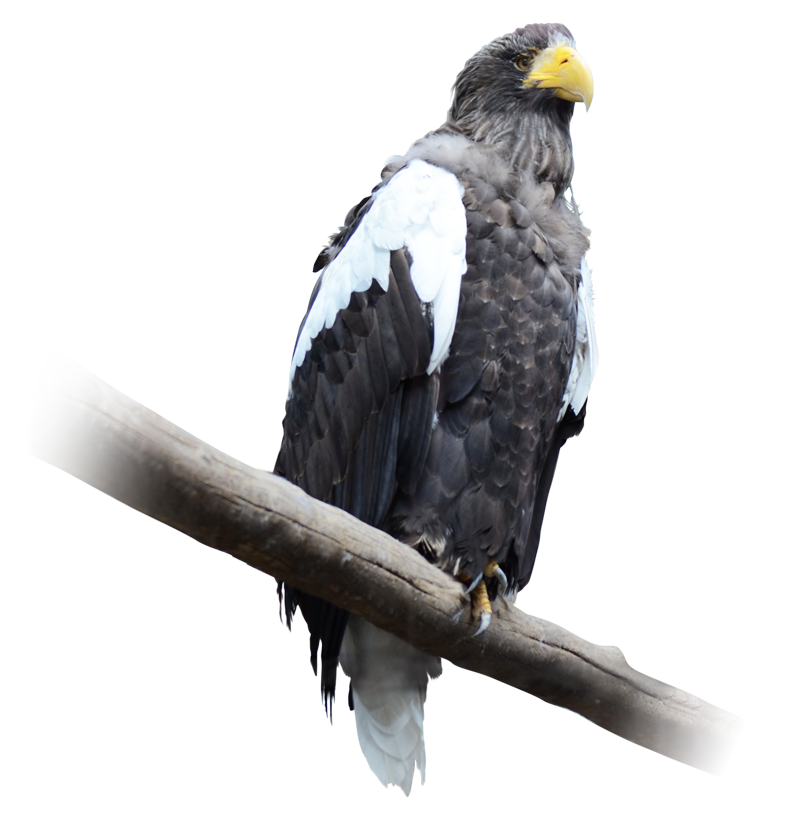
Haliaeetus pelagicus (Pallas, 1811)
北の地に君臨する猛禽類
A Dominant Raptor of the Northern Wilderness
全長約85~94cm、翼開長220~250cmに達する大型のワシ類で、重厚な体格と力強い飛翔が特徴です。全身は黒褐色を基調とし、翼の前縁や尾羽、脚の羽毛が白く際立ちます。特に太く大きな嘴と脚は鮮やかな橙黄色を呈し、遠目にもよく目立ちます。分布域はロシア極東からオホーツク海沿岸にかけてで、冬季には越冬のため北海道へ渡来し、まれに本州北部でも観察されます。主にサケやマスなどの魚類を捕食し、遡上期には河川や海岸で活発に採食します。時には漁業の残滓や死魚も利用し、このほか小型哺乳類や海鳥を捕えることもあります。
英名「Steller’s sea eagle」はドイツの博物学者ゲオルク・ヴィルヘルム・ステラーに由来します。同様に彼の名を冠した動物としては、北アメリカに分布するステラーカケスや、北太平洋に生息する大型のアシカであるトド(ステラーアシカ)などが知られています。また、発見後わずか27年で絶滅したことで有名なステラーカイギュウにもその名が残されています。本種もまた個体数は約4000羽前後とされ、近年は減少傾向にあり、IUCNでは危急種(Vulnerable)に分類されるなど、その存続が懸念されています。
近縁種であるオジロワシとは分布域が一部重なり、冬季の北海道では流氷域や河川周辺で並んで観察されることもありますが、本種は一回り大きく、特に嘴の鮮やかな黄色と太さが際立ちます。また翼の白斑や尾の白さも識別の手がかりとなります。両種はいずれも魚類を主な餌とする大型猛禽類であり、河川や沿岸の自然環境と深く関わっています。日本ではともに天然記念物に指定されており、北方の厳しい自然環境の頂点に立つ、北の地に君臨する猛禽類といえます。
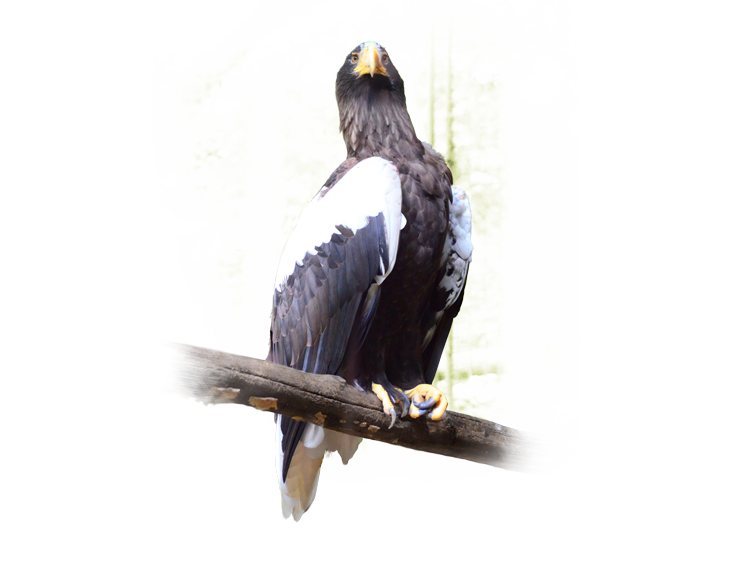
The Steller’s sea eagle is a large eagle, measuring about 85–94 cm in body length with a wingspan of 220–250 cm. It is characterized by its powerful build and strong flight. The body is predominantly dark brown, contrasted by striking white patches on the leading edge of the wings, tail, and legs. Its large, robust bill and legs are a vivid orange-yellow, making the bird highly conspicuous even at a distance. Its range extends across the Russian Far East and the coasts of the Sea of Okhotsk. In winter, it migrates south to Hokkaido, and is occasionally observed in northern Honshu. It feeds mainly on fish such as salmon and trout, actively foraging along rivers and coastal areas during spawning runs. It also takes advantage of fish remains from fisheries and carrion, and may prey on small mammals and seabirds.
The English name “Steller’s sea eagle” honors the German naturalist Georg Wilhelm Steller. Other animals bearing his name include the Steller’s jay of North America and the Steller sea lion, a large pinniped inhabiting the North Pacific. The extinct Steller’s sea cow, famously driven to extinction within just 27 years of its discovery, also carries his name. This species, too, is of conservation concern: its population is estimated at around 4,000 individuals and is believed to be declining, and it is currently classified as Vulnerable by the IUCN.
It overlaps in range with the closely related white-tailed eagle and may be seen perched alongside it in wintering areas of Hokkaido, particularly near drift ice and rivers. However, the Steller’s sea eagle is larger overall, with a thicker and more vividly colored bill. The white patches on the wings and tail also aid in identification. Both species are large raptors that primarily feed on fish and are closely tied to riverine and coastal ecosystems. In Japan, both are designated as Natural Monuments, and the Steller’s sea eagle stands as a dominant raptor of the northern wilderness, occupying the top tier of these harsh environments.
参考文献
サントリーの愛鳥活動 | 日本の鳥百科 | オオワシ 2024年10月8日閲覧
環境省 | 自然環境・生物多様性 | オオワシ 2024年10月8日閲覧
西遊旅行 | ワイルドライフ | 流氷の上のオオワシ Steller’s Sea Eagle (羅臼、知床半島) | (2018年3月14日) 2024年10月8日閲覧
“Steller’s Sea-Eagle” oiseaux-birds.com 2024年10月8日閲覧
美しき日本 全国観光資源台帳 | 知床のオジロワシ・オオワシ 2024年10月8日閲覧