
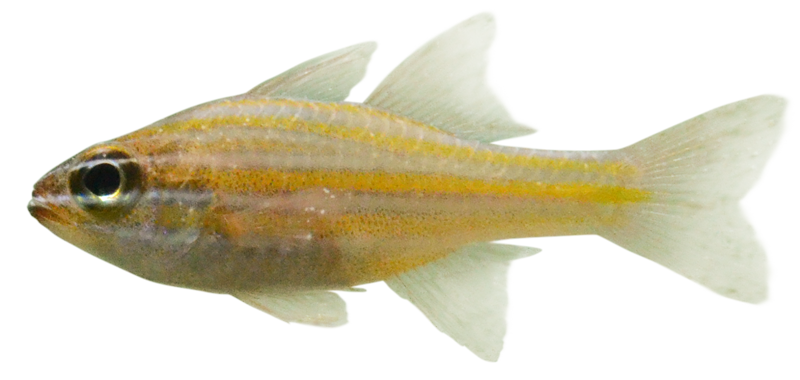
Ostorhinchus properuptus (Whitley, 1964)
耳石を見ればわかること
What Otoliths Can Reveal
体長約6cmほどの小型のテンジクダイの仲間で、細身でやや側扁した体形をしています。体色は黄橙色を基調とし、体側には白銀色の細い縦帯が5本前後走るのが特徴で、暗がりでも目立つ美しい外見を持ちます。分布域は紅海からインド洋、西太平洋にかけて広く、日本では千葉県以南の暖かい海域で見られます。主にサンゴ礁の外縁や岩礁域に生息し、日中は岩陰やサンゴの隙間に身を潜め、夜間に活動する傾向があります。小型甲殻類や動物プランクトンなどを捕食します。
和名の「金線石持」は、体側の金色の線模様と、「石持」と呼ばれる仲間に共通する特徴に由来します。「石持」とは頭部に大きな耳石を持つことにちなむ名称で、耳石は内耳に存在し、音や振動、体の傾きを感知する平衡・聴覚器官として機能します。主成分は炭酸カルシウムで、種ごとに形状や大きさが異なるため、耳石の形態は種の同定にも利用されます。さらに耳石は成長とともに層状に形成され、年輪のような輪紋が刻まれることから、個体の年齢推定にも用いられます。
エイ類やサメ類、マンボウの仲間を除く多くの硬骨魚類に耳石は見られますが、本種を含むテンジクダイ類は比較的大きな耳石を持つことで知られています。これにより水中のわずかな振動や音を敏感に捉え、外敵の接近を察知したり、餌の存在を把握したりするのに役立っていると考えられます。小型ながらも環境への適応が巧みな、サンゴ礁生態系を支える一種です。
A small cardinalfish reaching about 6 cm in length, this species has a slender, laterally compressed body. Its base coloration is yellow-orange, marked by around five narrow silvery vertical stripes along the sides, giving it a striking appearance even in dim environments. It is widely distributed from the Red Sea through the Indian Ocean to the western Pacific. In Japan, it occurs south of Chiba Prefecture in warm waters. It inhabits outer reef slopes and rocky areas of coral reefs, typically hiding in crevices or among corals during the day and becoming active at night. It feeds mainly on small crustaceans and zooplankton.
The Japanese name “Kin-sen Ishimochi” (金線石持) derives from its golden stripes and its classification among “Ishimochi,” a group known for having relatively large otoliths. Otoliths are structures in the inner ear that function in hearing and balance, detecting sound vibrations and body orientation. Composed primarily of calcium carbonate, their size and shape vary among species, making them useful for species identification. As fish grow, otoliths form layered ზრდ patterns similar to tree rings, allowing researchers to estimate age.
Most bony fishes possess otoliths, except for groups such as rays, sharks, and ocean sunfish. Cardinalfishes, including this species, are known for having relatively large otoliths, which likely enhance their sensitivity to subtle underwater vibrations. This adaptation may help them detect predators and locate prey efficiently. Despite its small size, this species is well adapted to its environment and plays a role in supporting coral reef ecosystems.
参考文献
美ら海水族館 | 美ら海生き物図鑑 | キンセンイシモチ 2025年1月26日閲覧
“Ostorhinchus properuptus (Whitley, 1964) Southern orange-lined cardinal fish” FishBase 2025年1月26日閲覧
宮城県 | 水産業 | 耳石ハンターの部屋 | (2024年10月16日) 2025年1月26日閲覧
「水族館の耳石ハンター」さくらじまの海 (2019年第23巻第1号), いおワールドかごしま水族館 2025年1月26日閲覧
魚食普及促進センター | 魚の耳石の役割は?耳石で何がわかるの? 2025年1月26日閲覧