
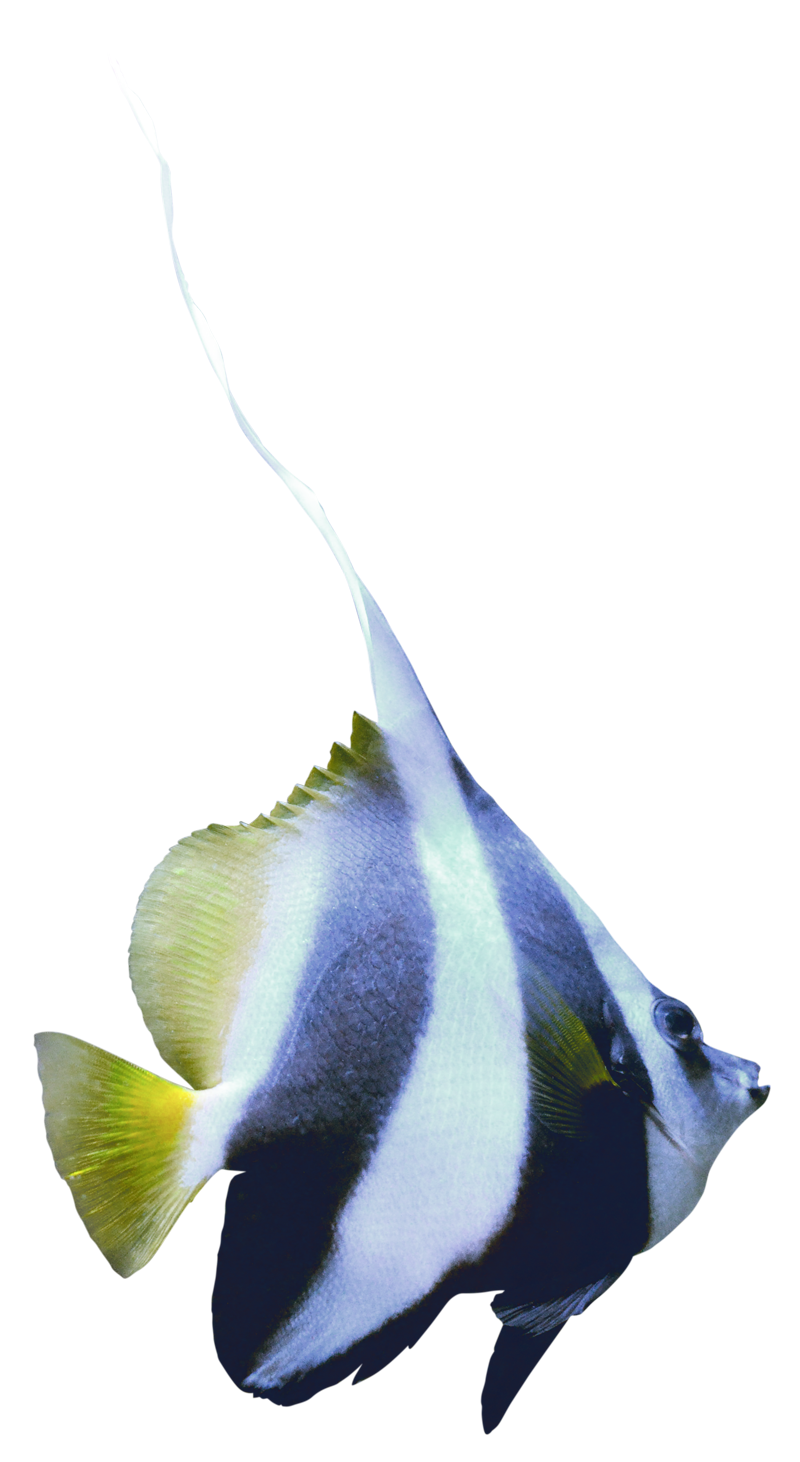
Heniochus singularius (H. M. Smith & Radcliffe, 1911)
旗を高く掲げる熱帯魚
A Tropical Fish Flying a High Banner
体長20cmほどになる、西太平洋のサンゴ礁域に生息するチョウチョウウオ科の魚です。白と黒のコントラストが鮮やかな体色と、背ビレの一部が長く糸状に伸びる優雅な姿が特徴です。和名は、体側に見られる縞模様と、背ビレ第4棘が旗を立てたように高く伸びることに由来しています。サンゴ礁の外縁や岩礁域を泳ぎ回り、小型無脊椎動物や付着生物などをついばんで生活しています。
近縁種のオニハタタテダイによく似ていますが、両種は体側の黒帯の位置によって見分けることができます。オニハタタテダイでは胸ビレ付近を通る黒帯が長く伸びた白い背ビレの後方に位置するのに対し、シマハタタテダイでは黒帯がその前方にあります。また、本種は成魚になると単独またはペアで行動することが多く、英名の「Singular bannerfish(単独で暮らすハタタテダイ)」もその習性に由来するとされています。
本種をはじめとするチョウチョウウオ類やスズメダイ類、クマノミ類などの熱帯性魚類は、日本ではしばしば「死滅回遊魚」として観察されます。これは、南方の海で生まれた幼魚が黒潮などの海流に乗って伊豆半島や三浦半島、さらには本州各地の温帯域まで運ばれてくる現象です。夏から秋にかけては浅海で元気に成長する姿が見られますが、多くの個体は冬の低水温に耐えられず繁殖することなく命を終えます。こうした魚たちは、海流が生み出す生物の移動や分布拡大の仕組みを知るうえで重要な存在となっています。
The Singular Bannerfish is a butterflyfish species that grows to about 20 cm in length and inhabits coral reefs throughout the western Pacific Ocean. It is distinguished by its striking black-and-white coloration and by the elongated fourth dorsal-fin spine, which extends upward like a banner. The Japanese name refers to both its striped body pattern and its flag-like dorsal fin.
This species is commonly found along reef slopes and rocky coral habitats, where it feeds on small invertebrates and attached organisms. Although it closely resembles the related Longfin Bannerfish (Heniochus acuminatus), the two can be distinguished by the position of the black band on the body. In the Longfin Bannerfish, the band lies behind the elongated white dorsal filament, whereas in the Singular Bannerfish it is positioned in front of it. Adult Singular Bannerfish are often seen alone or in pairs, and their tendency to live solitarily is reflected in the English name “Singular Bannerfish.”
Like many butterflyfishes, damselfishes, and clownfishes, this species is occasionally observed in Japan as a “seasonal stray tropical fish.” Juveniles are carried northward from tropical waters by the warm Kuroshio Current and may reach temperate regions such as the Izu and Miura Peninsulas. During the warmer months they can survive and grow in shallow coastal waters, but most are unable to withstand the low temperatures of winter and die before reproducing. These fishes provide valuable insight into the role of ocean currents in shaping the distribution and dispersal of marine life.
参考文献
WEB魚図鑑 | シマハタタテダイ 2024年12月7日閲覧
SEA EGG DIVERS 写真館 | オニハタタテダイ 2024年12月7日閲覧
ダイバーのための海水魚図鑑 | シマハタタテダイ 2024年12月7日閲覧
近畿地方環境事務所 | アクティブ・レンジャー日記 [近畿地区] | 死滅回遊魚という悲しい【動物】| (2013年9月11日) 2024年12月7日閲覧
横須賀市自然・人文博物館 | 学芸員自然と歴史のたより「死滅回遊魚」| (2019年8月4日) 2024年12月7日閲覧