
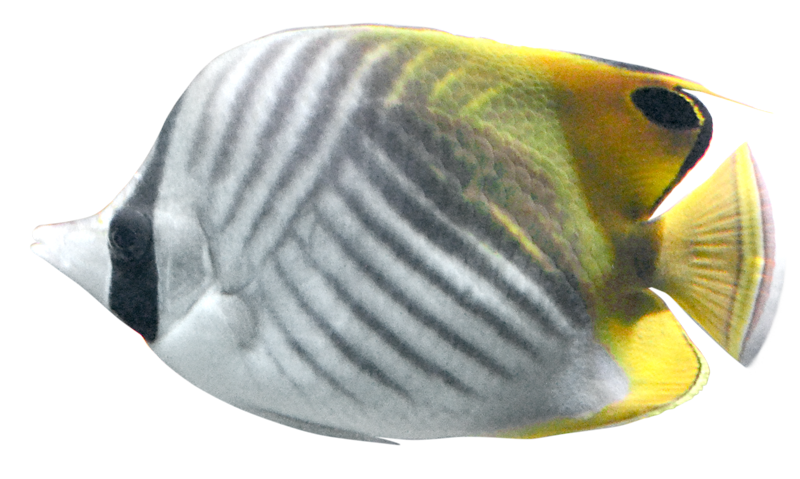
Chaetodon auriga (Forsskål, 1775)
眼を隠す黒帯と偽りの眼
A Black Band That Hides the Eye and a False Eye
全長20cmほど。紅海からインド洋、太平洋にかけて広く分布するチョウチョウウオの一種です。日本では琉球列島、南大東島、尖閣諸島、小笠原諸島などに生息し、本州沿岸では黒潮に乗って死滅回遊魚として見られることがあります。サンゴ礁や岩礁域、藻場などに生息し、単独やペア、小さな群れで行動します。主に多毛類、イソギンチャク、サンゴのポリプ、藻類などを食べます。最大では25cmほどに達します。
本種の特徴は、成魚になると背鰭後方の軟条が糸状に長く伸びることです。これが英名Threadfin butterflyfishの由来になっています。「トゲチョウチョウウオ」という名前ですが、糸状に伸びる部分は硬い棘ではなく軟条です。背鰭の軟条部には大きな黒い斑点があり、まるで魚の眼のように見えます。この眼状斑は実際の眼から離れた位置にあるため、捕食者に魚の前後を誤認させる働きがあると考えられています。
一方、実際の眼には太い黒い帯が縦に走ります。チョウチョウウオの仲間には、眼を通る帯模様や眼状斑を持つ種が多く、こうした模様には眼の位置や体の輪郭を分かりにくくし、捕食者の攻撃をそらす働きがあると考えられています。本種では、実際の眼を隠す黒帯と、眼のように見える背鰭の斑点が特徴的な模様をつくります。華やかな体色の中にある黒い模様は、単なる装飾ではなく、捕食者の認識を惑わせるための巧妙な仕組みと考えられています。
About 20 cm long, the threadfin butterflyfish is widely distributed across tropical waters from the Red Sea through the Indian and Pacific Oceans. In Japan, it occurs in the Ryukyu Islands, Minamidaito Island, the Senkaku Islands, and the Ogasawara Islands. Along the coast of mainland Japan, it may also appear as a temporary visitor carried northward by the Kuroshio Current. It inhabits coral reefs, rocky reefs, and seagrass or algal beds, occurring singly, in pairs, or in small groups. Its diet includes polychaete worms, sea anemones, coral polyps, and algae. It can grow to about 25 cm.
One of its most distinctive features is the elongated, thread-like soft rays at the rear of the dorsal fin, which become particularly prominent in adults. This feature gives rise to its English name, Threadfin butterflyfish. Despite its Japanese name meaning “thorn butterflyfish,” the elongated structures are not stiff spines but soft rays. A large black spot on the soft-rayed portion of the dorsal fin resembles an eye. Because this eyespot is positioned far from the actual eye, it is thought to help mislead predators about which end of the fish is the head.
Meanwhile, the actual eye is crossed by a broad black band. Many butterflyfish species have bands running through the eye or eyespots, and such markings are thought to make the eye and body outline less conspicuous, potentially diverting attacks from predators. In this species, the black band concealing the real eye and the dorsal-fin spot resembling a false eye create a distinctive pattern. The black markings within its otherwise vivid coloration are not merely ornamental, but are thought to be a sophisticated adaptation that may confuse the perception of predators.
参考文献
美ら海水族館 | 美ら海生き物図鑑 | トゲチョウチョウウオ 2025年3月30日閲覧
名古屋港水族館 | 海の仲間たち | 赤道の海【トゲチョウチョウウオ】 2025年3月30日閲覧