
Pterapogon kauderni (Koumans, 1933)
ウニの棘に守られて暮らす魚
A Fish That Finds Shelter Among Sea Urchin Spines
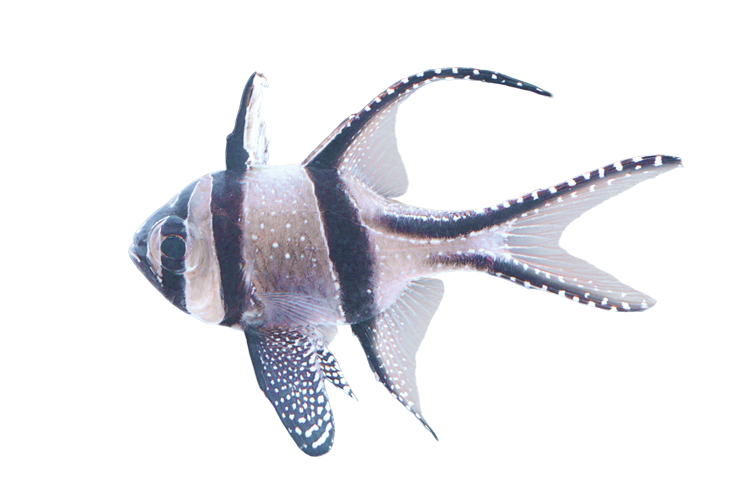
インドネシアのスラウェシ島東部、バンガイ諸島の周辺海域に分布するテンジクダイの仲間です。体長は約8cmで、銀白色の体に黒い幅広の横帯が入り、全身に白い斑点が散らばります。背鰭の第1棘は糸状に伸び、背鰭や臀鰭、尾鰭も長く発達しています。二又に分かれた尾鰭と、長く伸びた腹鰭も特徴的で、白黒の模様と相まって独特の姿をしています。雌雄の外見はよく似ていますが、繁殖期のオスは卵を口の中で保護するため、口元が大きく膨らみます。
浅いサンゴ礁や海草藻場に生息し、日中は群れをつくって中層を漂うように泳ぎます。特にガンガゼなどの長い棘を持つウニとの結びつきが強く、危険を感じると棘の間に逃げ込みます。幼魚はイソギンチャクなども隠れ場所として利用します。主に小型の甲殻類などを食べ、サンゴ礁の生態系の中で暮らしています。
繁殖では、メスが産んだ卵をオスが口に含み、孵化するまで保護する「口内保育」を行います。さらに特徴的なのは、孵化した仔魚もすぐには口から放さず、ある程度成長するまで口の中で育てることです。多くの海水魚では、仔魚が海中を漂う浮遊生活期を経て分散しますが、本種にはその期間がなく、親の保護を受けて成長した稚魚が直接海底の生活に移ります。この繁殖様式は、分布域が限られている理由の一つとも考えられています。
白黒の美しい模様と独特の繁殖習性から観賞魚として人気が高く、1990年代以降、世界各地のアクアリウム市場に向けて大量に採集されてきました。もともと生息域が狭く、親から離れた仔魚が遠くまで分散しにくいため、乱獲の影響を受けやすい魚です。現在も国際自然保護連合(IUCN)のレッドリストでは絶滅危惧種(EN)に分類されており、採集圧の軽減や生息環境の保全が課題となっています。

The Banggai cardinalfish is a member of the cardinalfish family found in the waters surrounding the Banggai Islands in eastern Sulawesi, Indonesia. It reaches about 8 cm in length and has a distinctive appearance, with broad black vertical bands across a silvery-white body covered in small white spots. The first dorsal-fin spine is elongated into a filament, while the dorsal, anal, and caudal fins are also well developed. Its deeply forked tail and long pelvic fins further contribute to its unusual appearance. Males and females look similar, although males develop an enlarged mouth during the breeding season as they carry eggs and young inside.
It inhabits shallow coral reefs and seagrass beds, where it often forms groups and swims in midwater during the day. One of its most characteristic associations is with long-spined sea urchins, particularly diadem urchins. When threatened, the fish takes refuge among their protective spines. Juveniles also use sea anemones and other structures as hiding places. Its diet consists mainly of small crustaceans and other tiny invertebrates.
During reproduction, the female lays eggs that are taken into the male’s mouth, where they are protected until hatching. Remarkably, the male continues to shelter the newly hatched young in his mouth until they have developed sufficiently. Unlike many marine fish, whose larvae spend a period drifting in the open water before settling, the Banggai cardinalfish has no pelagic larval stage. The young are released as relatively well-developed juveniles and begin life on the reef. This reproductive strategy is considered one of the factors contributing to its restricted distribution.
Its striking black-and-white pattern and unusual breeding behavior have made it a popular aquarium fish. Since the 1990s, large numbers have been collected from the wild for the international ornamental fish trade. Because its natural range is limited and its young have little opportunity to disperse over long distances, the species is particularly vulnerable to overcollection. It is currently classified as Endangered (EN) on the IUCN Red List, and reducing collection pressure and protecting its natural habitat remain important conservation challenges.
参考文献
NOAA Fisheries, “Banggai Cardinalfish”. 2026年11月23日閲覧
NOAA Fisheries, “Banggai cardinalfish (Pterapogon kauderni) 5-Year Review: Summary and Evaluation”. 2026年11月23日閲覧
CITES (2016). Proposal to include Banggai Cardinalfish Pterapogon kauderni in Appendix II. 2026年11月23日閲覧
足立区生物園 | 生物園の生きもの | アマノガワテンジクダイ 2026年11月23日閲覧