
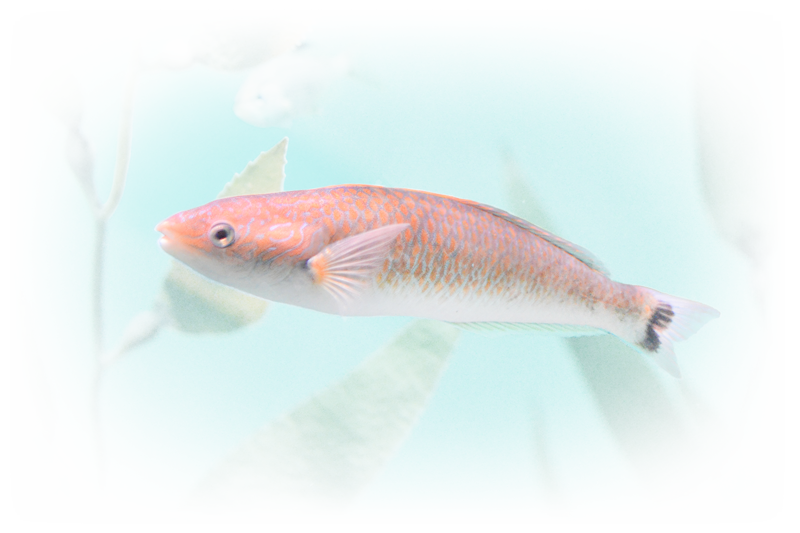
Oxyjulis californica (Günther, 1861)
多くの魚に信頼されるセニョリータ
The Señorita, Trusted by Countless Fish
体長約25cm。 アメリカ・カリフォルニア州モントレー湾周辺からメキシコ・バハ・カリフォルニア半島にかけての東部太平洋に分布し、ケルプフォレストや岩礁域に生息します。細長い体に黄褐色から橙褐色の体色をもち、尾柄部の黒い斑点が特徴です。英名の「セニョリータ(Señorita)」はスペイン語で「若い女性」を意味し、優雅に泳ぐ姿にちなんで名付けられたとされています。
本種を最も特徴づけるのは、他の魚の体表やエラから寄生虫や古い組織を取り除く「クリーナーフィッシュ」としての生態です。岩礁やケルプの周辺にはクリーニングステーションが形成され、大型魚は体を傾けたり口やエラを大きく開いたりして順番を待ちます。セニョリータは寄生虫などを餌として食べる一方、依頼する魚は健康を保てるため、双方が利益を得る共生関係が成立しています。特に幼魚ではこの行動への依存度が高く、南カリフォルニア沿岸を代表するクリーナーフィッシュとして、生態系の維持に重要な役割を果たしています。
食性は肉食性で、小型甲殻類や多毛類、コケムシ類などの底生無脊椎動物をついばむほか、クリーニングで得られる寄生性甲殻類も利用します。夜になると砂に潜って休み、捕食者から身を守ります。また、多くのベラ類では雌から雄への性転換が知られていますが、本種ではそのような性転換は確認されていません。クリーナーフィッシュという特殊な生活や、雄が雌を独占する社会構造をもたないことが関係している可能性が指摘されていますが、その理由はまだ十分には解明されていません。華やかな見た目だけでなく、魚たちの健康を支える「海の掃除屋」として欠かせない存在です。
Maximum length: about 25 cm. The señorita (Oxyjulis californica) is distributed along the eastern Pacific coast from the vicinity of Monterey Bay, California, to the Baja California Peninsula in Mexico. It inhabits kelp forests and rocky reefs. Its slender body is yellowish- to orange-brown, with a distinctive black spot on the caudal peduncle. Its English name, “Señorita,” comes from the Spanish word meaning “young lady,” inspired by its graceful appearance and elegant swimming.
The species is best known as a cleaner fish. Around rocky reefs and kelp beds, it establishes cleaning stations where larger fishes gather, tilt their bodies, and open their mouths and gill covers to have parasites and dead tissue removed. While the señorita feeds on these parasites, its clients benefit from improved health, making this a classic example of mutualism. Juveniles rely particularly heavily on cleaning behavior, and the species is regarded as one of the most important cleaner fishes along the coast of Southern California, where it plays a vital role in maintaining the balance of the ecosystem.
The señorita is carnivorous, feeding on small crustaceans, polychaete worms, bryozoans, and other benthic invertebrates, in addition to parasitic crustaceans obtained while cleaning. At night, it buries itself in the sand to avoid predators. Unlike many wrasses, which are known to change sex from female to male, no such sex change has been confirmed in this species. Its unique lifestyle as a cleaner fish and the absence of a social system in which males monopolize groups of females may be related to this difference, although the reason has yet to be fully understood. Beyond its elegant appearance, the señorita is an indispensable “cleaner of the sea,” helping to keep countless reef fishes healthy.
参考文献
“Señorita” Monterey Bay Aquarium. 2026年9月13日閲覧
Hobson, E. S. (1971). Cleaning Symbiosis Among California Inshore Fishes. Fishery Bulletin, 69, 491–523. 2026年9月13日閲覧
“Halichoeres californicus Günther, 1861 Señorita” FishBase. 2026年9月13日閲覧
Aguilar-Aguilar, R. Little-known members of the kelp forest: helminth parasites of the Garibaldi Damselfish Hypsypops rubicundus (Teleostei: Pomacentridae) from Bahía de Todos Santos, Baja California, Mexico, with the description of Opegaster gorgonioi sp. nov. (Trematoda: Opecoelidae). Mar. Biodivers. 55, 98 (2025). 2026年9月13日閲覧