
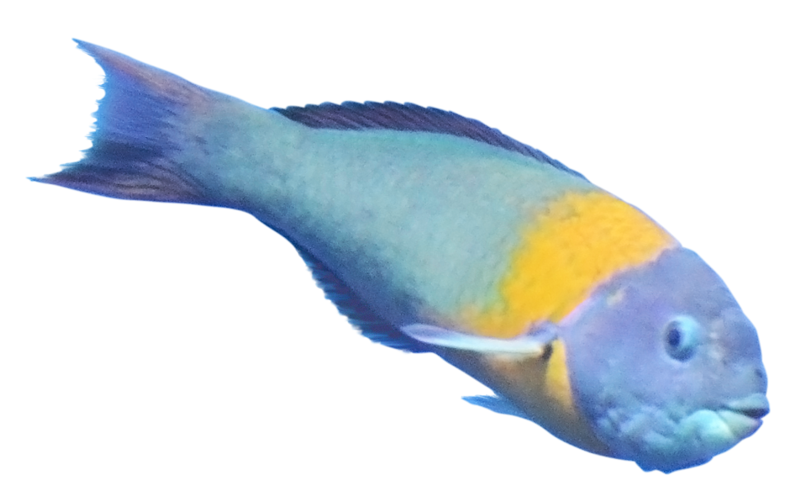
Thalassoma duperrey (Quoy & Gaimard, 1824)
ウィルウィルの名を持つハワイの魚
The Hawaiian Fish Named After the Wiliwili Tree
サドルラスは、最大体長30cmほどになるベラ科の海水魚で、ハワイ諸島とジョンストン環礁にのみ分布する固有性の高い種です。浅いサンゴ礁や岩礁域に生息し、ハワイの礁湖では最も普通に見られる魚の一つとして知られています。青緑色の体に首元の鮮やかな橙色帯が映える美しい魚で、遊泳時には胸ビレを羽ばたかせるように動かして泳ぎます。
本種はベラ科に広く見られる「雌性先熟」の性質を持ち、最初はメスとして成長し、その後オスへ性転換します。オスになると橙色帯の後方に白色帯が現れ、体色もより鮮やかになります。こうした色彩の変化は繁殖行動とも深く関わっていると考えられています。
ハワイ周辺海域では43種のベラ科魚類が知られ、そのうち13種はハワイ固有種です。本種はその代表的な存在であり、古くから食用魚としても利用されてきました。現地では「Hīnālea lauwili」と呼ばれ、「lauwiliwili」はハワイ固有のマメ科植物ウィルウィルに由来するとされます。本種の橙色を帯びた体色が、ウィルウィルの花や葉を連想させたのでしょう。なお、「lauwiliwili」の名を持つ魚は他にもおり、ハワイ固有のミレットシードバタフライフィッシュや、長い吻を持つフエヤッコダイの現地名にも用いられています。こうした呼び名からは、魚の姿や色彩を身近な自然と結び付けてきた、ハワイの人々の自然観もうかがえます。
The saddle wrasse is a species of wrasse that reaches about 30 cm in length and is endemic to the Hawaiian Islands and Johnston Atoll. It inhabits shallow coral reefs and rocky coastal areas, and is regarded as one of the most common reef fishes in Hawaiian waters. Its vivid blue-green body is marked by a bright orange band behind the head. Like many wrasses, it swims by fluttering its pectoral fins in a wing-like motion.
This species is protogynous, a reproductive strategy common among wrasses in which individuals begin life as females and later transform into males. Mature males develop an additional white band behind the orange marking and display even brighter coloration. These changes are thought to be closely associated with breeding behavior.
Around Hawaii, 43 species of wrasses have been recorded, including 13 endemic species. The saddle wrasse is among the most representative of them and has long been used as a food fish. In Hawaiian, it is known as “Hīnālea lauwili,” with “lauwiliwili” believed to refer to the native wiliwili tree. The fish’s orange coloration may have reminded people of the tree’s flowers and leaves. Other Hawaiian fishes also bear the name “lauwiliwili,” including the endemic milletseed butterflyfish and the long-snouted forcepsfish. Such names reflect the traditional Hawaiian tendency to associate the appearance and colors of reef fishes with familiar elements of the natural world.
参考文献
かぎけんWEB | サドル・ラス(Saddle Wrasse) 2025年2月2日閲覧
“Saddle Wrasse” Animal Guide, Waikiki Aquarium 2025年2月2日閲覧
“Hīnālea lauwili – Saddle Wrasse” University of Hawai‘i Sea Grant College Program 2025年2月2日閲覧
Studio Elepaio | ウィリウィリ | (2017年6月16日) 2025年2月2日閲覧