
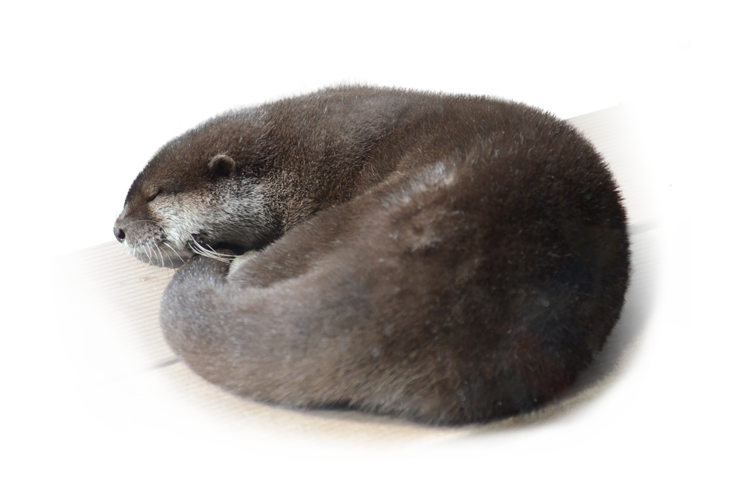
Aonyx cinerea (Illiger, 1815)
カフェで人気の絶滅危惧種
A Café Favorite at Risk of Extinction
インドから中国南部、東南アジアにかけて広く分布するカワウソの仲間です。河川や湖沼、湿地、マングローブ林、水田など多様な水辺環境に生息し、主にカニやエビ、貝類などの甲殻類や軟体動物を捕食します。採食の際には泥や石の隙間を探りながら餌を見つけるため、水中だけでなく陸上でも活発に行動します。環境への適応力が高く、山地の渓流から低地の湿地まで幅広い環境で暮らしています。
現生するカワウソ類の中では最も小型の種で、体長40~60cm、体重2~5kgほどになります。名前の由来となった小さな爪と、発達の弱い水かきを持つことが特徴です。その代わり前足の指先は非常に器用で、視覚に頼らず触覚を使って獲物を探し出します。この優れた操作能力はカワウソ類の中でも特に発達しており、硬い殻を持つ獲物を扱うのに適しています。
コツメカワウソは非常に社会性が高く、つがいとその子どもたちからなる家族群で生活します。家族内では多様な鳴き声や匂いを用いてコミュニケーションを行い、協力して子育てを行うことが知られています。繁殖した親だけでなく兄姉が育児を手伝うこともあり、複数世代からなる家族群が形成されます。時には十数頭規模の群れが観察されることもあります。
愛らしい表情や活発な行動、器用な前足を使う仕草から、日本では動物園や水族館の人気者として親しまれています。近年はSNSやテレビ番組などを通じて注目度が高まり、エキゾチックアニマルカフェで展示される例も増えました。人の近くで飼育される機会が増えたことで、コツメカワウソは日本で広く知られるカワウソとなり、その愛嬌のある姿は多くの人々を魅了しています。
しかし野生では、生息地の開発や水質汚染、密猟、ペット目的の違法取引などによって個体数が減少しており、国際自然保護連合(IUCN)では危急種(VU)に分類されています。2025年に発表された研究では、日本で飼育されるコツメカワウソの遺伝的な由来が調べられ、動物園・水族館の個体群とエキゾチックアニマルカフェの個体群では異なる由来を持つ可能性が示されました。特にカフェや税関押収個体の一部は、過去に密猟や違法取引との関わりが指摘されてきたタイ南部の野生個体群と共通する遺伝子型を持っており、日本におけるコツメカワウソの流通経路を考える上で注目されています。

The Oriental small-clawed otter is distributed widely across South and Southeast Asia, ranging from India to southern China. It inhabits a variety of wetland environments, including rivers, lakes, marshes, mangrove forests, and rice paddies. Its diet consists mainly of crustaceans and mollusks such as crabs, shrimps, and shellfish. When foraging, it uses its sensitive forepaws to search through mud and crevices for prey, making it active not only in water but also on land. Highly adaptable, the species occupies habitats ranging from mountain streams to lowland wetlands.
The smallest of all living otter species, it typically measures 40–60 cm in body length and weighs between 2 and 5 kg. Its name comes from its unusually small claws, while its webbing is less developed than that of other otters. In compensation, its forepaws are remarkably dexterous. Relying heavily on touch rather than sight, it can detect and manipulate prey hidden in mud or among rocks. This exceptional manual dexterity is especially useful for handling and opening hard-shelled prey.
Oriental small-clawed otters are highly social animals that live in family groups consisting of a breeding pair and their offspring. Family members communicate through a variety of vocalizations and scent signals, and cooperative care of the young is common. Older siblings often help raise younger pups, resulting in family groups that may include several generations. Groups of more than ten individuals have occasionally been observed in the wild.
Because of their expressive faces, playful behavior, and skillful use of their forepaws, these otters are popular attractions in Japanese zoos and aquariums. In recent years, their visibility has increased through social media and television programs, and they have also become common in exotic animal cafés. As opportunities for close human interaction have increased, the Oriental small-clawed otter has become one of the best-known otter species in Japan, captivating many people with its charm.
In the wild, however, populations have declined because of habitat loss, water pollution, poaching, and illegal trade for the pet market. As a result, the species is classified as Vulnerable (VU) on the IUCN Red List. A study published in 2025 investigated the genetic origins of captive Oriental small-clawed otters in Japan and suggested that otters kept in zoos and aquariums may have different geographic origins from those kept in exotic animal cafés. Some café animals and individuals seized by customs authorities shared genetic lineages with wild populations from southern Thailand, a region that has been identified as a source of poached otters and illegal wildlife trade. These findings provide valuable insight into the origins and trade pathways of captive otters in Japan.
参考文献
海遊館 | 生きものを知る | コツメカワウソ 2026年6月13日閲覧
多摩動物公園 | 多摩動物公園の生き物 | コツメカワウソ 2026年6月13日閲覧
“Aonyx cinereus” IUCN SSC Otter Specialist Group. 2026年6月13日閲覧
WWFジャパン | カワウソカフェにおける飼養環境調査と法規制改善の必要性 | (2024年9月24日) 2026年6月13日閲覧