
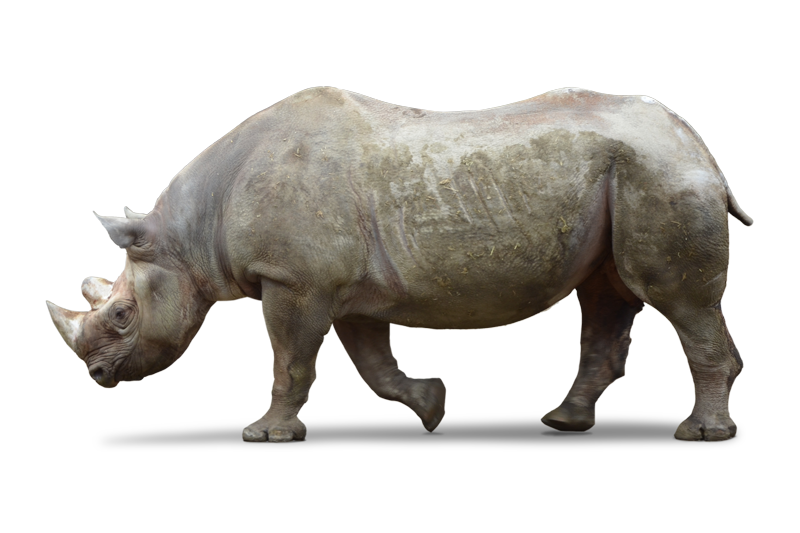
Diceros bicornis (Linnaeus, 1758)
日本に現れたサイの歴史
A History of Rhinoceroses in Japan
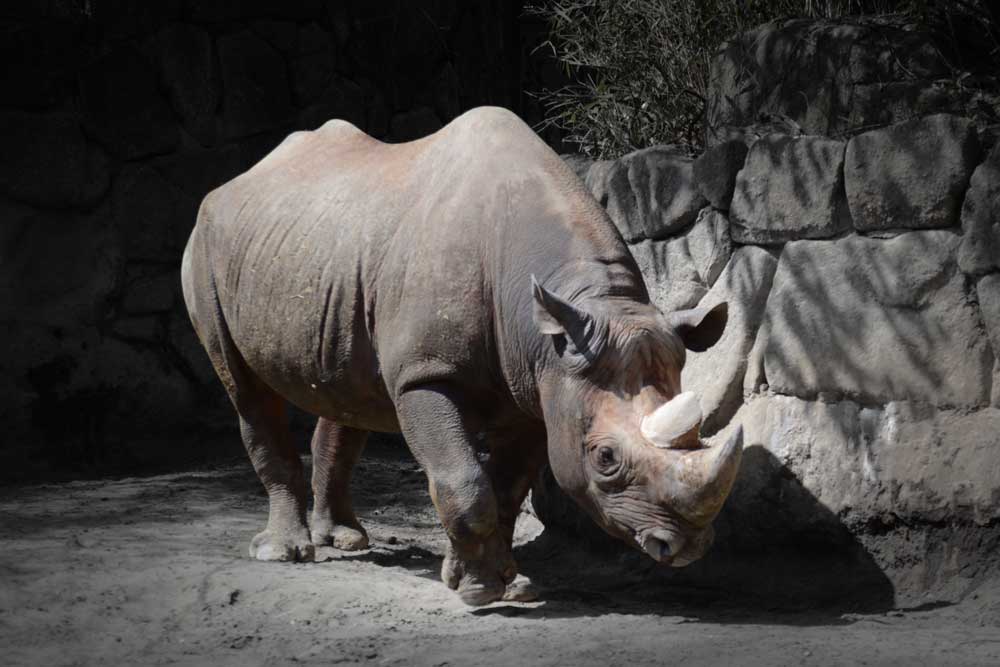
南アフリカ、ナミビア、ケニア、タンザニアなど、主にサハラ砂漠以南のアフリカ大陸東部から南部にかけて分布しています。オスは頭胴長(体長)280~290cm、尾長約60cm、肩高132~180cmで、メスはこれよりやや小型です。体色は灰褐色で、個体によっては泥浴びの影響により赤みや白みを帯びて見えることもあります。
アフリカに生息するサイのうち、クロサイとシロサイは外見が似ていますが、食性や形態に明確な違いがあります。地面の草を食べるシロサイは口先が幅広く発達しているのに対し、クロサイは低木の枝や葉を主食とするブラウザーで、枝をつかみやすいよう口先が細く尖っています。体格はシロサイの方が大きく、現生の陸上動物の中でも最大級に属するのに対し、クロサイはそれより一回り小型です。また角はどちらも2本ありますが、クロサイは前角が長く細く伸びる傾向があり、シロサイは比較的短く太い角を持つのが一般的です。さらにクロサイは単独で行動することが多く縄張り意識が強い一方、シロサイは比較的温和で群れをつくることもあります。
かつては広範囲に分布していましたが、角を目的とした密猟や生息地の減少により個体数は大きく減少しました。現在は各地で保護活動が進められており、国際的にも絶滅の危険性が高い種として分類されています。日本におけるサイの来歴としては、1921年に来園した個体がスマトラサイであった記録があり、この種は現在、世界の動物園では飼育されていません。また、クロサイは1933年にハーゲンベック・サーカスによってもたらされ、その後1952年に東京都恩賜上野動物園で初めて飼育展示が行われました。なおシロサイは1966年に同園で、インドサイは1958年に多摩動物公園で飼育が開始されています。
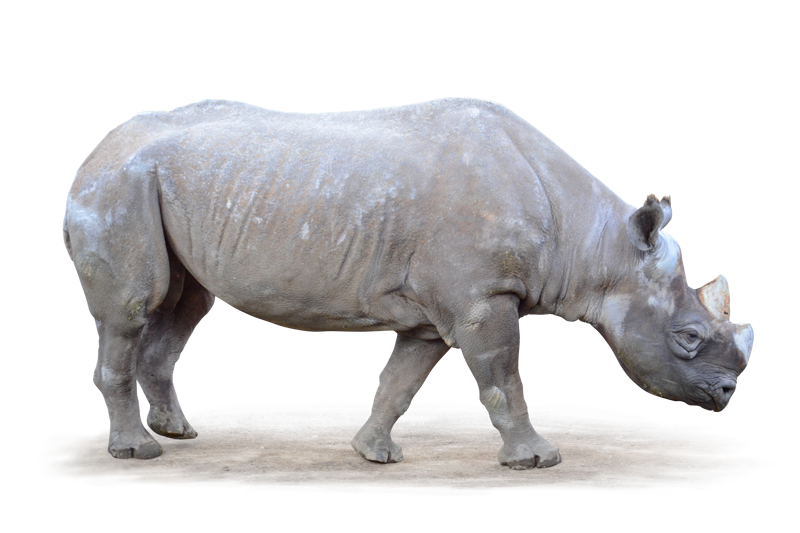
The black rhinoceros is distributed across eastern and southern sub-Saharan Africa, including countries such as South Africa, Namibia, Kenya, and Tanzania. Males measure about 280–290 cm in head–body length, with a tail length of around 60 cm and a shoulder height of 132–180 cm, while females are slightly smaller. Their body color is generally grayish-brown, though individuals may appear reddish or pale due to mud coating.
Among African rhinoceroses, the black rhinoceros and the white rhinoceros appear similar but differ clearly in feeding habits and morphology. The white rhinoceros, which grazes on ground vegetation, has a broad, square-shaped mouth, whereas the black rhinoceros is a browser that feeds mainly on shrubs and leaves, possessing a pointed, prehensile upper lip adapted for grasping branches. In terms of body size, the white rhinoceros is larger and ranks among the largest land animals alive today, while the black rhinoceros is comparatively smaller. Both species have two horns, but in the black rhinoceros the front horn tends to be longer and more slender, whereas in the white rhinoceros the horns are generally shorter and thicker. Behaviorally, black rhinoceroses are more solitary and territorial, while white rhinoceroses are relatively docile and may form groups.
Historically widespread, black rhinoceroses have suffered severe population declines due to poaching for their horns and habitat loss. Today, conservation efforts are underway across their range, and the species is classified as critically endangered at the global level. In Japan, records indicate that a Sumatran rhinoceros was exhibited as early as 1921, and this species is not currently kept in zoological collections worldwide. A black rhinoceros was later brought to Japan in 1933 with a traveling circus, and the species was first exhibited in a zoo in 1952 at Ueno Zoo in Tokyo. In comparison, the white rhinoceros was first kept there in 1966, while the Indian rhinoceros has been exhibited at Tama Zoological Park since 1958.
参考文献
Kurnit, Jennifer. “Diceros bicornis” KurnitAnimal Diversity Web. 2024年9月2日閲覧
『クロサイ』調査記録集第3号. 広島市安佐動物公園. (1995年5月10日) 2024年9月2日閲覧
半田 直人 ほか (2021年12月2日)「アフリカにおけるクロサイ族の多様性変動と初期放散の要因の解明」 2024年9月2日閲覧
祖谷勝紀「サイの飼育状況(サイの国内登録)」,1974-16-02号, 上野動物園, 日本動物園水族館協会 2026年3月29日閲覧
Rina Marie Doctor (2015, August 26) “Only Sumatran Rhino In U.S. To Be Sent To Indonesia To Breed” Tech Times. 2026年3月29日閲覧