
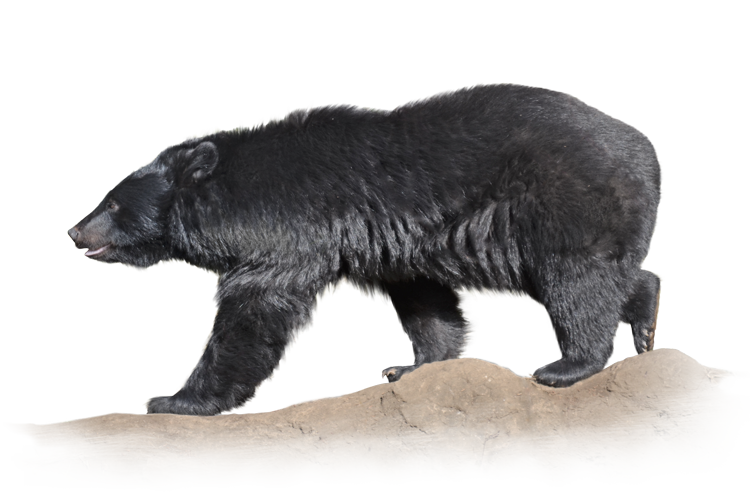
Ursus thibetanus japonicus (Schlegel, 1857)
日本に生息する二種のクマ
The Two Bear Species of Japan
ツキノワグマは本州と四国に生息する日本固有のクマで、体長100〜150cm、体重は雄60〜120kg、雌40〜80kgになります。全身は黒い毛に覆われ、胸に白いV字状の模様があるのが特徴です。北海道に生息するヒグマとは同じクマ科に属しますが、分類学的には異なる種です。北海道と本州の間にある津軽海峡は「ブラキストン線」と呼ばれ、動物相の境界として知られています。現在、この海峡が両種の分布を分けています。
研究によれば、ツキノワグマとヒグマは約500万年前に共通の祖先から分かれ、それぞれ独自に進化してきました。氷河期にはヒグマが本州に生息していた時期もありましたが、これまでの古生物学的・遺伝学的研究において、両種が自然に交雑したことを示す証拠は確認されていません。長い進化の過程で遺伝的差異が蓄積し、現在では明確に区別されています。
近年は本州のツキノワグマと北海道のヒグマの被害が同時に報道されることが多く、両者が混同される場合があります。とくに大型個体の出没が伝えられると「ヒグマとの混血ではないか」といった憶測が生じることもあります。しかし、そのような説を裏づける科学的根拠はなく、両種は進化史の中で長く独立してきた別種です。
The Japanese black bear inhabits Honshu and Shikoku and is an endemic subspecies of Japan. It measures 100–150 cm in body length and weighs 60–120 kg in males and 40–80 kg in females. Its body is covered in black fur, and it is characterized by a white V-shaped marking on the chest. Although it belongs to the same bear family as the brown bear found in Hokkaido, it is classified as a different species. The Tsugaru Strait between Hokkaido and Honshu is known as the “Blakiston Line,” a well-recognized faunal boundary. Today, this strait separates the distribution ranges of the two species.
Research suggests that the Japanese black bear and the brown bear diverged from a common ancestor approximately five million years ago and have since evolved independently. During the Ice Age, brown bears inhabited Honshu, but paleontological and genetic studies have found no evidence that the two species interbred in the wild. Over a long evolutionary history, genetic differences accumulated, and they are now clearly distinguished from one another.
In recent years, incidents involving Japanese black bears in Honshu and brown bears in Hokkaido have often been reported simultaneously, which may lead to public confusion between the two. When particularly large individuals are observed, speculation sometimes arises about possible hybridization with brown bears. However, there is no scientific evidence to support such claims, and the two are distinct species that have long followed separate evolutionary paths.
参考文献
WWFジャパン | 日本に生息する2種のクマ、ツキノワグマとヒグマについて | (2012年1月17日) 2026年3月28日閲覧
リープリーパー | 「ヒグマ風のツキノワグマ」は交雑種?ゲノム解析が示す歴史的真実 | (202512月11日) 2026年3月28日閲覧
Yoshiki Yasukochi, Shin Nishida, Sang-Hoon Han, Toshifumi Kurosaki, Masaaki Yoneda, Hiroko Koike, Genetic Structure of the Asiatic Black Bear in Japan Using Mitochondrial DNA Analysis, Journal of Heredity, Volume 100, Issue 3, May-June 2009, Pages 297–308. 2026年3月28日閲覧
科学バー | 進化の目で見る生き物たち | 第6話 クマ科の進化 | 長谷川政美 2026年3月28日閲覧