
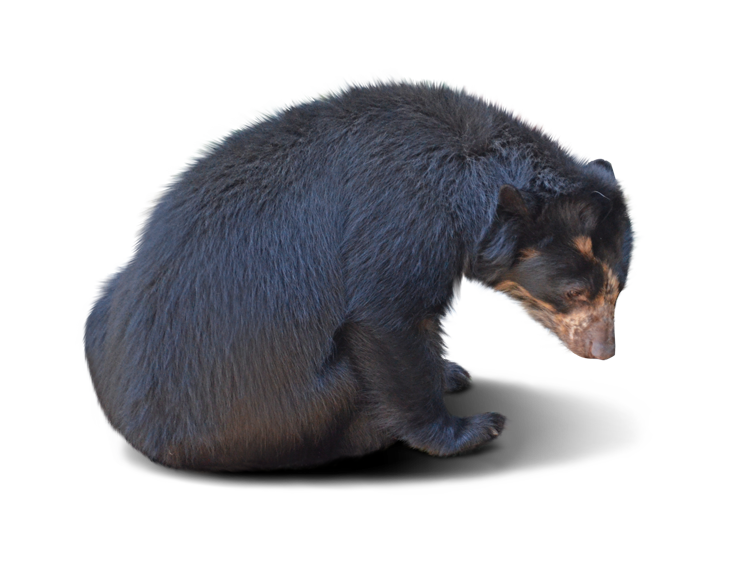
Tremarctos ornatus (F. Cuvier, 1825)
パナマ地峡を渡ったクマ
The Bear that Crossed the Isthmus of Panama
メガネグマは南アメリカに生息する唯一のクマで、体長130〜190cm、体重は雄100〜175kg、雌60〜80kgほどになる中型のクマです。体格はツキノワグマとほぼ同程度ですが、やや大きくなる傾向があります。分布はアンデス山脈周辺の山地で、コロンビア、エクアドル、ペルー、ボリビアなどの森林や雲霧林(うんむりん)に暮らしています。体毛は黒色から濃い褐色で、目の周囲や喉に淡いクリーム色の模様が入ることが多く、この斑紋が眼鏡のように見えることが名前の由来です。ただし模様の形や大きさには個体差があり、必ずしも左右対称のメガネ状になるとは限りません。
食性はクマとしては珍しく植物質への依存が高く、ヤシ科植物の新芽や果実、竹、サボテンなどを主に食べます。動物質は昆虫や小型哺乳類などがわずかに含まれる程度で、食物全体の数%ほどとされています。こうした食性に適応して臼歯が発達しており、硬い植物をすり潰すことができます。また手首の骨の一部である橈側種子骨(とうそくしゅしこつ)が大きく発達し、第六の指のように働く構造をもつ点も特徴です。これは植物の茎や果実をつかむ際に役立つもので、同様の構造をもつジャイアントパンダと比較されることがあります。系統的にもメガネグマはクマ科の中で古い系統に属し、パンダに次いで早い時期に分岐したグループと考えられています。
進化史の上でも興味深い存在です。約300万年前、北米大陸と南米大陸がパナマ地峡でつながると、多くの動物が両大陸の間を移動しました。その際に北米から南米へ渡った短顔グマ類の一部がアンデス山脈の高地環境に適応し、現在のメガネグマへと進化したと考えられています。同じ時期にはイヌ科やネコ科、シカ科など多くの北米系哺乳類も南米へ進出し、さらにラクダ科の祖先は南米で進化してリャマやアルパカの仲間になりました。同じ短顔グマの系統に属するアルクトドゥスは体長3〜4mにも達する巨大なクマでしたが、環境の変化や他のクマ類との競争の中で絶滅しました。こうして現在、南米にその系統の生き残りとして残っているのがメガネグマなのです。
The spectacled bear is the only bear species living in South America. It is a medium-sized bear measuring about 130–190 cm in body length and weighing roughly 100–175 kg in males and 60–80 kg in females. Its body size is broadly comparable to that of the Asian black bear, though it tends to be slightly larger. The species inhabits mountainous regions of the Andes, living in forests and cloud forests of Colombia, Ecuador, Peru, and Bolivia. The fur is black to dark brown, and pale cream-colored markings often appear around the eyes and throat. These markings sometimes resemble eyeglasses, giving rise to the common name. However, their shape and size vary greatly among individuals, and they do not always form a symmetrical “spectacle” pattern.
The diet of the spectacled bear is unusually plant-based for a bear. It feeds mainly on palm shoots, fruits, bamboo, and cacti. Animal matter such as insects or small mammals forms only a small portion of the diet. Adapted to this feeding habit, the molars are well developed for grinding tough plant material. Another notable feature is the enlarged radial sesamoid bone in the wrist, which functions like a sixth finger. This structure helps the bear grasp stems and fruits while feeding and is often compared with the similar adaptation seen in the giant panda. Phylogenetically, the spectacled bear represents one of the most ancient lineages within the bear family and is thought to have diverged early, second only to the giant panda.
Its evolutionary history is also remarkable. Around three million years ago, the North and South American continents became connected by the Isthmus of Panama, allowing many animals to move between the two landmasses. Some short-faced bears that migrated from North America to South America adapted to the high-elevation environments of the Andes and eventually evolved into the modern spectacled bear. During the same period, many other North American mammals such as canids, felids, and deer also entered South America, while the ancestors of camelids evolved there into animals such as llamas and alpacas. A related member of the short-faced bear lineage, Arctodus, was a gigantic bear reaching 3–4 meters in length, but it eventually became extinct due to environmental changes and competition with other bears. The spectacled bear is the sole surviving representative of that lineage in South America today.
参考文献
エレファントーク | No.120 メガネグマ – おもしろ哺乳動物大百科 69 食肉目 クマ科 | (2011年12月16日) 2026年4月19日閲覧
「南米にクラス唯一のクマ、メガネグマに迫る」BEARS JAPAN, Vol.18-1, 2017年7月. 2026年4月19日閲覧