
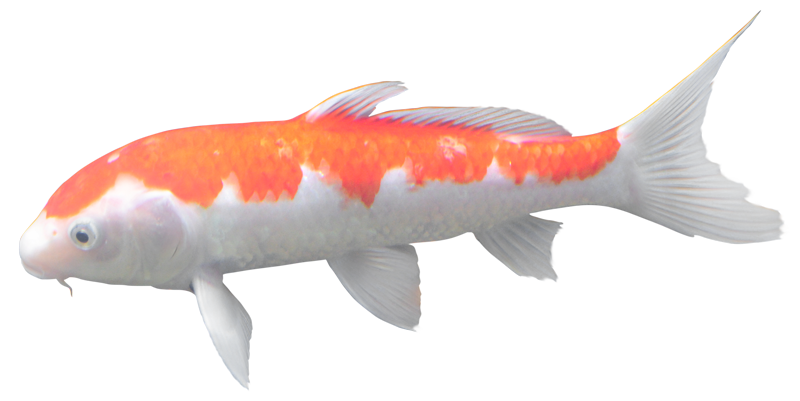
Cyprinus carpio (Linnaeus, 1758)
雪深き農村で始まった錦鯉の歴史
The History of Nishikigoi Begun in a Snowy Rural Village
観賞用として選抜・改良されたコイの総称です。約200年前の江戸時代後期、新潟県の二十村郷(現在の長岡市山古志地域と小千谷市東部一帯)で、食用に養殖されていたマゴイの中から、突然変異によって赤や白などの色や模様をもつ個体が現れたことが始まりとされています。雪深い二十村郷では、食料を確保するため古くからコイの養殖が行われており、こうした鯉の中から色や模様の優れた個体を選び、交配を重ねることで錦鯉が生み出されました。
明治時代に入ると品種改良が本格化し、現在の錦鯉の基礎となる品種が次々に作られました。1889年(明治22年)には小千谷市の広井国蔵によって「紅白」が作出されたとされ、1917年(大正6年)には「大正三色」、1927年(昭和2年)には「昭和三色」が成立しました。白地に紅の模様をもつ紅白、白地に紅と黒の模様をもつ大正三色、黒地に紅と白の模様をもつ昭和三色は、現在も錦鯉を代表する「御三家」と呼ばれています。
品種改良を大きく進展させたのが、1904年にドイツから導入された「ドイツ鯉」です。ドイツで食用に改良された鯉で、鱗が少なく、地肌が広く露出するのが特徴です。導入された40尾の一部が日本の鯉との交配に利用され、1906年には浅黄との交配によって「秋翠」が作出されました。その後、ドイツ鯉の形質を取り入れた品種が次々に生み出され、錦鯉の品種の多様化に大きく貢献しました。「山吹黄金」など、現在人気の高い品種にもその系統が受け継がれています。
錦鯉が全国的に知られる大きな転機となったのが、1914年(大正3年)の東京大正博覧会です。東京・上野公園で開催された博覧会に新潟の鯉が「越後の変わり鯉」の名で出品され、高い評価を受けたことで、全国へと広まっていきました。
「錦鯉」という名称は、大正時代に山古志郷の品種改良を指導した新潟県庁水産主任官の阿部圭が、大正三色を見て「これはまさしく錦鯉だ」と評したことが由来とされています。その後、戦後には「Fancy Carp」の名で海外に紹介されましたが、現在では「Nishikigoi」が国際的にも定着しています。
長年にわたる選抜と交配によって、現在では100を超える多様な品種が生み出され、錦鯉は日本を代表する観賞魚の一つとして世界各地で愛好されています。新潟県は現在もその主要な産地であり、錦鯉は約200年にわたる人々の選抜と改良の歴史を映す、まさに「泳ぐ芸術品」といえる存在です。
Nishikigoi is a collective name for carp selectively bred and refined for ornamental purposes. Their history is believed to have begun about 200 years ago in the late Edo period, in the Futatsumura region of Niigata Prefecture, now encompassing the Yamakoshi area of Nagaoka City and eastern Ojiya City. In this snowy, mountainous region, carp had long been raised as a source of food. Among these carp, individuals with unusual red, white, and other colors or distinctive patterns appeared through natural mutations. By selectively breeding fish with desirable colors and patterns, people gradually developed the ornamental carp now known as Nishikigoi.
During the Meiji period, selective breeding became more systematic, and several varieties that form the foundation of modern Nishikigoi were established. In 1889, Hiroi Kunizo of Ojiya is said to have developed Kohaku, characterized by a white body with red markings. Taisho Sanshoku, with a white body patterned in red and black, followed in 1917, and Showa Sanshoku, with a black base marked with red and white, was established in 1927. Together, these three varieties are known as the “Gosanke,” or Big Three, and remain among the most representative varieties of Nishikigoi.
A major development in Nishikigoi breeding came with the introduction of German carp from Germany in 1904. Originally bred as food carp, they have relatively few scales, leaving much of the skin exposed. Some of the 40 fish introduced to Japan were crossed with Japanese carp, and in 1906 the variety Shusui was developed by crossing German carp with Asagi. German carp subsequently contributed to the diversification of Nishikigoi, giving rise to numerous varieties with distinctive scale patterns and colors, including the popular Yamabuki Ogon.
A major turning point in the spread of Nishikigoi came in 1914, when the Tokyo Taisho Exposition was held in Ueno Park, Tokyo. Carp from Niigata were exhibited under the name “Echigo no Kawarigoi,” meaning “Echigo’s unusual carp,” and attracted considerable attention. This helped introduce Nishikigoi to people throughout Japan.
The name “Nishikigoi” is traditionally attributed to Kei Abe, a fisheries official of Niigata Prefecture who enthusiastically promoted carp breeding in the Yamakoshi region during the Taisho period. After World War II, Nishikigoi were introduced overseas under the name “Fancy Carp,” but today “Nishikigoi” has become the internationally recognized name.
Through generations of selective breeding and crossbreeding, more than 100 varieties have been developed. Nishikigoi are now kept by enthusiasts around the world as one of Japan’s most distinctive ornamental fish. Niigata remains one of their principal breeding regions, and Nishikigoi can be regarded as living expressions of roughly two centuries of human selection and craftsmanship—a true “living work of art.”
参考文献
山古志農泊推進協議会 #YAMAKOSHI | 泳ぐ宝石・錦鯉の発祥地は山古志だった! 2025年5月5日閲覧
新潟県 | 農林水産業 | にいがたの錦鯉 | (2020年5月21日) 2025年5月5日閲覧
全日本錦鯉振興会 | 錦鯉の誕生 | 錦鯉誕生とその背景 2025年5月5日閲覧
トランスユーロアカデミー | 日本人からみると不思議なドイツ事情 | ドイツの鯉文化 | (2022年3月22日) 2025年5月5日閲覧
菅豊「新潟で生まれた世界の観賞魚・錦鯉」全日本錦鯉振興会新潟地区 2026年9月12日閲覧