
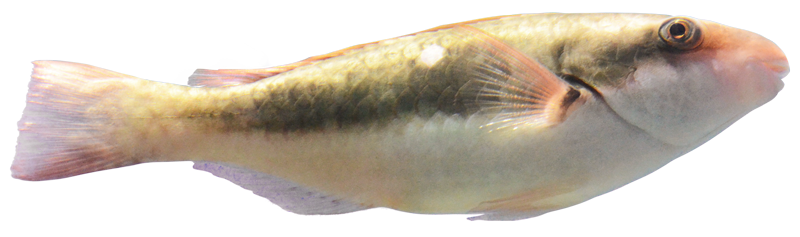
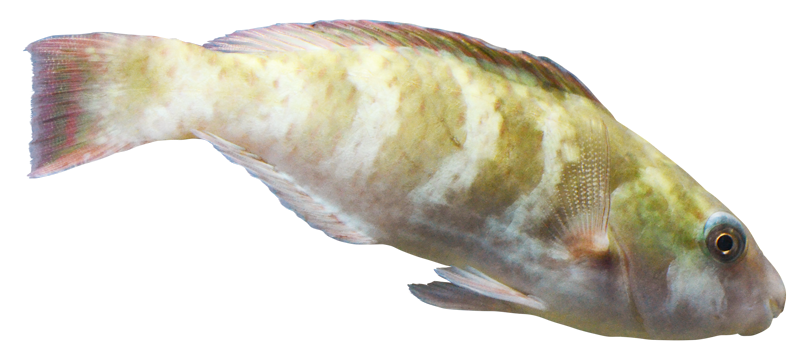
Scarus schlegeli (Bleeker, 1861)
サンゴ礁に適応した性転換魚
Sex-Changing Fish Adapted to Coral Reefs
オビブダイ Yellowband parrotfish は、体長30〜40cmほどに達するブダイ科の魚で、インド洋東部から太平洋中部にかけての熱帯海域に広く分布します。主にサンゴ礁や岩礁、礁湖(ラグーン)に生息し、岩やサンゴに付着した藻類を主食としつつ、小型の甲殻類なども捕食します。ブダイ類は板状に癒合した丈夫な歯を持ち、基質ごと削り取るようにして餌を摂るのが特徴です。
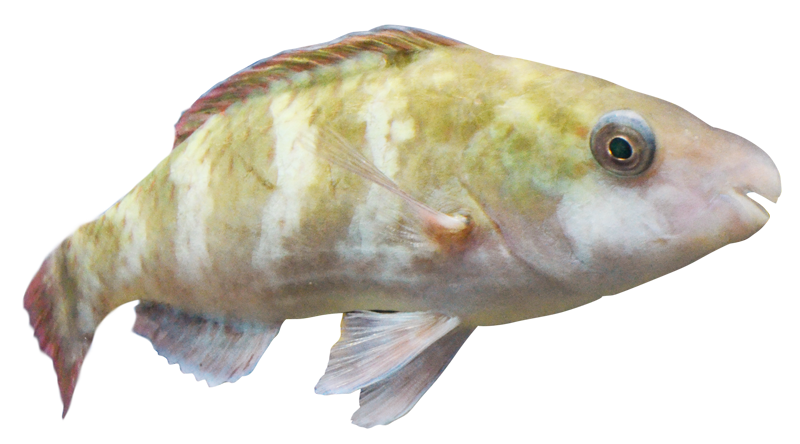
体形はやや楕円形で、雌雄によって体色が大きく異なります。雄は濃い青色を基調とし、体後半に淡い青色の帯が1本入るのに対し、雌は茶褐色の体に淡色の帯が4本見られます。こうした横帯模様が和名の由来となっています。かつてはこの顕著な性的二形のため、雌は別種と考えられ、「クロスジブダイ」として扱われていました。
また本種を含むブダイ類の多くは、成長に伴い雌から雄へと性が変化し、1匹の雄と複数の雌からなる群れをつくります。雄がいなくなると、群れの中で最も大きい雌が雄へと変化します。この性転換の時期は一定ではなく、群れの構成や個体数、さらには漁獲などの影響によっても変化することが知られています。こうした仕組みは、捕食や環境変動によって個体の入れ替わりが生じやすいサンゴ礁においても、安定して繁殖を維持するための適応と考えられています。
The Yellowband parrotfish is a member of the parrotfish family, reaching about 30–40 cm in length, and is widely distributed from the eastern Indian Ocean to the central Pacific. It inhabits coral reefs, rocky reefs, and lagoons, where it primarily feeds on algae attached to rocks and corals, while also consuming small crustaceans. Like other parrotfishes, it possesses strong, beak-like dental plates formed by fused teeth, enabling it to scrape food off the substrate.
Its body is somewhat oval in shape, and there is a marked difference in coloration between males and females. Males are predominantly deep blue, with a single pale blue band on the posterior part of the body, whereas females are brownish with four pale bands. These horizontal bands give rise to its Japanese name. Due to this pronounced sexual dimorphism, females were once considered a separate species and were referred to as “Kurosuji-budai.”
Many parrotfishes, including this species, change sex from female to male as they grow, forming groups consisting of a single male and multiple females. When the male disappears, the largest female in the group transforms into a male. The timing of this sex change is not fixed and is known to vary depending on group composition, population density, and even fishing pressure. This mechanism is considered an adaptation that allows stable reproduction to be maintained in coral reef environments, where individuals are frequently lost due to predation and environmental disturbances.
参考文献
東京都島しょ農林水産総合センター | 伊豆・小笠原諸島の魚 | ブダイ 2025年1月19日閲覧
“Scarus schlegeli (Bleeker, 1861) Yellowband parrotfish” FishBase. 2025年1月19日閲覧
WEB魚図鑑 | オビブダイ 2025年1月19日閲覧