
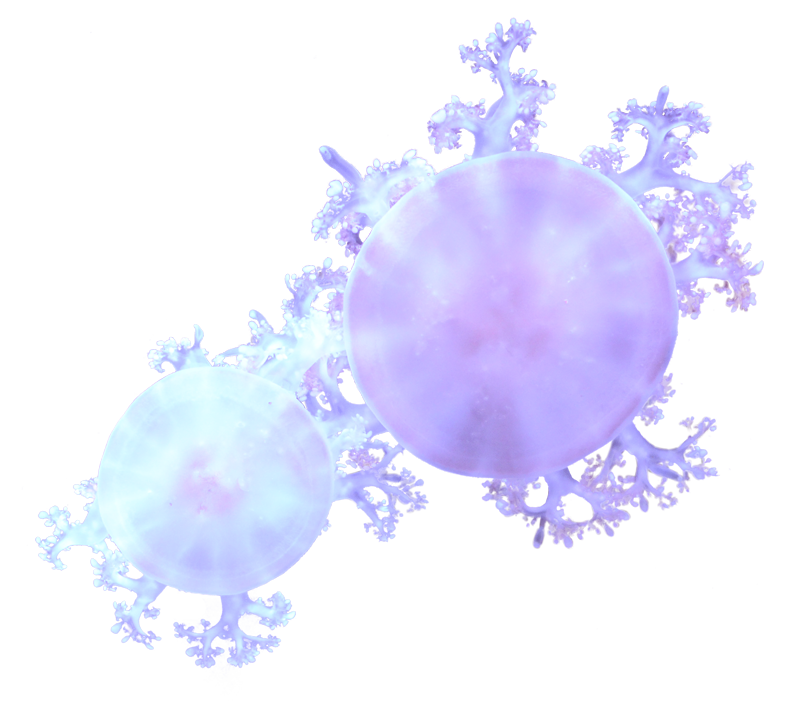
Cassiopea ornata (Haeckel, 1880)
クラゲは眠るのか?
Do Jellyfish Sleep?
サカサクラゲは傘径10〜12cmほどになるクラゲの仲間で、世界中の熱帯・亜熱帯域の穏やかな浅海に広く分布しています。一般的なクラゲは傘を上にして漂いますが、本種はその名の通り、傘を下にして海底付近で逆さに生活する特異な習性を持っています。砂地に横たわるように静止し、樹枝状に分かれた口腕を上方へ広げる姿が特徴です。
この逆立ちした姿勢は、体内に共生する褐虫藻と深く関係しています。褐虫藻は植物のように光合成を行い、その際に生み出された栄養分の一部をサカサクラゲが利用しています。褐虫藻は口腕周辺に多く存在するため、太陽光を効率よく受けられるよう、口腕を上に向けて生活していると考えられています。そのため本種は、水流が弱く日当たりの良い浅海域を好みます。一方で、プランクトンや有機物も取り込み、光合成だけに頼らず生活しています。
傘は扁平で中央がややくぼみ、水族館ではガラス面に吸い付くように付着している姿を見かけます。しかし自然界では岩や砂地に接して生活することが多く、水槽特有の展示風景といえるでしょう。
近年の研究では、サカサクラゲが夜間に活動を低下させ、刺激への反応も鈍くなる「睡眠様状態」を示すことが明らかになりました。クラゲ類は脳を持たない原始的な動物ですが、そのような生物にも睡眠に似た現象が存在することは、睡眠の進化的起源を考える上で注目されています。
The upside-down jellyfish is a species of jellyfish with a bell diameter of about 10–12 cm, widely distributed in tropical and subtropical shallow waters around the world. While most jellyfish drift with their bell facing upward, this species lives inverted on the seafloor with its bell facing downward. It typically rests on sandy bottoms, spreading its branched oral arms upward like the roots of a plant.
This unusual posture is closely related to the symbiotic dinoflagellates, known as zooxanthellae, living within its body. These microscopic algae perform photosynthesis and provide part of the nutrients used by the jellyfish. Because many of the zooxanthellae are concentrated in the oral arms, the jellyfish exposes them to sunlight as efficiently as possible by remaining upside down. For this reason, upside-down jellyfish prefer calm, sunlit shallow waters. However, they do not rely solely on photosynthesis and also capture plankton and organic matter as food.
The bell is flattened with a slightly concave center, and in aquariums they are often seen attached to the glass like suction cups. In the wild, however, they are usually found resting on sand or rocks, making this a characteristic aquarium scene.
Recent studies have shown that upside-down jellyfish enter a sleep-like state at night, during which their activity decreases and their responses to stimuli become weaker. Jellyfish belong to the cnidarians, an ancient animal group that diverged from other animals more than 700 million years ago and lack a true brain. The discovery that such primitive animals display sleep-like behavior is considered important for understanding the evolutionary origins and biological role of sleep.
参考文献
黒潮生物研究所 | Web図鑑 黒潮の生き物たち | サカサクラゲ 2025年2月2日閲覧
男鹿水族館 | 生き物たち | サカサクラゲ 2025年2月2日閲覧
海遊館 | ブログ「海遊館日記」 | 裏側シリーズ | (2016年2月27日) 2025年2月2日閲覧
金谷 啓之, 伊藤 太一「刺胞動物を用いた概日リズム・睡眠研究」時間生物学 Vol. 28, No. 2 (2022) p87 – 93. 2025年2月2日閲覧