
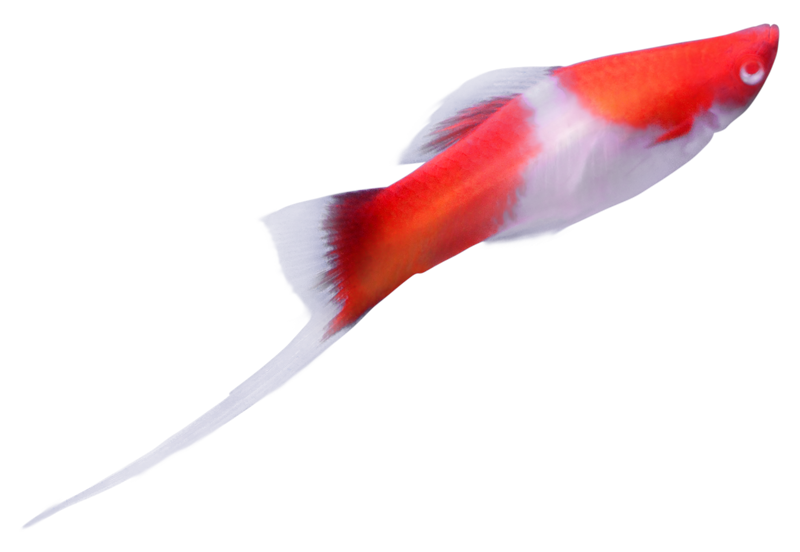
Xiphophorus hellerii (Heckel, 1848)
性転換で議論が続く熱帯魚
The Tropical Fish at the Center of a Sex-Change Debate
メキシコからグアテマラにかけての中米原産の淡水魚です。グッピーやプラティと同じカダヤシ科に属し、体内で受精した卵を孵化まで育てて稚魚を産む卵胎生魚として知られています。雄の体長は6〜7cmほどで、尾びれ下葉から伸びる細長い突起を含めると全長は12cm前後になります。この剣のような尾びれが名前の由来で、英名の「Swordtail」も同じ特徴にちなみます。
ソードテールは長年、「性転換する魚」として知られてきました。きっかけとなったのは、メスとして生活していた個体が後になって雄の特徴を示し、繁殖に参加したという報告です。1970年代には実際に、仔魚を産んだ後に雄として機能した個体が報告され、性転換の研究材料として注目を集めました。
しかしその後の研究により、ソードテールには成熟の早い雄と遅い雄が存在することが明らかになりました。成熟の遅い雄は長期間メスによく似た姿で成長し、十分に大きくなってから剣状の尾びれや交接器を発達させます。そのため、かつて性転換と考えられた現象の多くは「成熟の遅い雄」で説明できる可能性が高いとされています。一方で、過去に報告された一部の事例については現在も議論が続いており、本種の性決定機構には未解明な部分が残されています。
丈夫で繁殖が容易なため、ソードテールは古くから観賞魚として親しまれ、多くの改良品種が作出されてきました。原種はオリーブグリーンの体色に赤褐色の縦帯を持ちますが、赤、黄、白、黒など多彩な品種が知られています。中でも紅白ソードテール(ルビーアイ)はアルビノ系統の品種で、赤い目と紅白の鮮やかな体色が特徴です。美しい観賞魚であると同時に、魚類の性の仕組みを探る研究材料としても興味深い存在です。
The Green Swordtail (Xiphophorus hellerii) is a freshwater fish native to Mexico and Guatemala. It belongs to the family Poeciliidae, the same group as guppies and platies, and is a livebearing species that gives birth to fully developed fry after internal fertilization. Males typically reach 6–7 cm in body length, but their total length can approach 12 cm when the elongated lower lobe of the tail fin is included. This sword-like extension gives the species both its common name and its distinctive appearance.
For many years, the Green Swordtail was known as a fish that could change sex. This idea originated from reports of individuals that appeared to live as females before later developing male characteristics and participating in reproduction. During the 1970s, researchers even documented fish that had produced offspring and were later observed functioning as males, attracting considerable attention from scientists studying sexual development.
Subsequent research, however, revealed a more complex explanation. Green Swordtails possess both early-maturing and late-maturing males. The latter may resemble females for extended periods before eventually developing a gonopodium and the characteristic sword-shaped tail. As a result, many cases once interpreted as sex reversal are now believed to represent delayed male maturation. Nevertheless, some historical observations remain difficult to explain completely, and aspects of the species’ sex-determination system continue to be investigated.
Because of their hardiness and ease of breeding, Green Swordtails have long been popular aquarium fish. Numerous color varieties have been developed through selective breeding, including red, yellow, white, and black forms. The wild type displays an olive-green body marked with reddish-brown longitudinal stripes. One particularly striking variety is the Ruby Eye Swordtail, an albino strain characterized by bright red eyes and a vivid red-and-white coloration. Beautiful and easy to keep, the Green Swordtail is also a fascinating species that continues to contribute to our understanding of the diversity of reproductive biology in fishes.
参考文献
坂本 真衣, 小山 千里, 小池 啓一 (2011) 「ソードテールフィッシュXiphophorus helleriの生殖腺の発達と二次性徴」 群馬大学教育学部, pp77–90. 2025年3月22日閲覧
おさかなオンライン | INFORMATION | メスがオスになる? | (2023年11月24日) 2025年3月22日閲覧
アルプスあづみの公園 | あづみのブログ | 紅白ソードテール | (2023年1月4日) 2025年3月22日閲覧
All Aboout 趣味 | 熱帯魚オンライン図鑑 | ルビーアイ・紅白ソードテール | 長谷川 秀樹 (2011年1月10日) 2025年3月22日閲覧