
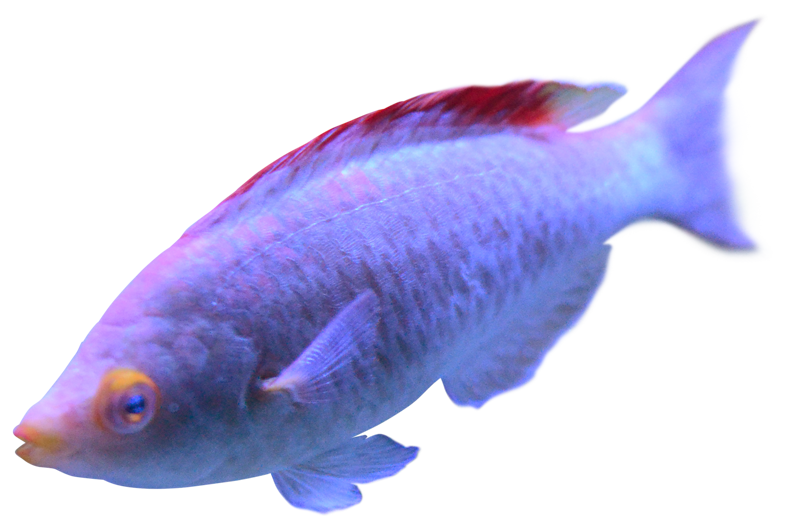
Cirrhilabrus cyanopleura (Bleeker, 1851)
多彩で識別が難しいイトヒキベラ
A Highly Variable and Hard-to-Identify Fairy Wrasse
体長10〜15cm程度に達する小型のベラ科魚類で、インド太平洋の熱帯域に広く分布します。日本では主に琉球諸島以南で見られ、南はオーストラリア北部のグレートバリアリーフに至るまでのサンゴ礁や岩礁域に生息します。外洋に面した礁斜面や礁湖内のガレ場など、水深数mから20m前後の比較的浅い場所で、単独または小さな群れで遊泳しながら生活し、日中は動物プランクトンや小型甲殻類を捕食して活発に採餌を行います。夜間は岩陰などに身を潜めて休息する習性を持ちます。
体はやや側扁した紡錘形で、吻は短く丸みを帯びます。成魚のオスは鮮やかな体色を示し、頭部はオリーブ色から青色に変化し、体側後半は赤紫色からワインレッド色を帯び、腹部は淡色となります。眼の周囲に赤橙色の縁取りが現れる点も特徴です。一方、メスは全体に茶褐色で細かな淡色斑が散在し、腹部はやや白っぽくなります。幼魚は赤褐色を基調とし、成長に伴って徐々に雌の体色へ移行しますが、これらの段階では近縁種と非常によく似ており、外見からの識別は容易ではありません。
本種は雌から雄へと性転換する雌性先熟の性質を持ち、成長や社会構造の変化に応じて体色も連続的に変化します。そのため、雌・若魚・移行個体の区別は曖昧で、最終的にはオスの発色パターンが同定の重要な手がかりとなります。ただしオスの体色にも個体差や地域差が見られ、例えば胸部に黄色斑が入るタイプなどが知られ、分類学的な再検討が進められています。
The Blueside wrasse is a small member of the wrasse family, reaching about 10–15 cm in length, and is widely distributed throughout the tropical Indo-Pacific region. In Japan, it is mainly found south of the Ryukyu Islands, extending as far as the Great Barrier Reef in northern Australia. It inhabits coral and rocky reefs, particularly along outer reef slopes exposed to oceanic currents and rubble areas within lagoons. It is typically found at relatively shallow depths, from a few meters down to around 20 meters, where it lives solitarily or in small groups, swimming actively while foraging during the day on zooplankton and small crustaceans. At night, it rests concealed among rocks or crevices.
The body is moderately compressed and fusiform, with a short, rounded snout. Adult males display striking coloration: the head shifts from olive to blue, the posterior half of the body ranges from reddish-purple to wine-red, and the underside is pale. A reddish-orange ring around the eye is also characteristic. Females, in contrast, are generally brownish with fine pale spots scattered across the body and a lighter underside. Juveniles are primarily reddish-brown and gradually transition to the female coloration as they grow; however, at these stages they closely resemble related species, making visual identification difficult.
This species is protogynous, undergoing sex change from female to male. As individuals grow or social structures shift, their coloration changes continuously, making it difficult to clearly distinguish between females, juveniles, and transitional individuals. Ultimately, the coloration pattern of terminal-phase males provides the most reliable basis for identification. However, even males exhibit individual and geographic variation; for example, some populations are known to display a yellow patch on the chest, and such differences are currently the subject of ongoing taxonomic re-evaluation.
参考文献
“Cirrhilabrus cyanopleura” Reef Life Survey. 2025年3月20日閲覧
Cabanban, A. & Choat, J.H. 2010. Cirrhilabrus cyanopleura. The IUCN Red List of Threatened Species 2010: e.T187544A8563582. 2025年3月20日閲覧
海と島の雑貨屋さん | Fishes of Minna Island – 水納島の魚たち – | クロヘリイトヒキベラ 2025年3月20日閲覧