
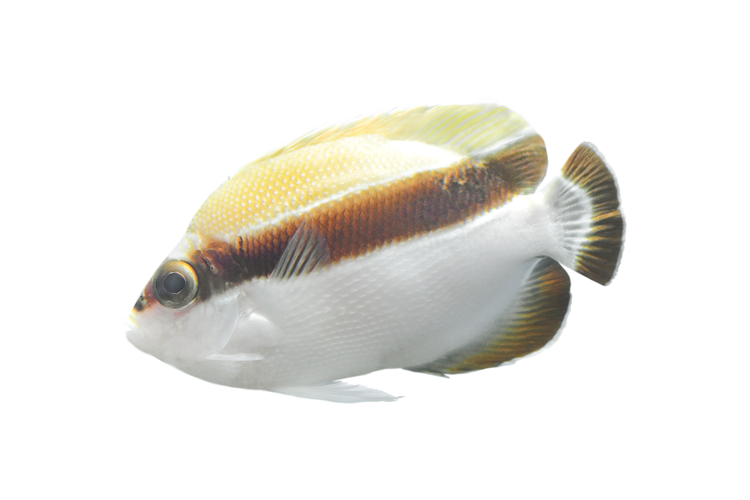
Apolemichthys arcuatus (Gray, 1831)
ハワイの孤立が生んだ美しい縞模様
A Striking Banded Beauty Born of Hawaiian Isolation
体長18cm。ハワイ諸島とジョンストン環礁周辺に分布するキンチャクダイ科の海水魚です。岩礁やサンゴ礁の斜面に生息し、岩棚や張り出した岩、洞窟などの周辺で見られます。比較的深い場所を好み、通常は水深12~50mほどで見られますが、183mという深所からも記録されています。ハワイ諸島の限られた海域に暮らす固有性の高い魚です。
真珠のような白色の体に、眼の前方から背びれの後方まで伸びる太い黒色の帯が入り、尾びれと臀びれにも黒い帯が現れます。この鮮明な白黒模様は非常に特徴的で、英名「Banded Angelfish」の由来にもなっています。ハワイ諸島の魚類をまとめた資料では、本種は近縁種とは大きく異なる独特の体色や斑紋をもつ魚として紹介されており、その外見は分類学的にも興味深い特徴とされています。島嶼環境に長く隔離されてきたハワイの魚類相を考えるうえでも興味深い存在です。
食性では海綿類への依存が大きく、岩肌に付着した海綿をついばむように食べます。海綿のほかにもホヤ類などを利用するとされ、こうした特殊な食性も飼育を難しくする要因です。
観賞魚としても知られていますが、流通する個体は少なく、入荷時には高価になりやすい魚です。深場に生息することに加え、海綿を主体とした餌を継続的に必要とするため、飼育難度は高く、初心者向けではありません。安定した水質や十分な隠れ場所、適切な餌を用意する必要があります。野生では深い岩礁の陰にひっそりと暮らし、観賞魚としても容易には手に入らないことから、その希少性もまた本種の魅力となっています。
Reaching 18 cm in length, the Banded Angelfish is a marine fish in the family Pomacanthidae found around the Hawaiian Islands and Johnston Atoll. It inhabits rocky reefs and coral reef slopes, often around ledges, overhanging rocks, and caves. It prefers relatively deep water, usually occurring at depths of 12–50 m, although it has also been recorded as deep as 183 m. With its restricted range around the Hawaiian Islands, it is a highly localized species.
Its pearly white body is marked by a broad black band extending from the front of the eye toward the rear of the dorsal fin, while additional black bands occur on the caudal and anal fins. This striking black-and-white pattern is highly distinctive and gives the fish its English name, “Banded Angelfish.” A checklist of the fishes of the Hawaiian Archipelago notes that the species has unusually distinctive coloration and markings compared with related species, making it of particular interest from a taxonomic perspective. It is also an intriguing member of the distinctive fish fauna that evolved in the isolation of the Hawaiian Islands.
The Banded Angelfish feeds largely on sponges, picking at those attached to rock surfaces. It also consumes organisms such as tunicates. This specialized diet is one of the factors that makes the species difficult to maintain in captivity.
The species is also sought after as an aquarium fish, but specimens are rarely available and can command high prices when they enter the trade. Its deep-water habitat and reliance on sponge-based foods make it a challenging species to keep and unsuitable for beginners. Stable water conditions, ample hiding places, and appropriate food are essential. Living quietly among deep reef structures in the wild and rarely appearing in the aquarium trade, its scarcity is part of what makes this distinctive angelfish so appealing.
参考文献
Froese, R. & Pauly, D. (eds.). FishBase: Apolemichthys arcuatus (Gray, 1831), Bandit angelfish. 2026年9月22日閲覧
Fishkeeper. Bandit Angelfish — Apolemichthys arcuatus. 2026年9月22日閲覧
Baensch, Frank “Bandit Angelfish Culture”Frank Baensch Fish Culture & Photography. 2026年9月22日閲覧
Mundy, B.C., 2005. Checklist of the fishes of the Hawaiian Archipelago. Bishop Mus. Bull. Zool. (6):1-704. 2026年9月22日閲覧