
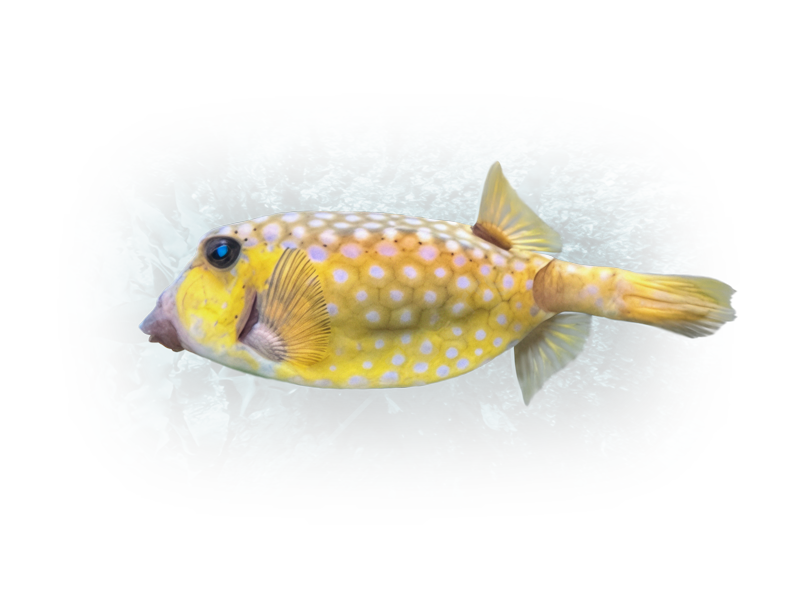
Ostracion immaculatum (Temminck & Schlegel, 1850)
愛らしい箱に秘められた特殊な毒
A Unique Toxin Hidden in an Adorable Box
体長20~25cm。日本近海から東シナ海、台湾周辺に分布し、沿岸の岩礁域やサンゴ礁域に生息するハコフグ科の魚です。黄色味を帯びた体に青い斑点が散りばめられた美しい姿で知られ、観賞魚としても人気があります。体は六角形の骨板が組み合わさった硬い「箱」のような構造で覆われ、この堅牢な外骨格は外敵から身を守る鎧の役割を果たしています。泳ぎは速くありませんが、胸鰭や背鰭、臀鰭を細かく動かして岩陰を自在に移動し、小型甲殻類や多毛類、付着生物、藻類などをついばんで暮らしています。
しかし、本種を語るうえで最も興味深いのは、その特異な毒性です。「フグ=テトロドトキシン」というイメージがありますが、本種はその例外です。ハコフグ類はテトロドトキシンではなく、オストラシトキシン(パフトキシン)という独自の防御毒を含む皮膚粘液を持つことが知られています。 強いストレスや外敵の攻撃を受けると、この毒性物質を放出します。オストラシトキシンは魚類のえらや赤血球に作用し、水中へ拡散すると周囲の魚を死に至らせることもあります。フグ科が持つ神経毒テトロドトキシンとは作用も性質も異なり、ハコフグ科が進化させた独自の化学的防御といえます。なお、人が素手で触れただけで健康被害が生じることはほとんどありません。
一方で、本種は食用による中毒例も報告されています。ただし、その原因は皮膚粘液中のオストラシトキシンではありません。日本ではハコフグを食べたことによる食中毒が発生しており、激しい筋肉痛や横紋筋融解症など、アオブダイ中毒とよく似た症状を示す例が確認されています。原因物質はパリトキシン様毒と考えられていますが、パリトキシンそのものが確認されたわけではなく、その詳細な正体は現在も完全には解明されていません。防御毒とは異なる仕組みによる中毒であり、食物連鎖を通じて毒化すると考えられています。
硬い骨板による「物理的防御」と、オストラシトキシンによる「化学的防御」、さらに食中毒との関わりを持つハコフグは、愛らしい姿の内側に複数の防御戦略を備えた、極めてユニークな魚です。
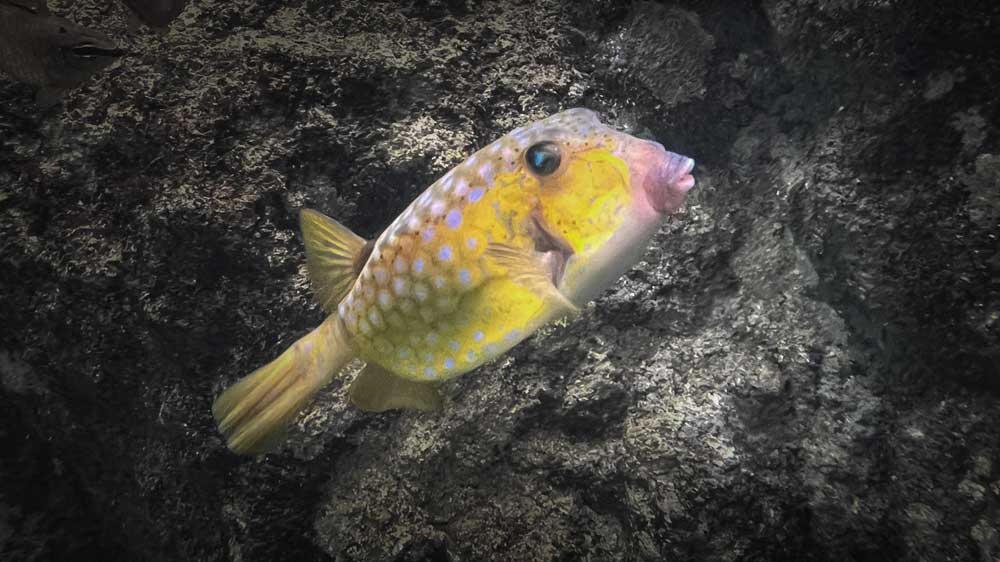
Reaching 20–25 cm in length, the Bluespotted Boxfish is a member of the boxfish family (Ostraciidae) distributed from the waters around Japan to the East China Sea and Taiwan. It inhabits coastal rocky reefs and coral reef areas. Its beautiful appearance, with blue spots scattered across a yellowish body, has made it a popular species among aquarium enthusiasts. The body is covered with a rigid “box-like” armor made of hexagonal bony plates, which serves as protection against predators. Although it is not a fast swimmer, it moves skillfully among rocks by finely controlling its pectoral, dorsal, and anal fins, feeding on small crustaceans, polychaete worms, encrusting organisms, and algae.
However, the most fascinating feature of this species is its unique toxicity. There is a common image that “pufferfish are associated with tetrodotoxin,” but this species is an exception. Boxfishes do not possess tetrodotoxin; instead, they are known to have skin mucus containing a unique defensive toxin called ostracitoxin (pahutoxin). When exposed to severe stress or attacked by predators, they release this toxic substance. Ostracitoxin affects the gills and red blood cells of other fish and can even kill nearby fish when released into the surrounding water. Unlike tetrodotoxin, the neurotoxin found in true puffers, it has a completely different mechanism and represents a unique chemical defense evolved by boxfishes. It should be noted that simply touching the fish with bare hands is unlikely to cause harm to humans.
On the other hand, cases of food poisoning caused by eating this species have also been reported. However, the cause is not ostracitoxin found in the skin mucus. In Japan, poisoning incidents have occurred after consuming boxfish, producing symptoms such as severe muscle pain and rhabdomyolysis, which resemble those caused by parrotfish poisoning. The causative substance is considered to be a palytoxin-like toxin, but palytoxin itself has not been confirmed, and its exact identity remains unresolved. This type of poisoning is thought to occur through a mechanism different from its defensive toxin, with the toxin likely acquired through the food chain.
With its “physical defense” of bony armor, “chemical defense” using ostracitoxin, and its association with food poisoning, the Bluespotted Boxfish is an exceptionally unique fish that possesses multiple survival strategies beneath its charming appearance.
参考文献
厚生労働省 | 生活衛生局食品監視安全課 | 自然毒のリスクプロファイル:魚類:パリトキシン様毒 2026年8月12日閲覧