
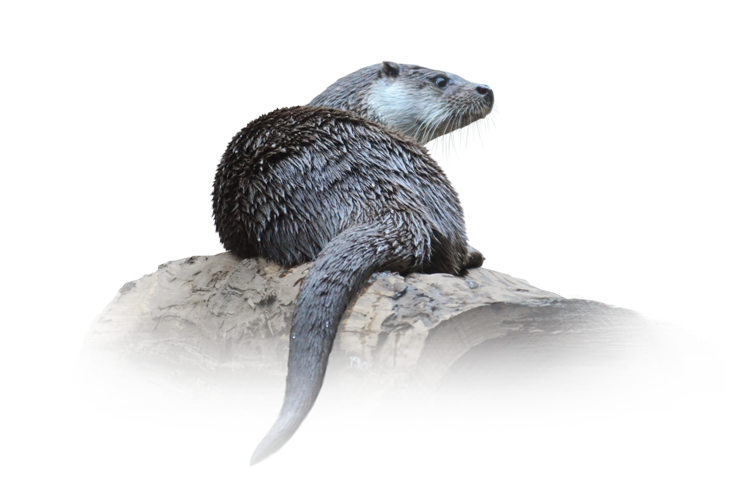
Lutra lutra (Linnaeus, 1758)
カワウソの祭り
The Otter Festival
頭胴長57〜60cm、体重4〜16kg。ツンドラ以南のユーラシア大陸全域とアフリカ北部に分布し、カワウソ類の中でも最も広い分布域を持ちます。河川や湖などの淡水域に加え、湾状の海岸にも生息します。日中は木の洞などで休み、夜になると小魚やザリガニ、カエル、水辺の小型哺乳類や鳥類を探して活動します。
顔には多くのヒゲがあり、感覚器として機能することで、暗く濁った水中でも獲物を探すことができます。他のカワウソとの識別点は鼻にあり、正面から見た黒い鼻の輪郭が王冠形になるのが特徴です。鼻孔は潜水時に閉じることができ、平たく長い尾は舵の役割を果たします。さらに、5本の指の間に発達した水かきを持つことで大きな推進力を得て、水中を自在に泳ぎ回ります。器用な前肢には鋭い鉤爪があり、捕らえた獲物をしっかりと保持します。
このような適応により高い捕食能力を持ち、1日に1.0〜1.5kgの餌を摂取します。捕らえた魚を食べずに岸辺に置いたままにしたり、腹部のみを食べて食い散らかすことがあり、並べられた魚が供物のように見えることから、「獺祭(だっさい)」という言葉が生まれました。「獺祭」は漢字で“獺(カワウソ)の祭り”と書き、この様子に由来します。この語は転じて、多くの書物を並べて調べ物をする様子も指します。
現在、日本にはカワウソは生息していません。かつてはニホンカワウソが分布していましたが、1979年の目撃を最後に絶滅したと考えられています。ニホンカワウソはユーラシアカワウソと同系統とされてきましたが、1977年に高知県で得られた標本のミトコンドリアDNA解析により、日本固有の種または亜種である可能性が高いことが示されました。一方で神奈川県産の標本はユーラシアカワウソ系統に属する結果が得られており、日本には複数系統が存在した可能性が示唆されています。近年、高知県や長崎県対馬での目撃例も報告されており、完全な絶滅については議論が続いています。
Head-body length 57–60 cm, weight 4–16 kg. The Eurasian otter is distributed across the entire Eurasian continent south of the tundra, as well as North Africa, making it the most widely distributed of all otter species. It inhabits not only freshwater environments such as rivers and lakes, but also sheltered coastal areas. During the day, it rests in tree hollows and similar refuges, becoming active at night to hunt small fish, crayfish, frogs, and small mammals and birds along the water’s edge.
Its face is equipped with numerous whiskers that function as sensory organs, enabling it to detect prey even in dark or murky water. A key feature distinguishing it from other otters is the shape of its nose: when viewed from the front, the outline of the black nose resembles a crown. Its nostrils can close tightly during dives, and its long, flattened tail serves as a rudder. In addition, the well-developed webbing between its five toes provides powerful propulsion, allowing it to swim freely underwater. Its dexterous forelimbs bear sharp claws that firmly grasp captured prey.
With these adaptations, it is a highly efficient predator, consuming 1.0–1.5 kg of food per day. It sometimes leaves captured fish uneaten on the riverbank, or feeds only on the abdomen and scatters the remains. The sight of fish arranged along the shore like offerings is said to have given rise to the Japanese term “Dassai,” written with characters meaning “otter festival.” The term later came to describe a person who spreads out many books while conducting research.
Today, otters no longer inhabit Japan. The Japanese otter once lived there, but is believed to have gone extinct after the last confirmed sighting in 1979. Although it was long considered to be closely related to the Eurasian otter, mitochondrial DNA analysis of a specimen obtained in Kochi Prefecture in 1977 suggests it may have been a distinct species or subspecies endemic to Japan. Meanwhile, a specimen from Kanagawa Prefecture has been identified as belonging to the Eurasian otter lineage, indicating that multiple lineages may once have coexisted in Japan. In recent years, sightings have been reported in Kochi and on Tsushima Island in Nagasaki Prefecture, leaving the question of its complete extinction open to debate.
参考文献
よこはま動物園ズーラシア | 動物紹介 | ユーラシアカワウソ 2026年4月26日閲覧
上野動物園 | 上野動物園の生き物 | ユーラシアカワウソ 2026年4月26日閲覧
サイエンスポータル | ニュース | ニホンカワウソは日本固有の生き物だった DNA解析で判明 | (2016年3月10日) 2026年4月26日閲覧
TCA東京ECO動物海洋専門学校 | カワウソの種類や特徴、習性|ペットにできない理由も解説 | (2026年1月30日) 2026年4月26日閲覧
朝日新聞withnews | 記者に届いた〝ニホンカワウソ〟出没情報 絶滅したはずなのに?| 湯川うらら(2021年9月11日) 2026年4月26日閲覧