
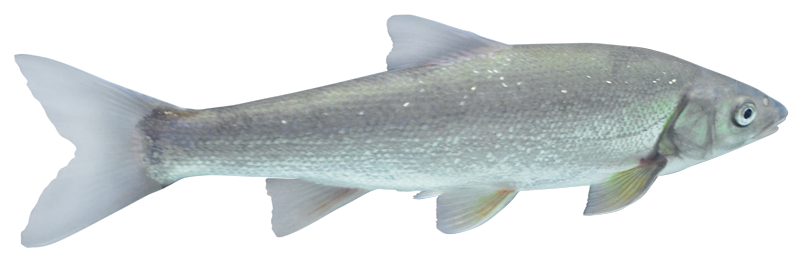
Tribolodon hakonensis (Günther, 1877)
海と川を行き来するコイの仲間
An Amphidromous Carp Relative
体長は最大で30cmほど。コイ科に属する淡水魚で、日本では北海道から本州・九州まで広く分布しますが、四国では分布が限られ、琉球列島には生息していません。国外では南千島、サハリン、アムール川流域、さらに沿海州から朝鮮半島東岸にかけて分布します。日本産コイ科魚類の中でも特に分布域が広く、河川の上流域から中・下流、湖沼、さらには汽水域にまで生息し、地域によっては海へ下る両側回遊性の個体群も知られています。
体はやや細長く側扁し、全体に暗色で腹部は銀白色を帯びます。鱗は比較的大きく、側線は明瞭です。3〜5月の繁殖期には雌雄ともに体側に鮮やかな赤色の帯状模様が現れ、特にオスでは頭部に追星(おいぼし)が発達します。産卵は流れのある浅瀬の礫底で行われ、群れで集まり活発に行動する様子が観察されます。食性は雑食性で、水生昆虫や藻類、小型甲殻類のほか、有機物や小魚なども幅広く捕食します。
和名は「鯎」などと表記されることがありますが、一般的な漢字表記は一定していません。名称の由来には諸説あり、古語「イグイ」に遡り、細身の体形が祭祀に用いる神聖な杭「斎杭(いくい)」に似ることから転じたとする説が有力とされています。各地の河川で普通に見られる身近な魚であり、地域によっては釣りや食用の対象としても親しまれるなど、人々の生活と関わりの深い種です。
This species reaches a maximum length of about 30 cm. It is a freshwater fish belonging to the carp family (Cyprinidae), widely distributed in Japan from Hokkaido to Honshu and Kyushu, though its occurrence in Shikoku is limited and it is absent from the Ryukyu Islands. Outside Japan, it is found in the southern Kuril Islands, Sakhalin, the Amur River basin, and further south along the Russian Far East to the eastern coast of the Korean Peninsula. Among Japanese cyprinids, it has one of the broadest distributions, inhabiting environments ranging from upper river reaches to middle and lower courses, lakes, and even brackish waters. In some regions, populations exhibit amphidromous behavior, migrating to the sea.
The body is somewhat slender and laterally compressed, generally dark in coloration with a silvery-white underside. The scales are relatively large, and the lateral line is distinct. During the breeding season from March to May, both males and females develop vivid red lateral stripes, while males in particular develop nuptial tubercles (oiboshi) on the head. Spawning takes place over gravel substrates in shallow, flowing water, where groups gather and display active behavior. The species is omnivorous, feeding on a wide range of items including aquatic insects, algae, small crustaceans, organic detritus, and small fish.
The Japanese name is sometimes written with the character “鯎,” though there is no standardized kanji representation. Several theories exist regarding its etymology; a widely accepted one traces it back to the archaic term igui, suggesting that its slender body resembles a sacred stake (ikui) used in ritual practices. Commonly found in rivers throughout Japan, it is a familiar species that has long been associated with human life, and in some regions it is valued both as a food fish and as a target for recreational fishing.
参考文献
日本ウグイ協会 | 学ぶ | ウグイの名前の由来・ルーツとは?-3つの説の解説 | 竹本 純 (2022年9月12日) 2025年4月20日閲覧
太田川河川事務所 | 太田川生物誌 | ウグイ 2025年4月20日閲覧
川のさかな情報館 | 日本産淡水魚一覧 | ウグイ属 2025年4月20日閲覧