
Canthigaster janthinoptera (Bleeker, 1855)
熱帯の海を泳ぐ豆絞りの巾着袋
A Tiny Drawstring Puffer Drifting Through Tropical Seas
全長9〜10cmほどになる小型のフグで、インド西太平洋の熱帯域に広く分布しています。日本では八丈島以南に見られ、水深30m以浅のサンゴ礁域や岩礁域に生息しています。浅い海をゆっくり泳ぐ姿が観察されることも多く、愛嬌のある表情と鮮やかな模様から、ダイバーにも人気の高い種類です。
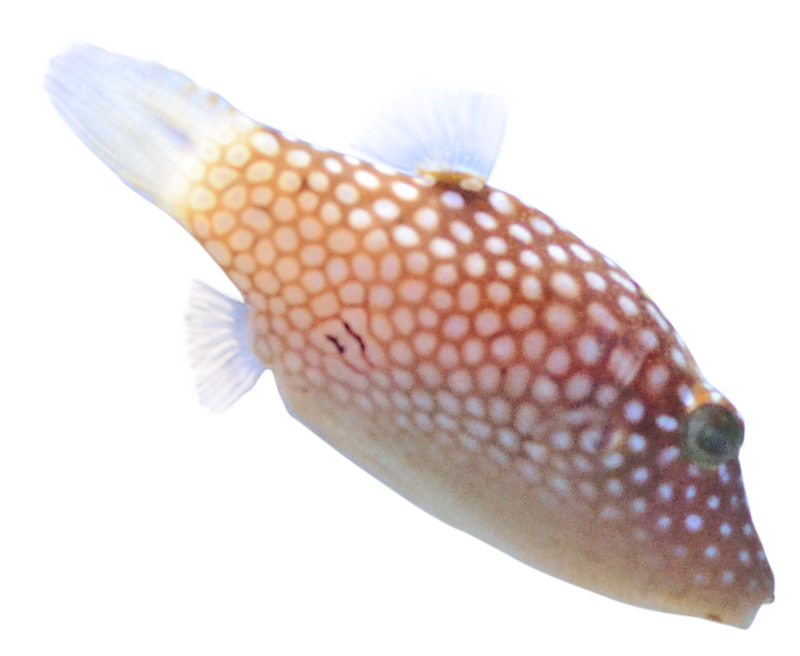
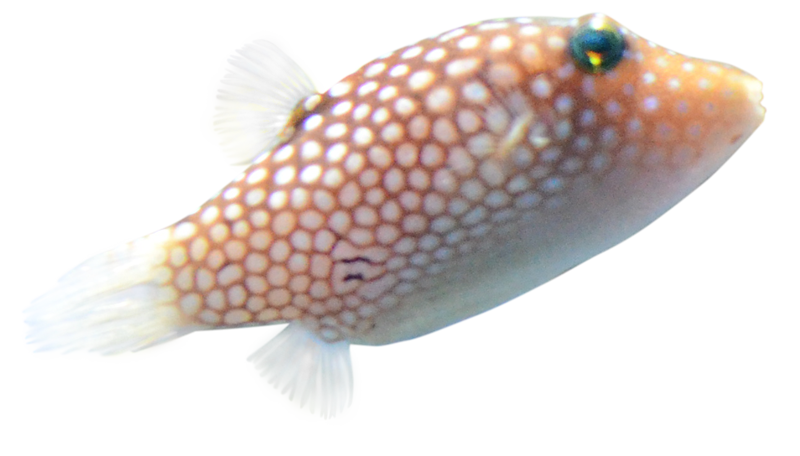
体色は赤褐色で、全身に薄青緑色の小さな斑点が規則的に並びます。この網目状の模様が蜂の巣を連想させることから、英名では「Honeycomb toby」と呼ばれています。和名の「シボリ」は伝統的な豆絞り模様に由来し、「キンチャクフグ」は丸みを帯びた体形を巾着袋に見立てた名前です。近縁種のアラレキンチャクフグとよく似ていますが、本種は尾びれに斑点が少ない、あるいはほとんど見られないことで区別されます。
キンチャクフグ類は小型ながら警戒心が強く、危険を感じると岩陰やサンゴの隙間へ素早く身を隠します。また、皮膚から粘液を分泌することが知られており、外敵に対する防御に役立っていると考えられています。
本種の毒性については詳しく解明されていません。しかし同属のキタマクラは強い毒を持つことで知られ、皮膚にも毒性があります。キタマクラという名前は、食べると命に関わり“北枕になる”ことに由来するともいわれています。近年では近縁種からも毒性が確認されており、シボリキンチャクフグも有毒である可能性が高いと考えられています。そのため、観察時には不用意に触れたり捕食したりしない注意が必要です。
The Honeycomb toby is a small pufferfish reaching about 9–10 cm in length. It is distributed throughout the tropical Indo-West Pacific, and in Japan can be found south of Hachijojima Island. It inhabits shallow coral reefs and rocky reefs at depths of less than 30 meters. With its charming appearance and slow, hovering swimming style, it is a popular species among divers.
Its body is reddish-brown and covered with numerous pale blue-green spots arranged in a honeycomb-like pattern, which gives rise to its English name, “Honeycomb toby.” The Japanese name “Shibori” refers to the traditional dotted tie-dye pattern known as mame-shibori, while “Kinchakufugu” compares its rounded body shape to a drawstring pouch. It closely resembles the related Arare-kinchakufugu, but can generally be distinguished by having few or no spots on the tail fin.
Like other sharpnose puffers, this species is cautious and quickly hides among rocks or coral crevices when threatened. It is also known to secrete mucus from its skin, which may help protect it from predators.
The toxicity of this species has not yet been fully studied. However, its relative the Kitamakura is known to possess strong toxins, including toxins in the skin. The name “Kitamakura” is said to originate from the idea that eating it could be fatal enough to leave one “sleeping with the head facing north,” a traditional orientation associated with the dead in Japan. In recent years, toxicity has also been confirmed in several related species, suggesting that the Honeycomb toby may likewise be poisonous. For this reason, it should not be touched or eaten carelessly.
参考文献
海響館 | 海響館の生き物紹介 | シボリキンチャクフグ 2025年2月2日閲覧
海響館 | 海響館の生き物紹介 | No,010:シマキンチャクフグ 2025年2月2日閲覧
TSURINEWS | 「食べたら死ぬ」で知られる『キタマクラ』は素手で触ることもダメ? | (2020年6月19日) 2025年2月2日閲覧
Froese, Rainer; Pauly, Daniel (eds.). “Species in genus Canthigaster”. FishBase. 2025年2月2日閲覧