
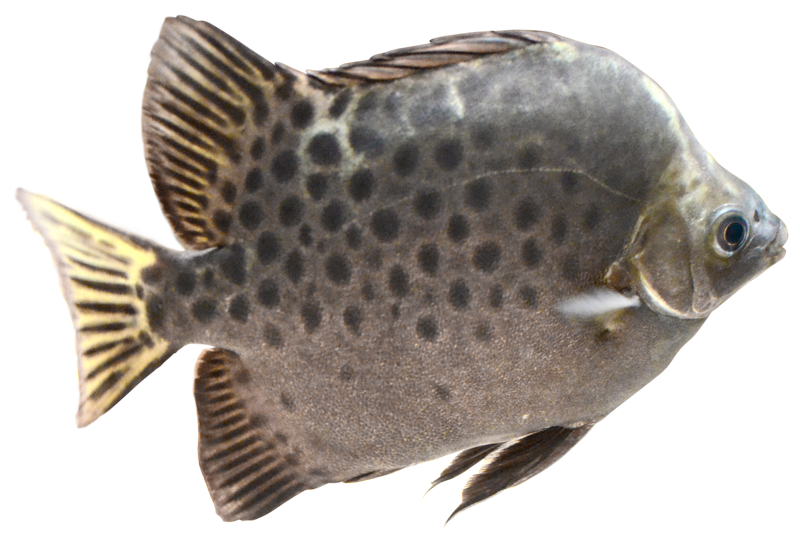
Scatophagus argus (Linnaeus, 1766)
巨人アルゴスの名を冠するマンジュウダイ
A Scat Named After the Giant Argus
体長は最大25cmほどに達するマンジュウダイ科の魚で、インド洋から西太平洋にかけての熱帯・亜熱帯域に広く分布します。日本では主に本州中部以南に見られ、特に河口域や内湾の汽水域、マングローブ周辺など塩分濃度の変化が大きい環境に適応して生息します。幼魚は純淡水域に侵入することもあり、成長に伴ってより塩分の高い場所へ移動する傾向が知られています。
体は強く側扁した円盤状で、銀灰色の地に多数の黒色斑が散在し、この特徴が和名「クロホシマンジュウダイ」の由来となっています。種小名 argus は、ギリシャ神話に登場する「百の目を持つ巨人アルゴス」にちなみ、体表の斑点をその目に見立てたものです。また属名 Scatophagus は「糞を食べるもの」を意味し、実際に本種が藻類やデトリタス、小型無脊椎動物、さらには有機物片などを幅広く摂取する雑食性であることを反映しています。
背びれ・腹びれ・尻びれの棘条には毒腺があり、刺されると強い痛みを伴うため、漁獲時や飼育時の取り扱いには注意が必要です。このため一般的な食用魚としての流通は多くありませんが、地域によっては食用とされるほか、乾燥させて民間薬的に利用される例もあります。一方で、その独特な体形と斑紋の美しさから観賞魚としての人気が高く、水族館やアクアリウムで飼育されることも多い種です。
The spotted scat is a member of the family Scatophagidae, reaching up to about 25 cm in length. It is widely distributed across tropical and subtropical regions of the Indo-Pacific. In Japan, it occurs mainly from central Honshu southward, inhabiting brackish environments such as estuaries, inner bays, and mangrove areas where salinity fluctuates greatly. Juveniles are known to enter freshwater habitats, gradually shifting to more saline waters as they grow.
Its body is strongly laterally compressed and disc-shaped, with numerous black spots scattered over a silvery-gray background—this distinctive pattern giving rise to its Japanese name. The specific epithet argus refers to Argus, the hundred-eyed giant of Greek mythology, alluding to the many თვალ-like spots on its body. The genus name Scatophagus, meaning “dung eater,” reflects its omnivorous feeding habits; the species consumes algae, detritus, small invertebrates, and various organic materials.
The dorsal, pelvic, and anal fins bear short spines equipped with venom glands, and envenomation can cause intense pain, requiring careful handling when caught or kept. For this reason, it is not widely distributed as a food fish, although it is locally consumed in some regions and occasionally used in traditional medicine. Owing to its unique body shape and attractive pattern, it is also popular as an ornamental species and is frequently exhibited in aquariums.
参考文献
“Family SCATOPHAGIDAE Scats” The ETYFish Project. 2025年3月16日閲覧
朝日新聞デジタル | 連載:ネイチャーフォト | 変わった名前の生き物続編:4 | (2022年7月28日) 2025年3月16日閲覧
四万十川財団 | データ | 四万十川の魚 85 クロホシマンジュウダイ | (2020年6月22日) 2025年3月16日閲覧