
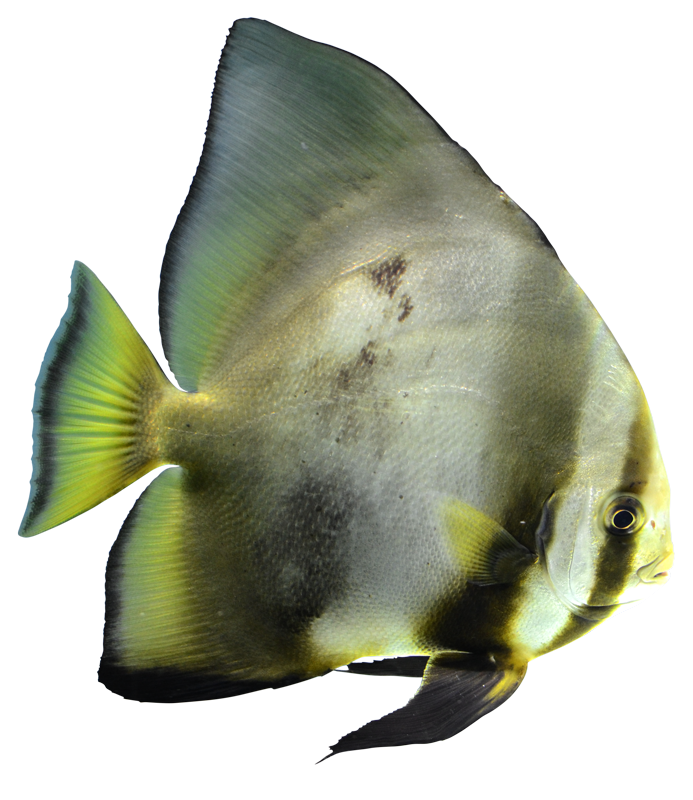
Platax orbicularis (Forsskål, 1775)
枯葉に似る幼魚
Juveniles That Resemble Fallen Leaves
インド洋から西太平洋にかけての熱帯・亜熱帯海域に生息するツバメウオの仲間です。成魚は体長約35cm、最大で45cmほどになり、日本では南西諸島などに分布するほか、季節来遊魚として南日本の沿岸でも見られます。
同じツバメウオ属のアカククリとよく似ていますが、アカククリはナンヨウツバメウオに比べて口先が前方に突き出しているため、成魚でも見分けることができます。しかし、両種の違いがよりはっきり表れるのが幼魚の時期です。ツバメウオの仲間は成長にともなって体形や体色を大きく変化させ、幼魚と成魚ではまるで別の魚のような姿になることが知られています。
ナンヨウツバメウオの幼魚は赤褐色で、体を横に倒すようにして水中を漂い、枯れ葉のように見えることがあります。この特徴は、捕食者から身を守るための枯れ葉への擬態と考えられています。一方、アカククリの幼魚は黒色の体に赤い縁取りをもち、毒をもつヒラムシ類に似た姿をしています。このように、成魚ではよく似ている2種が、幼魚ではそれぞれ異なる対象に似た姿を示します。成長にともなう大きな姿の変化と、幼魚期に見られる巧みな擬態は、ツバメウオ類の興味深い特徴です。
The Orbicular Batfish is a member of the batfish family found from the Indian Ocean to the tropical and subtropical waters of the western Pacific. Adults reach about 35 cm in length, with a maximum of around 45 cm. In Japan, they occur mainly around the Nansei Islands and are also occasionally seen along the coast of southern Japan as seasonal visitors.
They closely resemble the Redtail Batfish, but the two can be distinguished even as adults by the shape of the mouth. The Redtail Batfish has a more protruding snout than the Orbicular Batfish. However, the differences between the two species are much more apparent during their juvenile stages. Batfish are known for undergoing dramatic changes in body shape and coloration as they grow, with juveniles sometimes looking completely different from adults.
Juvenile Orbicular Batfish are reddish brown and may drift through the water while tilted on their side, resembling a dead leaf. This appearance is thought to be an adaptation for avoiding predators by mimicking a fallen leaf. Juvenile Redtail Batfish, on the other hand, have a black body edged in red and resemble toxic flatworms. Thus, although the two species become quite similar as adults, their juveniles resemble entirely different objects or animals. The striking transformation that occurs during growth, together with the sophisticated mimicry displayed by the juveniles, is one of the most fascinating features of batfish.
参考文献
マリンダイビングWeb | 海のいきもの | 第60回アカククリとツバメさんトリオ~前編 | 山本 真紀 (2019年10月), 後編 (2019年11月) 2024年9月22日閲覧
美ら海生き物図鑑 | ナンヨウツバメウオ 2024年9月22日閲覧
海遊館 | ブログ「海遊館日記」 | その後のナンヨウツバメウオ | (2022年4月17日) 2024年9月22日閲覧