
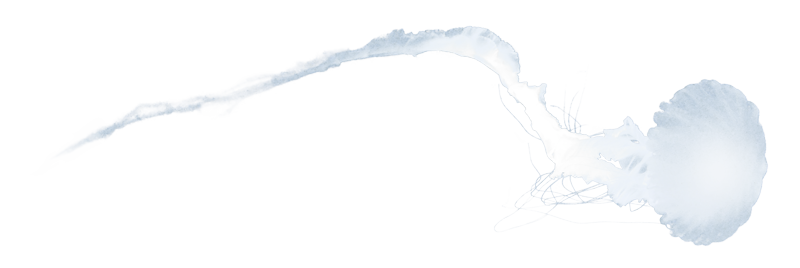
Chrysaora quinquecirrha (Desor, 1848)
触れてはいけない優雅な漂泳者
An Elegant Drifter Not to Be Touched
アトランティックシーネットルは、北米東岸の大西洋沿岸に分布する大型のクラゲで、沿岸域から沖合まで広く見られます。特に春から夏にかけては湾や河口などの汽水域にも出現し、季節的に個体数が増加します。傘の直径は成体で30〜40cmほどに達し、半透明の傘には放射状の模様が見られます。
傘の縁からは多数の長い触手と4本の口腕が伸び、そこには無数の刺胞が密集しています。これらを用いて動物プランクトンや小型の甲殻類、小魚、他のクラゲなどを捕食します。刺胞毒は獲物を麻痺させるのに十分な強さを持ち、人が触れると激しい痛みや炎症を引き起こすことがあります。
本種はポリプ世代とクラゲ世代を持つ生活史を送り、海底に付着するポリプから幼生が放出されることで個体数を増やします。塩分耐性の幅が広く、汽水環境でも生存できることが、本種が湾内で大量発生しやすい要因の一つと考えられています。捕食者は多くありませんが、オサガメやマンボウなどの大型動物には捕食されます。2017年には近縁のベイネットルが別種と判明し、本種はより外洋寄りに分布するクラゲとして整理されています。
The Atlantic sea nettle is a large jellyfish distributed along the Atlantic coast of eastern North America, where it occurs widely from nearshore waters to offshore areas. From spring to summer, it frequently appears in bays and estuaries with brackish water, during which its population size seasonally increases. The bell of an adult typically reaches a diameter of about 30–40 cm and is semi-transparent, often displaying radiating patterns.
Numerous long tentacles extend from the margin of the bell, along with four elongated oral arms. These structures are densely covered with countless nematocysts, which are used to capture prey such as zooplankton, small crustaceans, small fish, and other jellyfish. The venom is sufficiently potent to immobilize prey and can cause intense pain and inflammation when humans come into contact with it.
This species has a life cycle that includes both a polyp stage and a medusa stage. Individuals increase in number when larvae are released from polyps attached to the seafloor. Its relatively broad tolerance to salinity allows it to survive in brackish environments, a trait thought to contribute to its tendency to form blooms within bays. Although it has few natural predators, large animals such as leatherback sea turtles and ocean sunfish do prey upon it. In 2017, a closely related form known as the bay nettle was recognized as a distinct species, and the Atlantic sea nettle is now regarded as a species that is more strongly associated with outer coastal and offshore waters.
参考文献
新江ノ島水族館 | えのすいトリーター日記 | 休館日を経て | (2023年1月27日) 2024年9月21日閲覧
サンシャイン水族館 | ニュースレター | いきものディスカバリー通信vol.2「 クラゲ特集-海⽉空感1周年記念- 」 | (2021年7月5日) 2024年9月21日閲覧
サンシャイン水族館 | いきほめ〜しょん | 癒しの見た目にご注意! 世界の危険なクラゲ5選 | (2022年10月21日) 2024年9月21日閲覧
Chrysaora quinquecirrha — Animal Diversity Web, University of Michigan Museum of Zoology. 2025年12月31日閲覧