
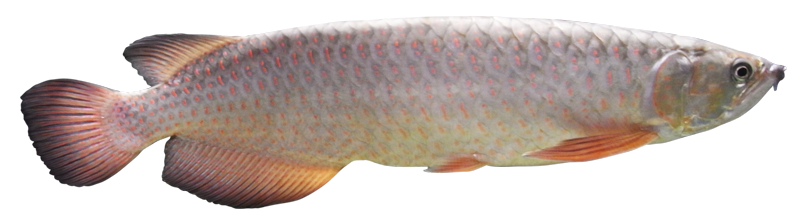
Scleropages formosus (Müller & Schlegel, 1844)
最も高値で取引される観賞魚
The World’s Most Valuable Ornamental Fish
全長約90cmに達する淡水性の古代魚で、進化的に原始的な特徴を色濃く残しています。原産地は東南アジアですが、森林伐採や乱獲の影響により、野生個体は現在ほとんど絶滅したと考えられています。
南米産のアロワナに比べて気性が荒い傾向があり、その堂々とした遊泳姿から観賞魚として非常に高い人気を誇ります。華麗な体形と大きな鱗、上向きの口は伝説上の龍を思わせることから、中華圏では「龍魚」と呼ばれ、特に縁起が良いとされる金色や赤色の体色をもつ個体が好まれます。原産地では政府の管理下にある養殖施設で繁殖された個体のみが輸出され、高値で取引されています。そのため、多くのレストランや高級ホテルではロビーに水槽を設置し、一部の富裕層は自宅で飼育することもあります。
体色の発色や鱗の配列、ヒレの形状など外見的特徴が価格に大きく影響するため、見た目を整える「整形サービス」と呼ばれる処置も登場しました。ただし、これらは正式な獣医学的施術ではなく、ペットショップやベテランブリーダーによる非公式な処置であり、魚の健康や動物福祉の観点から議論があります。
日本では1971年に初めて輸入されましたが、1987年に法整備が進み輸入は禁止されました。その後、1994年から養殖個体に限って輸入が再開され、現在に至っています。主にマレーシア、インドネシア、シンガポールから輸入され、ワシントン条約(CITES)の管理下にあるため、個体識別チップの挿入が義務付けられています。アロワナは富やステータスの象徴とされますが、大型に成長する本種を飼育するには相応の設備と費用が必要です。
The Asian arowana is a freshwater fish reaching a total length of approximately 90 cm and retains many primitive evolutionary characteristics. It is native to Southeast Asia; however, due to deforestation and overharvesting, wild populations are now considered to be nearly extinct.
Compared with South American arowana species, it tends to be more aggressive in temperament and is highly prized as an ornamental fish for its imposing appearance in the water. Its elegant body shape, large scales, and upturned mouth resemble the legendary dragon, which is why it is known as the “dragon fish” in Chinese cultural regions. Individuals displaying auspicious gold or red coloration are especially favored. Only specimens bred in government-regulated aquaculture facilities in their countries of origin are permitted for export, and these fish are traded at high prices. As a result, many restaurants and luxury hotels install arowana aquariums in their lobbies, and some wealthy individuals keep them in private residences.
Because external features such as coloration, scale arrangement, and fin shape strongly influence market value, practices known as “cosmetic services” have emerged to enhance appearance. These procedures, however, are not recognized veterinary treatments and are carried out informally by pet shops or experienced breeders, raising ongoing concerns regarding fish health and animal welfare.
In Japan, the Asian arowana was first imported in 1971, but imports were banned following legal reforms in 1987. Since 1994, imports have resumed but are restricted to captive-bred individuals. Most are imported from Malaysia, Indonesia, and Singapore. As the species is regulated under the Convention on International Trade in Endangered Species of Wild Fauna and Flora (CITES), the implantation of individual identification microchips is mandatory. Although the Asian arowana is regarded as a symbol of wealth and status, maintaining this large-growing species requires substantial facilities and financial investment.
参考文献
アクアライフブログ | 高価&高級な熱帯魚!100万円超えも?淡水魚の中からいろいろ紹介! | (2022年10月31日) 2024年9月21日閲覧
My TOKYO | インドネシア共和国からアジアアロワナが来園 | (2024年7月10日) 2024年9月21日閲覧
ナショナルジオグラフィック | ニュース | 量産される絶滅危惧種アジアアロワナの危険な誘惑 | (2016年7月21日) 2024年9月21日閲覧
東京アクアガーデン | コラム | アロワナの飼育方法とは!費用や難易度、注意点も初心者向けに紹介! | (2024年8月30日) 2024年9月21日閲覧
神畑養魚株式会社「絶滅のおそれのある野生動植物の種の保存に関する法律の在り方について」資料2-1.CITES検討会資料. 環境省 2024年9月21日閲覧
“Want lovelier fins? Pet fish get cosmetic fixes, as owners angle for perfection” (2018, May 26) Local News Singapore. 2025年12月29日閲覧
Crockett, Zachary (2021, January 24) “The crazy market for the world’s most expensive pet fish” HubSpot. 2025年12月29日閲覧