
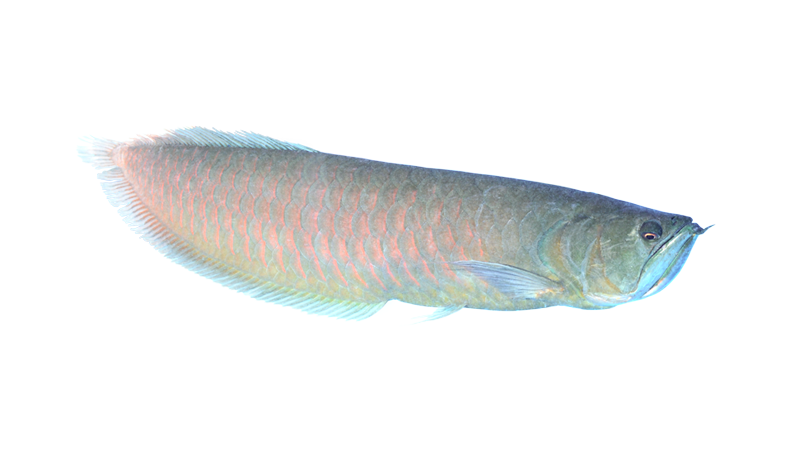
Osteoglossum bicirrhosum (Cuvier ex Vandelli, 1829)
なぜアロワナは世界に散らばったのか
Why Are Arowanas Scattered Across the World?
全長90cmほどに達する大型の淡水魚で、アマゾン川水系を中心に南アメリカに広く分布しています。細長く銀色に輝く体と大きな鱗が特徴で、観賞魚としても高い人気を集めています。アジアアロワナに比べて体が大きく成長する一方、体高は低く、しなやかで柔軟な体を持っています。
主に昆虫や甲殻類、小魚などを捕食しますが、水面上の獲物を狙って高く跳び上がることでも有名です。発達した上向きの口は水面採食に適応したもので、時には水面上の枝に止まった昆虫や小型の脊椎動物を捕らえることもあります。雨季には氾濫した森林へ入り込み、豊富な餌資源を利用します。また繁殖期には雄が口の中で卵や仔魚を保護する「マウスブルーディング」を行い、稚魚が十分に成長するまで見守ります。幼魚は尾部に黄色や橙色を帯びることが多く、成長とともに全身が美しい銀色へと変化していきます。
アロワナ類は白亜紀の地層からも化石が発見されており、その起源は1億年以上前にさかのぼると考えられています。興味深いのは、海を渡れない淡水魚でありながら、近縁種が南アメリカのシルバーアロワナ、アフリカのナイルアロワナ、アジアのアジアアロワナ、オーストラリアのバラムンディアロワナとして離れた地域に分布していることです。
これは、アロワナ類の祖先が南半球に広がっていたゴンドワナ超大陸の時代にすでに存在していたためと考えられています。その後、大陸の分裂に伴って各地の集団が隔離され、それぞれの環境に適応しながら独自の進化を遂げた結果、現在の多様なアロワナ類が誕生しました。シルバーアロワナは、アマゾンを代表する大型魚であると同時に、大陸移動と生物進化の歴史を今に伝える存在でもあります。
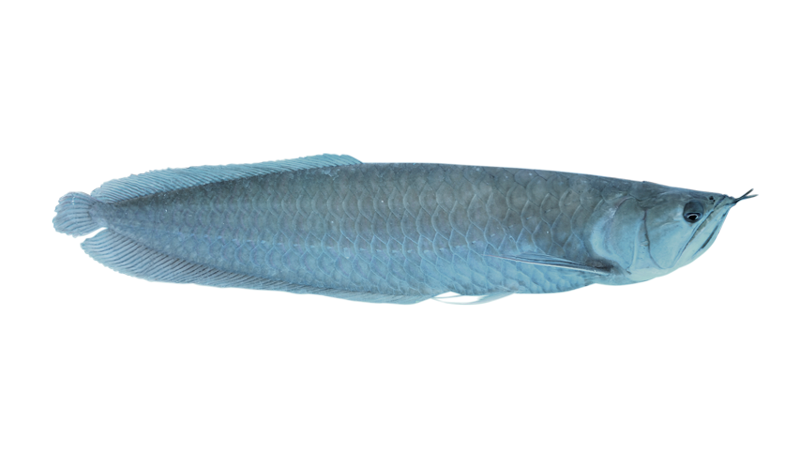
The Silver Arowana is a large freshwater fish that can reach nearly 90 cm in length. It is widely distributed throughout northern South America, particularly within the Amazon River basin. Its elongated body, covered with large silvery scales, gives it a striking appearance that has made it one of the most popular ornamental fishes in the world. Compared with the Asian Arowana, it generally grows larger but has a slimmer and more flexible body.
This species feeds mainly on insects, crustaceans, and small fishes. It is famous for its ability to leap from the water in pursuit of prey. Its upward-facing mouth is highly adapted for feeding at the surface, allowing it to capture insects and even small vertebrates resting on overhanging branches. During the rainy season, Silver Arowanas often move into flooded forests, where abundant food resources become available. Breeding males practice mouthbrooding, carrying eggs and young fry inside their mouths until the offspring are large enough to survive on their own. Juveniles often display yellow or orange coloration in the tail, gradually developing the characteristic silvery body of adults as they mature.
Arowanas belong to an ancient lineage whose fossil record extends back to the Cretaceous Period, more than 100 million years ago. An intriguing aspect of their history is that closely related species occur on widely separated continents: the Silver Arowana in South America, the Nile Arowana in Africa, the Asian Arowana in Southeast Asia, and the Barramundi Arowana in Australia.
This distribution is thought to reflect the existence of ancestral arowanas on the southern supercontinent Gondwana before it broke apart. As the continents drifted apart, isolated populations evolved independently and adapted to their local environments, giving rise to the diverse arowana species alive today. The Silver Arowana is therefore not only one of the iconic fishes of the Amazon, but also a living reminder of continental drift and the long evolutionary history of life on Earth.
参考文献
足立区生物園 | 展示生物 | シルバーアロワナ 2024年9月16日
熊澤 慶伯「淡水魚アロワナが海を挟んで暮らしている理由」『季刊「生命誌」39号』(2003年) 2024年9月16日閲覧
四国新聞社 | 全国ニュース | 世界最古のアロワナ目新種/石川で発見の白亜紀化石 | (2008年11月21日) 2024年9月16日閲覧