
Pomacanthus asfur (Forsskål, 1775)
月の満ち欠けのようなエンゼルフィッシュ
An Angelfish Like the Phases of the Moon
体長約35cmに達するキンチャクダイ科の大型魚で、紅海やペルシア湾、アデン湾、東アフリカ沿岸など、西インド洋のサンゴ礁域に分布します。「アズファー」とも呼ばれ、アラビア語で「黄色」を意味する語に由来します。
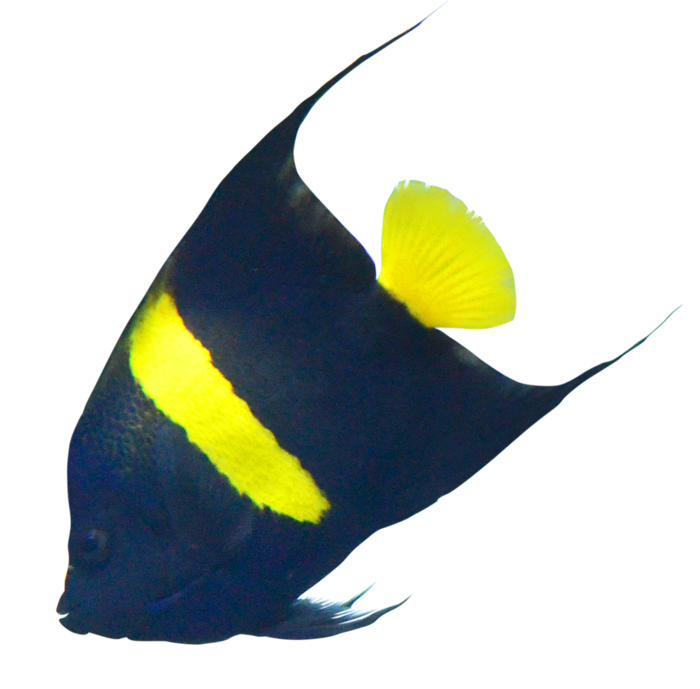
成長に伴う体色変化が顕著で、幼魚は黒地に白と淡青色の横縞を持ちます。この模様はサザナミヤッコの幼魚に酷似しますが、本種では縞の間隔がやや広く、分布域も異なります。成魚になると濃紺の体側に三日月状の大きな黄色斑が現れ、尾びれも黄色となるのが大きな特徴です。
食性は雑食性で、海綿やホヤ類、海藻、甲殻類などを中心に捕食し、貝類をかじることもあります。サンゴ礁内を巡って採餌し、単独またはペアで行動します。縄張り意識が強く、単独個体では攻撃的な一面も見られます。
The Arabian angelfish is a large member of the angelfish family, reaching about 35 cm in length. It is distributed in coral reef habitats of the western Indian Ocean, including the Red Sea, the Persian Gulf, the Gulf of Aden, and the coasts of East Africa. It is also known as “asfur,” a name derived from an Arabic word meaning “yellow.”
This species shows a striking change in coloration as it grows. Juveniles are black with narrow white and pale blue horizontal stripes. This pattern closely resembles that of the juvenile Semicircle angelfish, but in this species the stripes are more widely spaced and its distribution differs. As it matures, the body turns deep blue with a large crescent-shaped yellow marking on the side, and the tail also becomes yellow.
It is an omnivorous species, feeding mainly on sponges, tunicates, algae, and crustaceans, and it may also nip at shellfish. It forages actively within coral reefs and is usually found alone or in pairs. With a strong sense of territory, solitary individuals can sometimes show aggressive behavior.
参考文献
“Pomacanthus asfur (Forsskål, 1775)” Nonindigenous aquatic species. United States Geological Survey. 2025年1月11日閲覧
“Pomacanthus asfur (Fabricius, 1775) Arabian angelfish” Fishbase. 2025年1月11日閲覧
“Highly Underrated Fish – What’s an Asfur (Pomacanthus asfur)” Quality Marine. 2025年1月11日閲覧
“Learning Arabic Colors” University of Wisconsin-madison. 2025年5月17日閲覧