
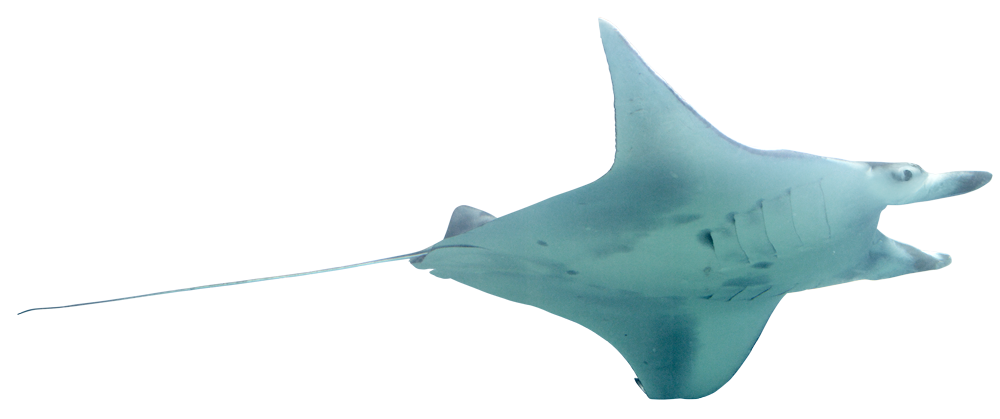
Mobula alfredi (Krefft, 1868)
黒いマントをなびかせて
With Its Black Cloak Billowing
エイの仲間では最大級の大きさになる種類で、体盤幅は4mを超えることがあります。沖縄以南を含むインド・太平洋の温帯から熱帯の海域に生息し、サンゴ礁や島嶼周辺など比較的沿岸性の環境を利用します。かつてはオニイトマキエイ Mobula birostris と同種とされていましたが、形態的な違いなどから2009年に Manta alfredi として再び独立種とされ、現在は Mobula alfredi という学名で呼ばれています。
「マンタ」という名前は、スペイン語の manta(マント、毛布)に由来し、大きく広がった体が布のように見えることから名付けられたとされます。その名のとおり、黒いマントをまとったような姿の個体も存在します。これはメラニン色素が過剰に発現する「メラニズム」と呼ばれる色彩型で、マンタ類ではナンヨウマンタとオニイトマキエイの両方で確認されています。ナンヨウマンタではその頻度に地域差があり、インドネシア東部のラジャアンパットでは40.7%に達したという調査結果もあります。こうした黒色型の個体は「ブラックマンタ」と呼ばれることがあります。
これほど大きな体を持ちながら、主な餌は小さな動物プランクトンです。頭部にある一対の頭鰭を広げ、大きな口から海水とともにプランクトンを取り込み、鰓にある濾過器官で餌をこし取ります。餌が集まる場所では複数の個体が集まり、海面近くを泳ぎながら摂餌する姿も見られます。
繁殖期には、1匹の雌を複数の雄が追いかける「メイティング・トレイン」と呼ばれる行動が見られます。雌が泳ぐ後ろに雄が次々と連なり、長い追跡の末に雌が受け入れた雄が交尾します。交尾の際、雄は雌の胸鰭の先端を口でくわえて体を反転させ、雌と腹面を向かい合わせにします。そして、尾の付け根に一対あるクラスパーと呼ばれる交接器の一方を雌の総排泄腔に挿入し、精子を送り込みます。雄が胸鰭をくわえる行動は雌の体に傷を残すことがあり、ナンヨウマンタでは左胸鰭に傷が集中することが知られています。
One of the largest rays in the world, the Alfred manta can reach a disc width of more than 4 meters. It inhabits tropical and temperate waters of the Indo-Pacific, including waters south of Okinawa, and is often found around coral reefs and islands. It was once considered the same species as the giant oceanic manta ray, Mobula birostris, but was recognized as a separate species in 2009 based on morphological differences and other evidence. It is now known by the scientific name Mobula alfredi.
The name “manta” comes from the Spanish word manta, meaning “cloak” or “blanket,” referring to the broad, cloth-like shape of its body. Fittingly, some individuals appear to be wearing a black cloak. This is a color form known as melanism, in which an excess of melanin produces unusually dark coloration. Melanistic individuals have been documented in both the Alfred manta and the giant oceanic manta ray. The frequency of this color form varies among regions, reaching as high as 40.7% in Raja Ampat, eastern Indonesia. These dark individuals are often called “black mantas.”
Despite its enormous body, the Alfred manta feeds mainly on tiny zooplankton. It spreads its paired cephalic fins and takes in seawater and plankton through its huge mouth, filtering the food with specialized structures in its gills. Where food is abundant, several individuals may gather and feed near the surface.
During the breeding season, several males may follow a single female in a behavior known as a “mating train.” The males line up behind the female, pursuing her until she eventually accepts one of them. During mating, the male grasps the tip of the female’s pectoral fin with his mouth, turns his body over, and positions himself belly-to-belly with her. One of the pair of claspers at the base of his tail is then inserted into the female’s cloaca to transfer sperm. The male’s grip can leave scars on the female’s pectoral fin, and in Alfred mantas, such mating scars are known to occur particularly often on the left pectoral fin.
参考文献
NAUI×ずかんくん | 第4回 ずかんくんコラム「マンタ」| (2023年7月) 2025年3月30日閲覧
ヘレン・スケールズ「魚の自然誌」築地書館 pp.84
oceana | マンタ徹底解説!特徴、生態、見られるダイビングポイント、ウオッチングのコツまで | (2024年2月16日) 2025年3月30日閲覧
MAX DIVE Bali | お魚のおもしろ生態 | ブラックマンタ マンタが黒くなる理由とその謎を解く| (2023年10月17日) 2025年3月30日閲覧
McGrouther,Mark “Manta Ray, Mobula alfredi (Krefft, 1868)” Australian Museum. 2026年9月12日閲覧