
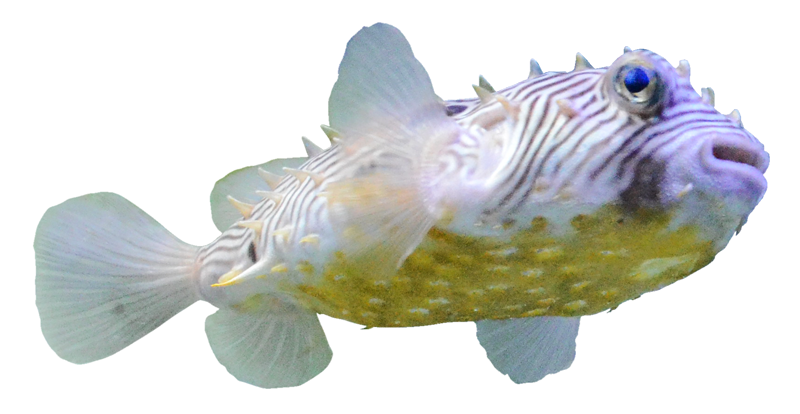
Chilomycterus schoepfi (Walbaum, 1792)
迷路模様に直立する棘
Maze Patterns and Upright Spines
最大全長30cm。西大西洋に分布し、カリブ海やメキシコ湾を中心とした暖かい海の岩礁域や海草藻場に生息しています。フジツボやカニ類、ヤドカリ、貝類などの硬い殻をもつ無脊椎動物を主な餌とし、丈夫なくちばし状の歯で砕いて食べます。
ハリセンボン科の仲間で、頭部から体全体にかけて短く太い棘が密生しています。一般的なハリセンボン類では棘を寝かせたり立てたりできますが、本種の棘は常に直立しているのが特徴です。また、体表には迷路や指紋を思わせる複雑な縞模様が広がり、青緑色に輝く虹彩と半開きの口がどこか愛嬌のある表情をつくり出しています。
泳ぎはあまり得意ではなく、体を大きくくねらせるのではなく胸びれや尾びれを細かく動かしながらゆっくりと移動します。性質は比較的穏やかで、水族館でも他の魚と争うことはあまりありません。しかし外敵に襲われたり強い刺激を受けたりすると、フグの仲間らしく大量の水を飲み込んで体を大きく膨らませます。膨張した体と鋭い棘の組み合わせは、捕食者にとって飲み込みにくい厄介な存在となります。
フグ科の魚の多くはテトロドトキシンという強力な神経毒をもつことで知られていますが、ハリセンボン科の魚では毒性は弱い、あるいはほとんど認められないとされています。その代わり、本種は堅牢な体と無数の棘を発達させることで身を守っているのです。
Reaching a maximum length of about 30 cm, the Striped Burrfish inhabits rocky reefs and seagrass beds in the warm waters of the western Atlantic, particularly around the Caribbean Sea and the Gulf of Mexico. It feeds mainly on hard-shelled invertebrates such as barnacles, crabs, hermit crabs, and mollusks, crushing them with its powerful beak-like teeth.
Like other members of the porcupinefish family, its head and body are covered with short, sturdy spines. Unlike many porcupinefish, however, these spines remain permanently erect rather than lying flat against the body. The fish is also distinguished by intricate maze-like stripes across its skin, iridescent blue-green eyes, and a half-open mouth that gives it a comically expressive appearance.
It is not a strong swimmer and moves slowly by fluttering its pectoral fins and tail rather than undulating its entire body. Generally peaceful in nature, it rarely harasses other fish in aquariums. When threatened or startled, however, it employs the classic defense of pufferfish relatives: rapidly gulping water to inflate its body. Combined with its sharp spines, this swollen form makes it difficult and dangerous for predators to swallow.
Many members of the pufferfish family are famous for possessing tetrodotoxin, a powerful neurotoxin. In contrast, porcupinefishes are thought to have little or no significant toxicity. Instead, the Striped Burrfish relies primarily on its armored body and formidable spines for protection.
参考文献
Striped Burrfish. Animals. National Aquarium. 2024年8月4日閲覧
Striped Burrfish. Department of Natural Resources. Maryland.gov 2024年8月4日閲覧
東京ズーネット | ニュース | ストライプトバーフィッシュの展示 | (2014年1月11日) 2024年8月4日閲覧
国立科学博物館魚類研究室 | 魚さまざま | フグ毒 | 松浦 啓一 2024年8月4日閲覧