
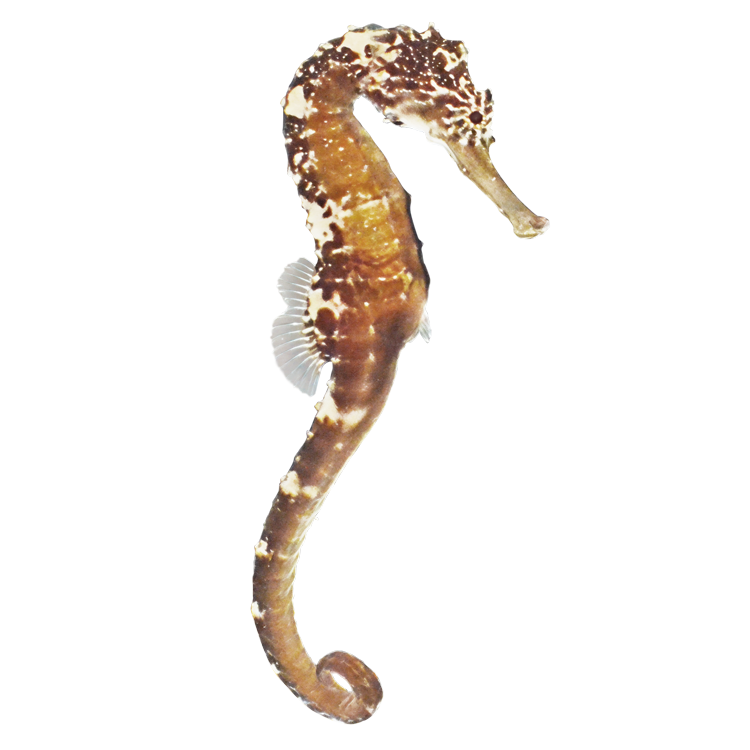
Hippocampus comes (Cantor, 1850)
サンゴ礁で出会うトラとウマ
A Tiger and a Horse Meet in the Coral Reef
体長15cmほど。東南アジア沿岸のサンゴ礁や藻場に生息するタツノオトシゴの仲間です。学名 Hippocampus comes。観賞魚としても人気が高く、近年はベトナムなどで養殖・繁殖された個体が流通しています。体色は固定されておらず、ベージュや黄色、灰色、黒色など、環境や光の加減、状態によってさまざまに変化します。特に長く発達した尾には特徴的な縞模様があり、本種を見分ける大きな特徴となっています。
日中は尾をソフトコーラルや海藻に巻き付け、岩陰やサンゴの間でじっとして過ごすことが多く、夕方から夜間にかけて活発に活動します。泳ぎはあまり得意ではありませんが、尾を巧みに使って流れの中で体を支え、周囲を漂う小型甲殻類や動物プランクトンなどを吸い込むように捕食します。周囲の環境に合わせて体色を変化させることも、本種の魅力のひとつです。
繁殖期にはオスとメスが寄り添うように泳ぐ求愛行動を行い、オスは体色を変化させて相手にアピールします。交尾の際、メスはオスの腹部にある育児嚢(いくじのう)へ数百~2000個ほどの卵を預け、そこで受精が行われます。卵は育児嚢の中で保護されながら成長し、約10~12日後に稚魚として誕生します。出産にあたる役割をオスが担うという繁殖様式は脊椎動物では極めて珍しく、タツノオトシゴ類を代表する特徴のひとつです。本種は、トラを思わせる縞模様の尾とウマに似た頭部をもち、その名の通り二つの哺乳類を連想させる、海の中でもひときわユニークな存在です。
Growing to around 15 cm in length, the Tiger Tail Seahorse is a member of the seahorse family found in coral reefs and seagrass beds along the coasts of Southeast Asia. Its scientific name is Hippocampus comes. It is also popular in the aquarium trade, and captive-bred individuals from countries such as Vietnam are now available. Its body coloration is not fixed, and individuals may appear beige, yellow, gray, or black depending on their surroundings, lighting conditions, and physiological state. The long, well-developed tail has a distinctive striped pattern, which is one of the key features used to identify this species.
During the day, it usually remains motionless among rocks and corals, anchoring itself by wrapping its tail around soft corals or seaweed. Although it is not a strong swimmer, it uses its tail skillfully to hold its position in currents and captures small crustaceans and zooplankton by sucking them into its mouth. It can also change its coloration to blend with its surroundings, adding to its appeal.
During the breeding season, males and females engage in courtship behavior, swimming closely together, and males change their body coloration to attract mates. During mating, the female deposits several hundred to around 2,000 eggs into the male’s brood pouch, where fertilization takes place. The eggs develop safely inside the pouch and hatch after approximately 10–12 days, releasing young seahorses. The fact that males take on the role of giving birth is an extremely rare reproductive strategy among vertebrates and is one of the defining characteristics of seahorses. With a striped tail reminiscent of a tiger and a head resembling that of a horse, this species lives up to its name and represents a truly unique creature of the ocean, evoking the forms of two different mammals.
参考文献
“All about tiger tail Seahorse” The Smiling Seahorse, 2020, August 7. 2025年5月4日閲覧