
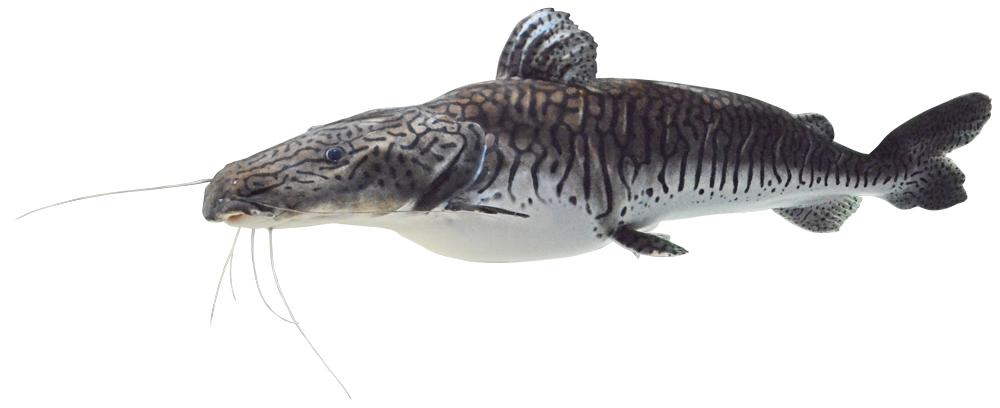
Pseudoplatystoma fasciatum (Linnaeus, 1766)
アジアで作出されるアマゾンの大型ナマズ
An Amazonian Giant Catfish Bred in Asia
南米の大河に暮らす大型ナマズ、タイガーショベルノーズキャットフィッシュ(Barred sorubim)は、アマゾン川やオリノコ川水系などに広く分布する淡水魚です。最大で130〜140cm程度に達することもある大型種で、細長い体と、ショベルのように平たく突き出した頭部が特徴です。この独特な体形は、川底近くを泳ぎながら獲物を探す生活に適応したものと考えられています。暗褐色の体には淡色の帯状模様が入り、その複雑な斑紋は虎の縞模様を思わせ、野性的な魅力を備えています。
夜行性で、暗い水中では口元に伸びた6本のヒゲが重要な役割を果たします。ヒゲによって周囲の振動や水中の化学的変化を感知し、視界の悪い川底でも獲物を探し出します。食性は肉食性で、小魚を中心に甲殻類や貝類なども捕食する優れたハンターです。
本種は近縁種である Pseudoplatystoma tigrinum などと外見が非常によく似ており、いずれも「タイガーショベルノーズキャットフィッシュ」として流通することがあります。模様による識別が試みられることもありますが、個体差や地域変異が大きく、外見だけでの判別は容易ではありません。
アクアリウムでは、レッドテールキャットフィッシュと並ぶ人気の大型ナマズとして知られています。流通する個体の多くは東南アジアなどの養殖場で繁殖・育成されたもので、野生個体を目にする機会は限られています。両種とも単なる美しさだけではなく、巨大に成長する体格や捕食魚らしい迫力、野生の大型魚を思わせる力強い姿が愛好家を魅了しています。本種はレッドテールキャットフィッシュより細長く流線形の体を持ち、川底で暮らすのに適した姿をしています。
近年では、本種とレッドテールキャットフィッシュを交配して作出された「レッドテールタイガーショベルノーズキャットフィッシュ」も市場に流通しています。この交雑魚は、タイガーショベルノーズの特徴的な斑紋と、レッドテールキャットフィッシュの力強い体格や赤い尾を組み合わせることで、より印象的な大型ナマズを生み出そうとしたものです。アジアの観賞魚ブリーダーによって作出されたとされ、ヒョウを思わせる模様から「レオパードキャットフィッシュ」と呼ばれることもあります。野生には存在しない姿ですが、人間が大型魚に感じる威厳や野性味を形にした、観賞魚文化の一例といえるでしょう。
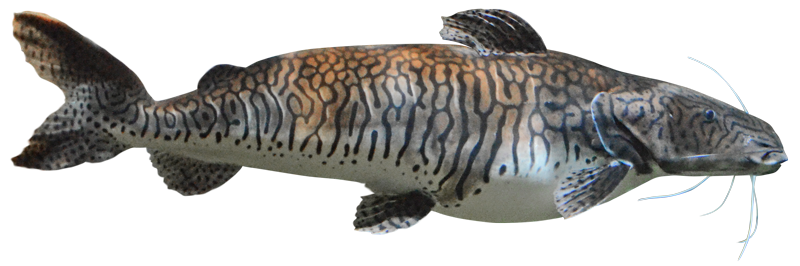
The Tiger Shovelnose Catfish (Barred sorubim) is a large catfish native to the great rivers of South America, widely distributed throughout the Amazon and Orinoco river basins. It is a large species that can reach approximately 130–140 cm in length, characterized by its slender body and flattened, shovel-like head. This distinctive body shape is thought to be an adaptation for life near the river bottom, where it searches for prey. Its dark brown body is marked with pale bands, creating a complex pattern reminiscent of tiger stripes and giving it a distinctly wild appearance.
A nocturnal predator, it relies on its six barbels around the mouth to navigate and hunt in dark waters. These sensitive organs detect vibrations and chemical changes in the water, allowing the fish to locate prey even in murky river environments. It is a carnivorous species that feeds mainly on small fish, as well as crustaceans and mollusks, making it an efficient hunter of the river floor.
This species closely resembles related species such as Pseudoplatystoma tigrinum, and several similar species are sometimes traded under the name “Tiger Shovelnose Catfish.” Although differences in body patterns are sometimes used for identification, individual and geographic variation is considerable, making reliable identification based solely on appearance difficult.
In the aquarium trade, it is one of the most popular large catfish, alongside the Redtail Catfish. Most specimens in circulation today are captive-bred and raised at fish farms in Southeast Asia and elsewhere, while wild-caught individuals are encountered far less frequently. These fish attract enthusiasts not only through their appearance, but also through their massive size, predatory nature, and powerful presence reminiscent of the great fishes of South American rivers. Compared with the Redtail Catfish, the Tiger Shovelnose Catfish has a more streamlined body adapted for life close to the river bottom.
In recent years, a hybrid known as the “Redtail Tiger Shovelnose Catfish” has also become available in the aquarium trade. This hybrid was created by combining the distinctive markings of the Tiger Shovelnose Catfish with the powerful body shape and red tail of the Redtail Catfish, producing an even more striking large catfish. It is believed to have been developed by ornamental fish breeders in Asia and is sometimes referred to as the “Leopard Catfish” because of its leopard-like pattern. Although such a fish does not exist in the wild, it represents an example of ornamental fish culture in which humans have sought to embody the majesty and wild character they admire in large predatory fishes.
参考文献
瀬戸の匠 気まぐれ熱帯魚飼育日記 | レッドテールタイガーシャベルノーズ・キャット | (2011年2月7日) 2025年5月4日閲覧
“Pseudoplatystoma tigrinum Tiger Shovelnose” Seriously Fish. 2025年5月4日閲覧
ABYの熱帯魚図鑑 | タイガーシャベルノーズキャットの飼育法(餌・最大サイズ・適切な水槽サイズ等) | (2023年2月14日) 2025年5月4日閲覧