
Plectorhinchus cinctus (Temminck & Schlegel, 1843)
綾模様を纏うコショウダイ
A Sweetlips Adorned with a Twill Pattern
体長は最大で約50cmに達します。西太平洋から東インド洋の熱帯域に分布し、日本では屋久島、琉球列島、小笠原諸島などの暖流域に生息するイサキ科魚類です。主に水深数m〜30mほどの浅い岩礁域やサンゴ礁域の外縁、潮通しのよい斜面で見られ、単独または小群で行動します。昼行性で、甲殻類や多毛類、小型魚などの底生動物を捕食します。
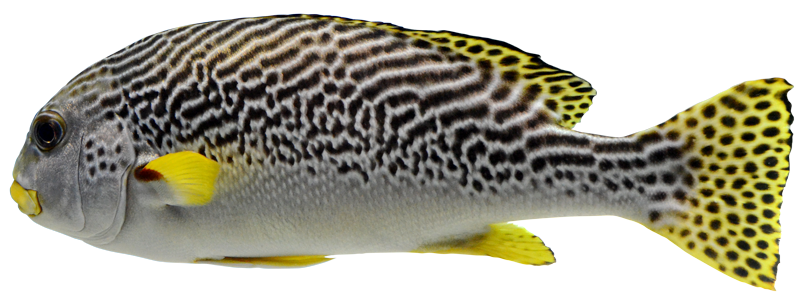
和名「綾胡椒鯛」は、体側に走る斜め後方へ伸びる黒色帯が織物の綾模様に似ることに由来します。体色は銀白色から淡黄褐色で、各鰭は鮮やかな黄色を帯びます。幼魚では縞模様が明瞭ですが、成長に伴い体の下部から途切れて斑点状へと変化します。かつてはシマコショウダイとも呼ばれましたが、近縁種との識別のため現在の和名が用いられています。
The body length reaches up to about 50 cm. This species is a member of the sweetlips (family Haemulidae) distributed in tropical regions of the western Pacific and eastern Indian Oceans. In Japan, it occurs around Yakushima, the Ryukyu Islands, and the Ogasawara Islands, inhabiting warm-current areas. It is typically found at depths of a few meters to around 30 m on rocky reefs and along the outer edges of coral reefs, especially on well-exposed slopes with strong water movement. It is usually seen alone or in small groups and is diurnal, feeding on benthic animals such as crustaceans, polychaetes, and small fishes.
The Japanese name “Ayakosho-dai” refers to the oblique dark stripes running along the body, which resemble a twill textile pattern (“aya”). The body is silvery to pale yellowish-brown, with vividly yellow fins that stand out underwater. In juveniles, the stripe pattern is bold and distinct, but as the fish grows, the lower part of the stripes breaks up into spots. It was formerly known as “Shima-kosho-dai,” but the current name is now preferred to distinguish it from related species.
参考文献
ダイバーのための海水魚図鑑 | アヤコショウダイ 2025年3月16日閲覧
海と島の雑貨屋さん | Fishes of Minna Island | アヤコショウダイ 2025年3月16日閲覧
Domani | 「綾」の持つ意味とは? 名付けに人気の理由や「綾」を使った名前を紹介 | (2022年11月24日) 2025年3月16日閲覧
ぼうずコンニャクの市場魚貝類図鑑 | アヤコショウダイ 2025年3月16日閲覧