
Balaeniceps rex (Gould, 1850)
その時を待つ大嘴の王
The Great-Billed King Waiting for the Right Moment
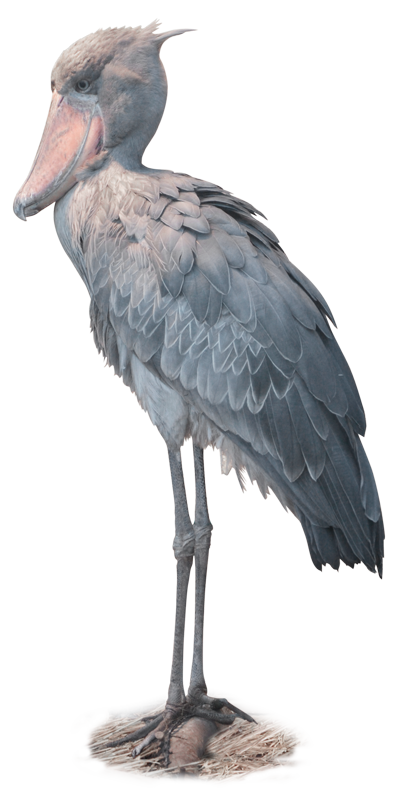
アフリカ中東部の熱帯地域に広がる淡水湿地に生息する大型の鳥類です。頭頂までの高さは110~140cm、翼開長は230~260cm、体重は4~7kgほど。巨大な嘴は長さ19~24cmにもなります。和名は「嘴の広いコウノトリ」に由来し、英名のShoebillは、靴のような形をした嘴を意味します。学名 Balaeniceps rex の Balaeniceps は「クジラの頭」を意味し、rex はラテン語で「王」を意味します。
ハシビロコウの分類については、以前から議論がありました。外見や行動にはコウノトリ類と共通する特徴が見られ、繁殖期などに嘴を打ち鳴らして音を出す「クラッタリング」も知られています。一方、骨格にはペリカン類と共通する特徴があり、飛翔時に首を縮める姿勢はサギ類にも似ています。形態的特徴に加え、DNAを用いた系統解析などから、現在はペリカン目ハシビロコウ科に分類されており、近縁な系統としてシュモクドリ科があります。
動物園では、長時間じっとしている姿から「動かない鳥」として人気があります。野生では湿地の水辺で獲物を待ち伏せ、魚が呼吸のために水面へ浮上する瞬間などを狙います。獲物を見つけると、大きな嘴を使って素早く捕らえます。主な獲物はハイギョをはじめとする魚類ですが、カエルやヘビなどを食べることもあります。狩りの成功率は約60%とする資料もあり、じっと待つ時間の長さに対して、捕食の瞬間には素早い動きを見せます。
ハシビロコウは、狩りの際を除けば動作がゆっくりしており、飛翔時の羽ばたきも鳥類の中では遅く、毎分150回ほどとされています。ザンビアのバングウェウル湿地で行われたGPS調査では、1日の移動距離が3km未満だった日が全体の81%を占めました。一方、年間の行動圏は平均約1,500km²に及び、雨季の始まりには移動距離が増える傾向も見られました。水位の変化に応じて利用する場所を変えながら、広い湿地の中で餌場を探していると考えられています。
The Shoebill is a large bird that inhabits freshwater wetlands across tropical parts of central and eastern Africa. It stands about 110–140 cm tall, has a wingspan of 230–260 cm, and weighs around 4–7 kg. Its enormous bill can reach 19–24 cm in length. The Japanese name, Hashibirokō, refers to a stork with a broad bill, while the English name, Shoebill, describes the bill’s distinctive shoe-like shape. Its scientific name, Balaeniceps rex, combines Balaeniceps, meaning “whale-head,” with rex, the Latin word for “king.”
The classification of the Shoebill has long been debated. Its appearance and behavior share certain characteristics with storks, and it is known to produce a clattering sound by rapidly clapping its bill, particularly during the breeding season. However, its skeleton also shares features with pelicans, while its habit of retracting its neck during flight resembles that of herons. Based on these morphological characteristics and DNA-based phylogenetic analyses, the Shoebill is now classified in its own family, Balaenicipitidae, within the order Pelecaniformes. The Hamerkop family is also part of a closely related lineage.
In zoos, the Shoebill is popular for its habit of standing motionless for long periods, earning it a reputation as the “bird that never moves.” In the wild, it waits in ambush near the water’s edge, targeting prey such as fish that rise to the surface to breathe. When an opportunity arises, it uses its massive bill to seize its prey with a rapid strike. Its main food consists of fish, including lungfish, but it also eats frogs, snakes, and other animals. Some sources report a hunting success rate of around 60 percent. Despite spending long periods waiting, the Shoebill can move remarkably quickly when striking at its prey.
Outside of hunting, the Shoebill moves slowly, and its wingbeats in flight are also relatively slow for a bird, at approximately 150 beats per minute. A GPS study conducted in the Bangweulu Wetlands of Zambia found that the birds traveled less than 3 km per day on 81 percent of the days monitored. Nevertheless, their average annual home range extended to approximately 1,500 km², and their movements tended to increase at the beginning of the rainy season. The Shoebill is thought to search for feeding sites across this extensive wetland, changing the areas it uses in response to fluctuations in water levels.
参考文献
千葉市動物公園 | 不思議の国のハシビロコウ 2024年7月15日閲覧
高知県立のいち動物公園 | ハシビロコウ 2024年7月15日閲覧
FNNプライムオンライン | 特集 いきものディープランド | 「ハシビロコウ」の“爆音すぎるコミュニケーション”が衝撃的…どんな時にするのか聞いてみた | (2021年6月5日) 2024年7月15日閲覧
アニコムどうぶつコミュニティー | 動かないだけじゃない!ハシビロコウの特徴&魅力がわかるマメ知識 | 佐藤 華奈子 | (2024年2月14日) 2024年7月15日閲覧
Hamerkops, pelicans and shoebills are related. The Pterosaur Heresies. (2021, December 24) 2024年7月15日閲覧
BirdLife International. 2018. Balaeniceps rex. The IUCN Red List of Threatened Species 2018: e.T22697583A133840708. 2026年11月1日閲覧