
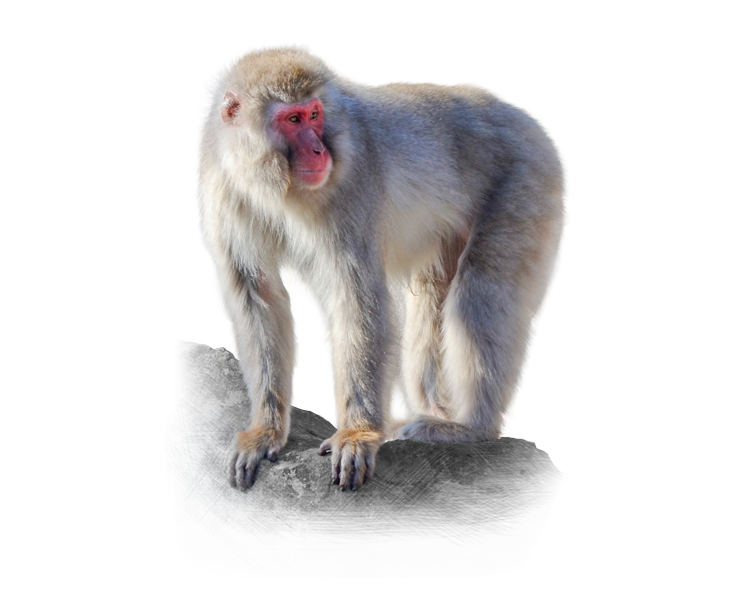
Macaca fuscata (Gray, 1870)
最北限のサル
The Northernmost Monkey
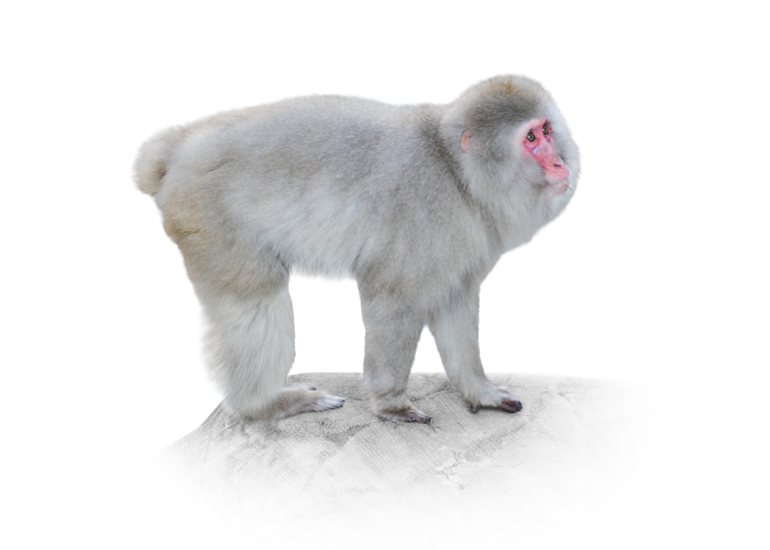
頭胴長(体長)はオス53~60cm、メス47~55cm、尾長はオス7~11cm、メス6~11cm、体重はオス6~18kg、メス6~14kgほどです。日本固有種で、本州、四国、九州、屋久島などに分布し、低地から標高2,000m近い山地まで、落葉広葉樹林や常緑広葉樹林など、さまざまな森林環境に適応しています。群れで暮らし、果実や種子、葉、芽、昆虫など幅広い食物を利用します。寒冷な地域にも生息できることから、ニホンザルはヒト以外では世界で最も北まで分布する霊長類として知られています。
その分布の北限は青森県下北半島で、北海道には自然分布していません。北海道と本州の間にある津軽海峡は、動物の分布を分ける生物地理学上の境界「ブラキストン線」とされ、ニホンザルはその南側を代表する動物の一つです。海峡を挟んで生息する動物相が大きく異なるのは、津軽海峡が長い間、陸上動物の移動を妨げる地理的障壁となってきたためです。
南限にあたる屋久島には、ヤクシマザル(Macaca fuscata yakui)と呼ばれる個体群が分布してきました。本土のニホンザルとは形態や遺伝的特徴に違いがあり、両者は約17~18万年前に分岐したとする研究があります。ただし、近年はヤクシマザルを独立した亜種として扱うことについても議論があります。
さらに祖先をたどると、ニホンザルはアジア大陸に分布するアカゲザルと近縁です。両者の分岐時期については研究によって推定値に幅があり、近年の全ゲノム解析では約100万~230万年前とされています。一方、過去の研究では約50万年前とする推定もあり、日本列島に渡ったニホンザルが独自の進化を遂げてきた歴史は、現在も研究が進められています。なお、種子島ではかつてニホンザルが生息していましたが、1950年頃までに絶滅したとされています。
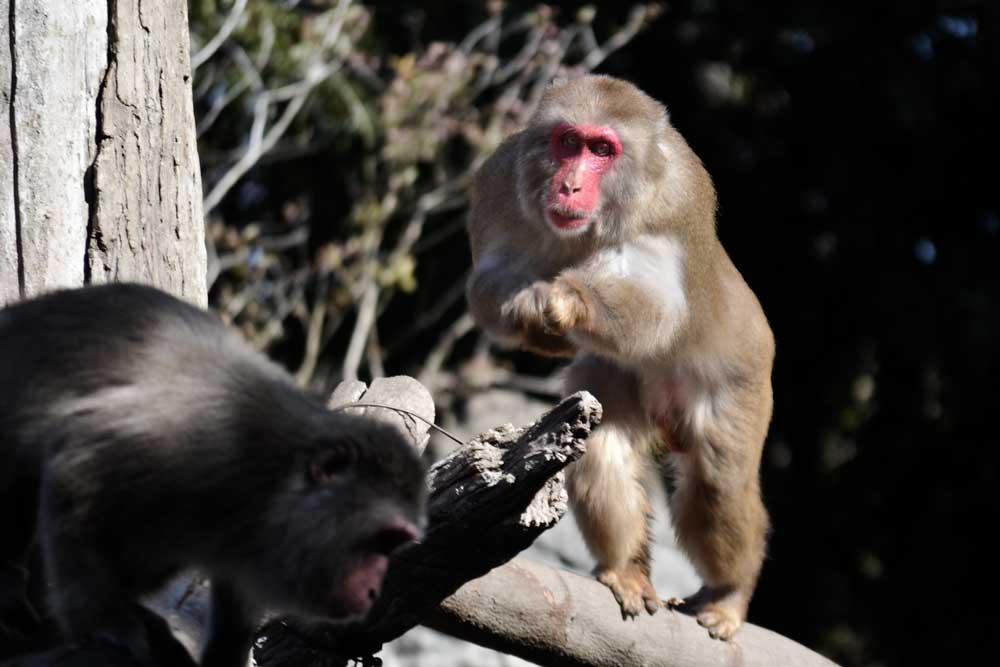
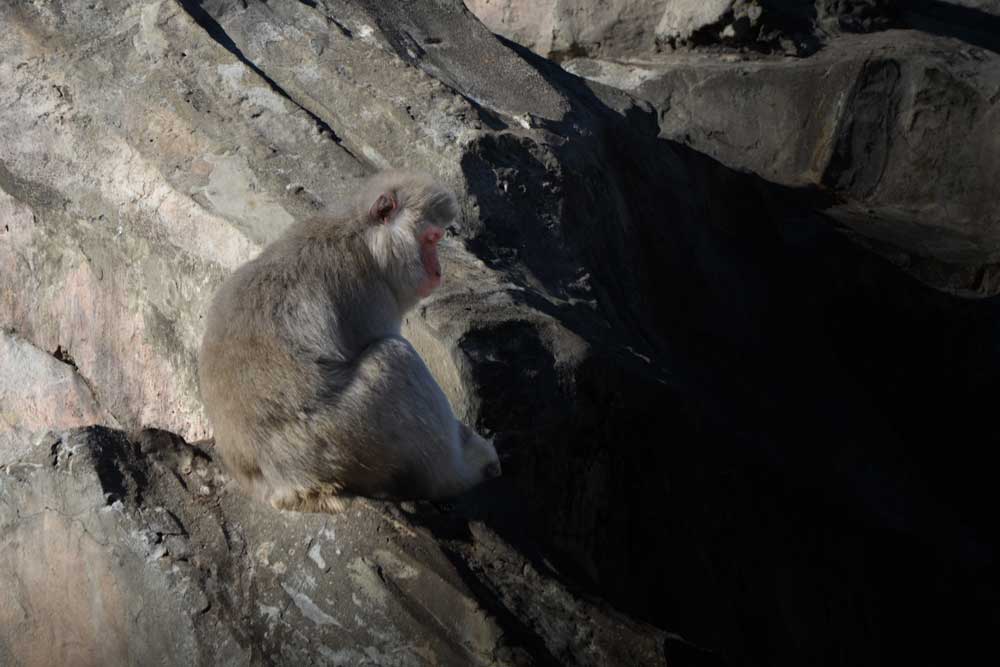
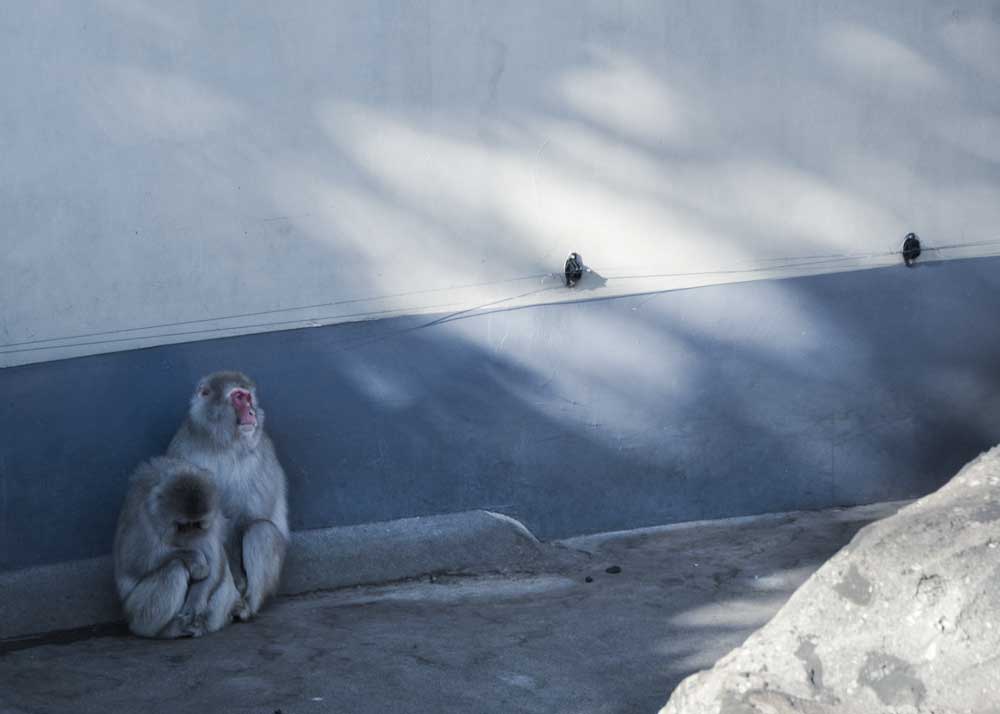
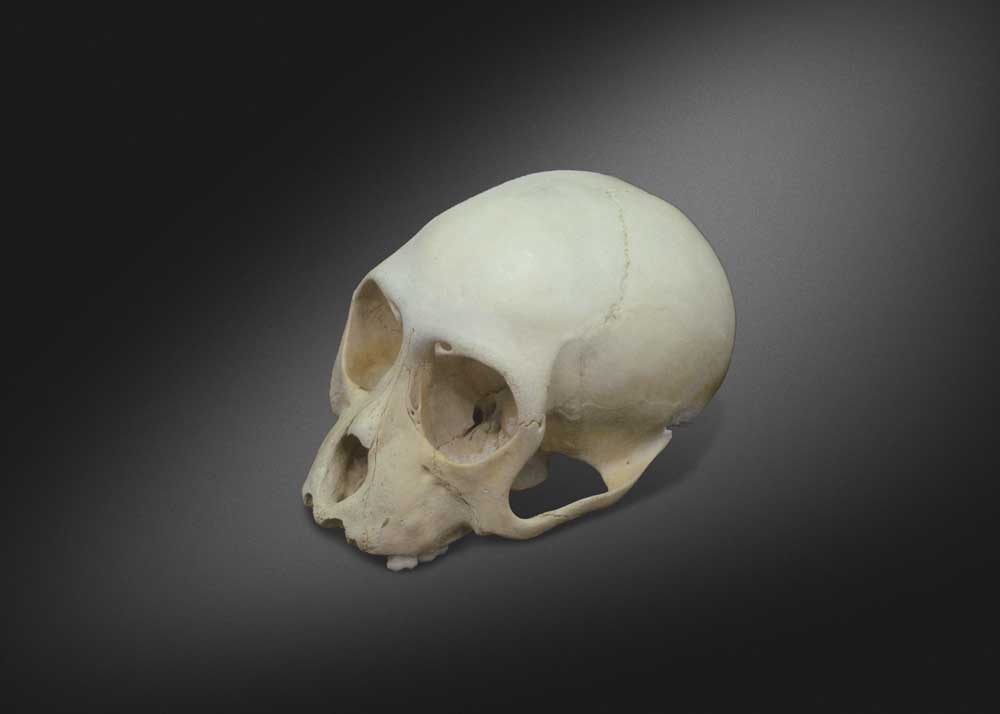
The Japanese macaque has a head-and-body length of 53–60 cm in males and 47–55 cm in females. Its tail measures 7–11 cm in males and 6–11 cm in females, while body weight ranges from 6–18 kg in males and 6–14 kg in females. Endemic to Japan, it occurs on Honshu, Shikoku, Kyushu, Yakushima, and several other islands. It inhabits a wide range of forest environments, from lowlands to mountainous areas at elevations approaching 2,000 m, including both deciduous and evergreen broad-leaved forests. Japanese macaques live in groups and have a highly varied diet that includes fruits, seeds, leaves, buds, and insects. Their ability to tolerate cold conditions makes them the northernmost non-human primates in the world.
The northern limit of their natural distribution is the Shimokita Peninsula in Aomori Prefecture, and they do not naturally occur in Hokkaido. The Tsugaru Strait between Honshu and Hokkaido forms a biogeographical boundary known as the Blakiston Line, across which the composition of terrestrial wildlife changes markedly. The strait has long acted as a geographical barrier preventing land animals from moving between the two regions, and the Japanese macaque is one of the species whose distribution reflects this boundary.
At the southern end of their range, Yakushima is home to a population known as the Yakushima macaque, Macaca fuscata yakui. It differs from macaques on the main islands in certain morphological and genetic characteristics, and one study estimates that the two populations diverged approximately 170,000–180,000 years ago. However, whether the Yakushima macaque should be treated as a distinct subspecies remains under discussion.
Tracing their evolutionary history further back, Japanese macaques are closely related to rhesus macaques, which are distributed across mainland Asia. Estimates of when the two lineages diverged vary among studies. A recent whole-genome analysis places the divergence at approximately 1–2.3 million years ago, while earlier research estimated it at around 500,000 years ago. The history of Japanese macaques after their ancestors reached the Japanese Archipelago and subsequently evolved in isolation remains an active area of research. On Tanegashima, where Japanese macaques once occurred, the population is believed to have become extinct by around 1950.
参考文献
エコチル | 【旭山動物園だより】なぜ北海道にいないの?「ニホンザル」 | (2022年4月11日) 2024年7月14日閲覧
瀬戸口烈司『ニホンザルとアカゲザルの分岐時期の再考』京都大学霊長類研究所(1986)
沖縄こどもの国 | 動物図鑑 | ヤクシマザル 2024年7月14日閲覧