
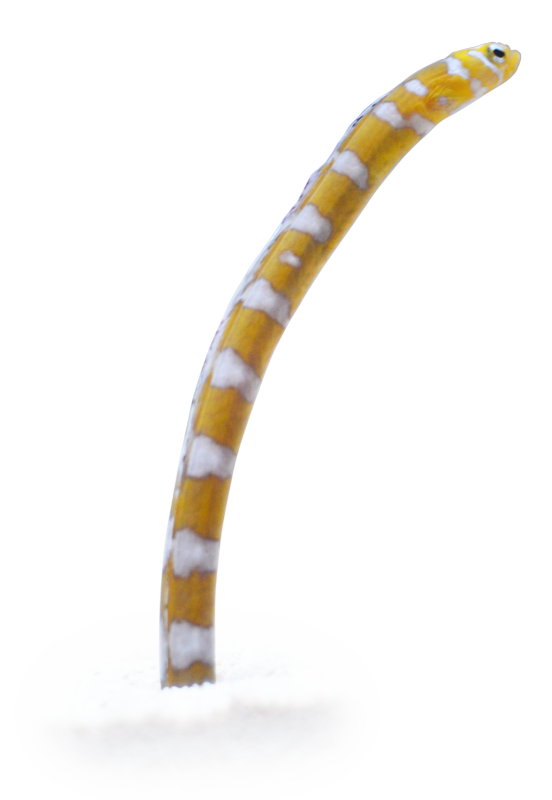
Gorgasia preclara (J. E. Bohlke & J. E. Randall, 1981)
錦が織りなす熱帯の海底
A Tropical Seafloor Woven in Brocade
全長約40cm。インド洋から西太平洋の熱帯域に分布し、サンゴ礁の外縁など、潮の流れが比較的強い砂地に生息します。体はオレンジ色と白色の鮮やかな縞模様に彩られ、その華やかな姿を錦にたとえて「ニシキアナゴ」と呼ばれます。細長い体を砂から伸ばす姿は、イラストなどでチンアナゴとして描かれることもありますが、両者は別種です。ニシキアナゴはチンアナゴより大型になり、より深い場所で見られる傾向があります。ニシキアナゴは水深18~75mで記録され、30m以深で見られることが多い魚です。
普段は体の大部分を砂の中に埋め、頭部から体の一部だけを砂上に出しています。流れに乗って運ばれてくるプランクトンを待ち受け、巣穴からほとんど動かずに捕食します。危険を感じると、砂の中へ素早く身を隠します。巣穴は尾部を使って砂の中を後ろ向きに掘り進めてつくられ、砂の壁を体から分泌する粘液で固めることで、巣穴が崩れるのを防いでいます。
ニシキアナゴは単独で暮らすこともありますが、数百匹、ときには1,000匹を超える個体が集まってコロニーをつくることもあります。それぞれが自分の巣穴を持ち、近くの個体が接近すると、体を伸ばしたり振るわせたりして追い払うなど、巣穴をめぐる争いも見られます。砂の中に身を隠しながら、流れてくる餌を待つという生活に適応した、独特な姿をしたアナゴの仲間です。
Growing to about 40 cm in length, the splendid garden eel is distributed throughout tropical waters of the Indian Ocean and western Pacific. It inhabits sandy bottoms, often along the outer edges of coral reefs where currents are relatively strong. Its body is marked with vivid orange-and-white stripes, giving it an ornate appearance reminiscent of nishiki, the richly patterned Japanese brocade from which its Japanese name is derived. Although its slender body emerging from the sand is sometimes illustrated as a garden eel, it is a different species from the spotted garden eel, or hassi garden eel. The splendid garden eel grows larger and tends to occur in deeper water. It has been recorded at depths of 18–75 m and is often found below 30 m.
Most of its body remains buried in the sand, with only the head and part of the body protruding above the seabed. It waits for plankton carried by the current and feeds without moving far from its burrow. When threatened, it quickly retreats into the sand. Its burrow is excavated by using the tail to work backward through the sediment. Mucus secreted by the body helps stabilize the walls of the burrow and prevents them from collapsing.
Splendid garden eels may live alone, but they can also form colonies containing hundreds of individuals, sometimes more than 1,000. Each individual maintains its own burrow, and when a neighboring eel approaches too closely, it may stretch and wave its body to drive the intruder away. This unusual eel has evolved a distinctive lifestyle, remaining partly hidden in the sand while waiting for food drifting past in the current.
参考文献
サンシャイン水族館 | いきふぉめ〜しょん | 『チンアナゴ』『ニシキアナゴ』が砂に埋まっているのはどうして? | (2029年12月13日) 2024年7月28日閲覧
すみだ水族館 | コラム | 知っているだけで100倍かわいい!チンアナゴの豆知識 | (2028年11月12日) 2024年7月28日閲覧
“Splendid Garden Eel” Georgia Aquarium. 2026年9月12日閲覧