
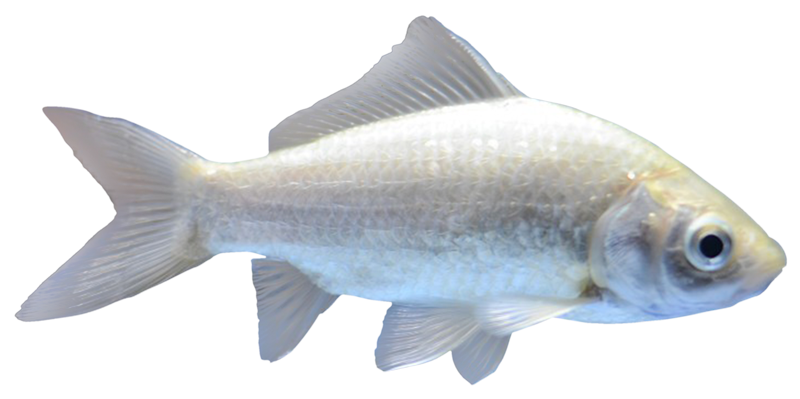
Carassius langsdorfii (Temminck et Schlegel, 1846)
クローンで増えるフナ?ギンブナの不思議な繁殖
Cloning Crucian Carp? The Unusual Reproduction of the Ginbuna
全長約25cm。東アジアに分布するコイ科の淡水魚で、真鮒(マブナ)とも呼ばれます。日本では北海道から沖縄まで全国に広く分布し、湖沼や河川の下流域、水田、ため池など多様な止水・緩流域に生息しています。特に水質の悪化や低酸素環境にも強く、他の魚類が生息しにくい汚濁水域でも見られることが特徴です。雑食性で、水生昆虫や甲殻類、藻類、有機物などを幅広く摂食し、環境に応じて柔軟に食性を変えます。
他種のフナ類の染色体数が100(2倍体)であるのに対し、ギンブナは150(3倍体)の個体が多く、通常3倍体は減数分裂が正常に行えないため繁殖が困難とされます。しかし本種は雌性発生という特殊な生殖様式を持つことで繁殖を可能にしています。一般的な有性生殖では、オスの精子が卵に遺伝情報を提供しますが、ギンブナでは精子は発生の引き金となるだけで、遺伝子は子に受け継がれません。
この発生刺激は同種に限らず、ウグイやドジョウ、コイなど他魚種の精子でも成立し、結果として生まれる子はすべて母親と同一の遺伝子を持つクローンとなります。そのため多くの個体群はメスのみで構成され、関東地方ではほぼメスだけが確認されています。
一方で、すべての個体が無性生殖のみを行うわけではなく、稀に2倍体のフナ類と有性生殖を行い交雑する例も報告されています。こうした現象により遺伝的多様性が一定程度維持されていることが近年の研究で明らかになってきました。クローン繁殖と有性生殖を併せ持つ点は極めて特異であり、進化や生殖戦略を考える上で重要なモデルケースとして注目されています。
Reaching a total length of about 25 cm, this cyprinid freshwater fish is distributed throughout East Asia and is also known as “mabuna” (true crucian carp). In Japan, it occurs widely from Hokkaido to Okinawa, inhabiting a variety of lentic or slow-flowing environments such as lakes, lower river reaches, rice paddies, and ponds. It is particularly tolerant of poor water quality and low-oxygen conditions, and can survive in polluted habitats where many other fish cannot. An omnivore, it feeds on aquatic insects, small crustaceans, algae, and organic detritus, flexibly adjusting its diet to local conditions.
While most other crucian carp have 100 chromosomes (diploid), this species commonly possesses 150 chromosomes (triploid). Triploids are generally unable to reproduce normally due to irregular meiosis; however, this species overcomes the limitation through a unique reproductive mode known as gynogenesis. In typical sexual reproduction, sperm contributes genetic material to the egg, but in this case the sperm merely triggers embryonic development, and the male’s genetic material is not incorporated into the offspring.
This stimulus can be provided not only by conspecific males but also by males of other fish species, such as dace, loaches, and common carp. As a result, no hybrids are produced, and females give rise to clonal offspring that inherit the mother’s genome unchanged. Consequently, many populations consist entirely of females, and in the Kanto region, almost only females have been recorded.
However, not all individuals reproduce exclusively through asexual means. Rare cases of sexual reproduction with diploid crucian carp have been documented, resulting in hybridization. Such events are thought to contribute to the maintenance of genetic diversity, as revealed by recent studies. The coexistence of clonal reproduction and occasional sexual reproduction makes this species an important model for understanding alternative reproductive strategies and evolutionary processes.
参考文献
北海道開発局 | 十勝の川の生き物たち 十勝の川生物図鑑 | ギンブナ 2024年11月4日閲覧
WEB魚図鑑 | ギンブナ 2024年11月4日閲覧
佐賀の自然デジタル大百科事典 | ギンブナ 2024年11月4日閲覧
東京ズーネット | ニュース | クローンで増えるギンブナ | (2018年5月18日) 2024年11月4日閲覧
三品 達平, 他「クローン繁殖フナは稀に有性⽣殖をしながら繁栄 ―遺伝的に多様なクローンフナが存在する謎を解明― 」(2021年11月19日) 京都大学 2024年11月4日閲覧