
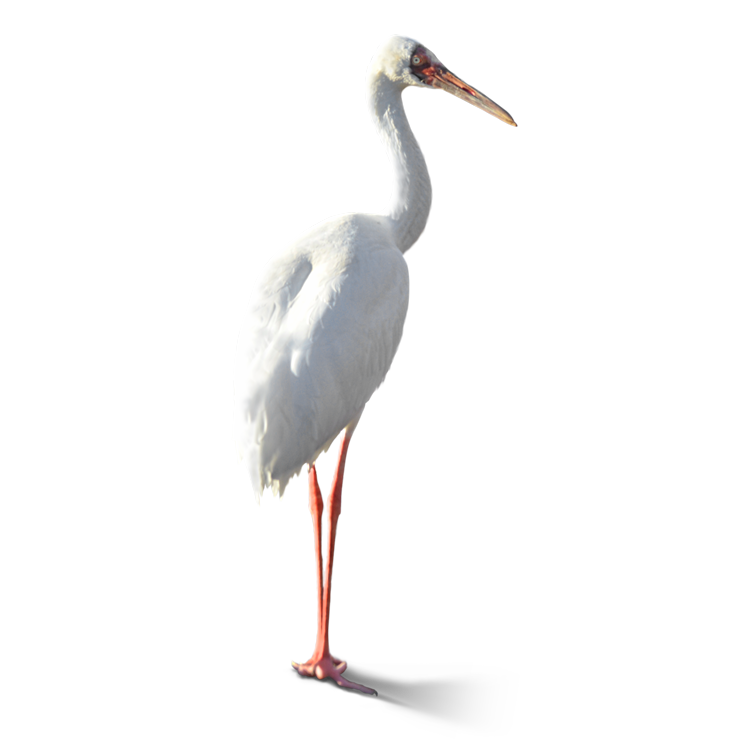
Leucogeranus leucogeranus (Pallas, 1773)
夜空を飛ぶ純白のツル
A Pure White Crane in the Night Sky
全長125~137cm、翼開長230~260cm。シベリア北部のツンドラ地帯で繁殖し、冬になると中国やイランなどへ渡って越冬する大型のツルです。全身は純白ですが、顔には羽毛がなく赤い皮膚が露出しています。嘴や脚も赤褐色を帯び、飛翔時には和名の由来となった黒い初列風切がよく目立ちます。
かつては広い範囲に分布していましたが、生息地の開発や渡り途中の環境悪化などにより個体数は大きく減少しました。現在の世界個体数は約3,000羽とされ、絶滅が危惧される希少なツルのひとつです。特に西方個体群はほぼ消滅し、現在は中国の鄱陽湖で越冬する東方個体群が大半を占めています。
ソデグロヅルは主に昼間に渡る鳥として知られていましたが、近年の研究では日没後も飛行を続けることが確認されています。東シベリアでの観察では、渡りの群れの4~69%が夜間にも飛行し、湿地などの好適な休息地が近くにあっても飛び続ける例が見られました。このことから、夜間飛行は単なる環境条件ではなく、渡りを続けようとする内的な要因によって引き起こされている可能性が示されています。
日本ではごくまれに迷鳥として記録されます。迷鳥とは、台風や強風などの影響で本来の渡り経路から外れて飛来した鳥のことです。夜間にも長距離を移動する習性をもつ本種では、悪天候や風向きの変化が進路に影響し、日本への偶発的な飛来につながっているのかもしれません。純白の体に黒い翼端をもつその姿は、世界でもっとも美しいツルのひとつとして多くの人々を魅了しています。
The Siberian Crane is a large crane measuring 125–137 cm in length with a wingspan of 230–260 cm. It breeds in the tundra regions of northern Siberia and migrates south to wintering grounds in China and Iran. Although its plumage is almost entirely pure white, the bare skin on its face is bright red, and both the bill and legs are reddish-brown. In flight, the black primary feathers that give the species its Japanese name become clearly visible against the white body.
Once widespread across a much larger range, the Siberian Crane has suffered severe population declines due to habitat loss and degradation along its migration routes. Today, the global population is estimated at only about 3,000 individuals, making it one of the world’s most threatened crane species. The vast majority belong to the eastern population, which spends the winter around Poyang Lake in China, while the western population has nearly disappeared.
Traditionally regarded as a primarily diurnal migrant, the Siberian Crane has recently been shown to continue migration after sunset. Observations conducted in eastern Siberia found that between 4 and 69 percent of migrating flocks were still flying after dark. Some birds even continued their journey despite the presence of suitable wetlands nearby, suggesting that nocturnal flight may be influenced not only by environmental conditions but also by internal migratory drives.
In Japan, the species is occasionally recorded as a vagrant. A vagrant bird is one that has strayed from its normal migration route, often because of storms or strong winds. Since Siberian Cranes are capable of prolonged flights that extend into the night, adverse weather conditions may sometimes divert them far from their intended destination and lead to these rare appearances. With its striking white plumage and contrasting black wingtips, the Siberian Crane is widely regarded as one of the most beautiful crane species in the world.
参考文献
東京ズーネット | 動物図鑑 | ソデグロヅル 2024年8月3日閲覧
朝日新聞デジタル | 記事 | 赤いクチバシで踊るツル、鯖江で越冬中 福井県内で初めて確認 (2024年2月6日) 2024年8月3日閲覧
学研キッズネット | 辞典 | めいちょう【迷鳥】 2024年8月3日閲覧