
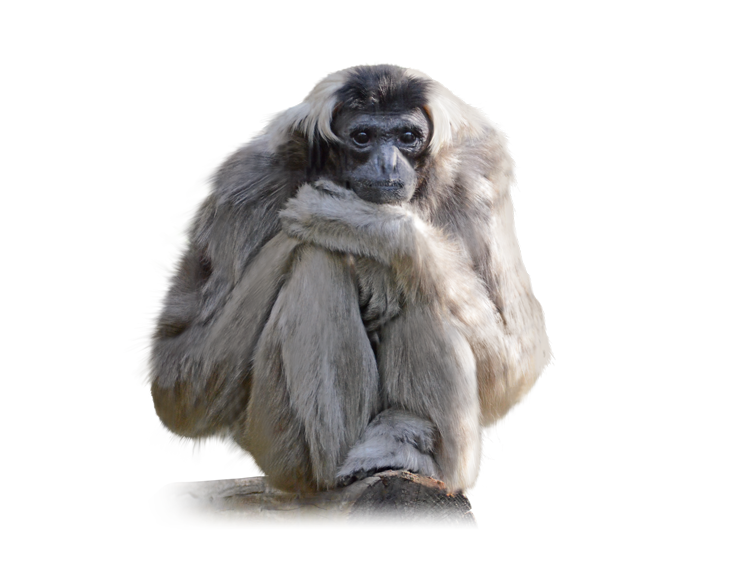
Hylobates pileatus (Gray, 1861)
樹上の類人猿が示す直立の手がかり
An Arboreal Ape Reveals Clues to Upright Walking
体長約50〜60cm。東南アジアの熱帯林に生息するボウシテナガザルは、頭頂部の黒い“帽子”状の毛と、雌で顕著な淡色の体毛との対比が特徴です。雌雄で体色が大きく異なり、つがいで響かせるデュエットのような大きな鳴き声でも知られています。長い前肢と柔軟な肩関節を持ち、樹上生活に高度に適応した小型類人猿です。
尾を持たない霊長類であるテナガザルは類人猿、すなわちヒト上科に属します。ヒト上科はヒト科(ヒト、チンパンジー、ゴリラ、オランウータンなど)とテナガザル科に分けられ、テナガザル科は約2000万〜1600万年前にヒト科から分岐したと考えられています。両者の大きな違いは移動様式にあり、ヒト科では直立二足歩行が発達した一方、テナガザル科は長い前肢を用いたブラキエーションに特化しています。
しかしテナガザルは全く二足歩行を行わないわけではありません。地上や安定した枝の上では、前肢を使わず直立して歩く行動も見られます。特に枝上では歩幅を調整し、体の揺れを抑えることで不安定な足場でも移動できます。このように樹上環境においてすでに直立姿勢と高度なバランス制御を備えている点は、ヒトの常習的な二足歩行の起源を考える上で重要な手がかりとされています。
With a body length of about 50–60 cm, the pileated gibbon (Hylobates pileatus) inhabits the tropical forests of Southeast Asia. It is characterized by a black “cap” on the crown and a striking contrast with the pale body coloration seen in females. Males and females differ markedly in coloration, and the species is also known for its loud, duet-like calls produced by mated pairs. Possessing long forelimbs and highly flexible shoulder joints, it is a small ape well adapted to an arboreal lifestyle.
Gibbons, which lack tails, belong to the superfamily Hominoidea. This group consists of the family Hominidae (including humans, chimpanzees, gorillas, and orangutans) and the family Hylobatidae. The latter is thought to have diverged from the former approximately 20 to 16 million years ago. A major difference between them lies in locomotion: while hominids have developed habitual bipedalism, gibbons are specialized for brachiation, moving through the trees by swinging from branch to branch using their long arms.
However, gibbons do not entirely lack bipedal locomotion. On the ground or on stable branches, they are capable of walking upright without using their forelimbs. Especially on branches, they adjust their stride and reduce body sway to maintain balance on unstable substrates. The fact that they already possess upright posture and advanced balance control in arboreal environments provides important clues for understanding the evolutionary origins of habitual human bipedalism.
参考文献
京都大学人類進化論研究室 | ヒトとチンパンジーの系統的学位置 2026年4月12日
上野動物園 | 上野動物園の生き物 | シロテナガザル 2026年4月12日
日本モンキーセンター | 霊長類図鑑 | ボウシテナガザル 2026年4月12日