
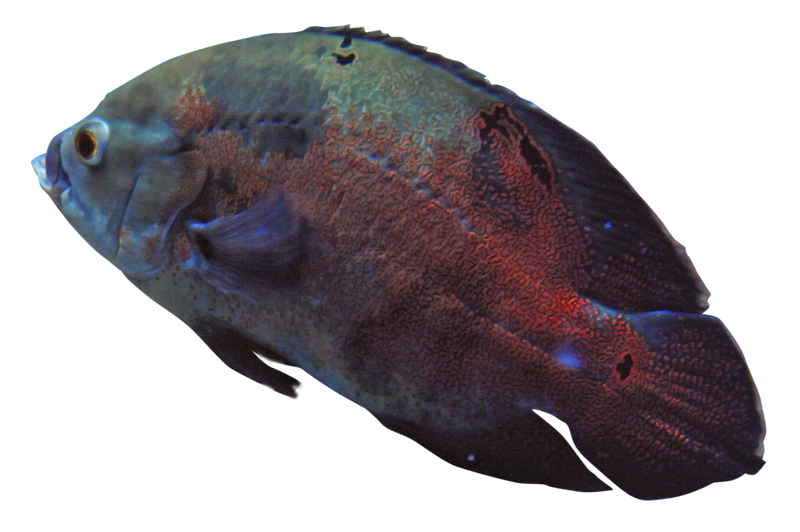
Astronotus ocellatus (Agassiz, 1831)
後ろに目がある?アマゾンの魚
Eyes on the Back? A Fish of the Amazon
南米アマゾン川流域に分布する淡水魚であり、全長45cm、重さは1.6kgにもなります。流れの穏やかな川の浅瀬に生息しており、流木や木の根を寝床にしています。肉食魚で気性は荒く、小型魚と混泳させると捕食してしまいます。
尾びれや背びれのつけ根には鮮やかな橙色で縁取られた黒い目玉模様があり、これは目を狙って襲ってくる水鳥や、生息域の重なるピラニアなどの天敵を欺き、頭部を守るための適応と考えられます。なお、この目玉状の模様(英語ではocelli)が種小名ocellatusの由来であり、ocellatusが訛ってoscar と呼ばれるようになったと考えられます。属名のAstronotus は「天体」を意味する古代ギリシャ語の ἄστρον (astron) と「後ろ」または「南」を意味するνότος (notos) が由来です。これも目玉模様のことを表していると考えられます。
生息地では食用にされていますが、体色や模様の変化に富み世界各地で観賞魚として人気が高く、東ヨーロッパやタイ、シンガポールで多くの改良品種が作られています。繁殖力が強く南フロリダでは意図的に放流された結果、繁殖し外来種として定着しました。
This freshwater fish is distributed throughout the Amazon River basin in South America, reaching a maximum total length of about 45 cm and a weight of up to 1.6 kg. It inhabits shallow areas of slow-moving rivers and lakes, using driftwood and submerged tree roots as shelters and resting places. It is a carnivorous species with an aggressive temperament and strong territorial behavior, and will readily prey on smaller fish when kept together. At the same time, it is known for its relatively high intelligence and remarkable ability to adapt to its environment.
At the base of the tail fin and dorsal fin are conspicuous black eyespots edged with bright orange. These markings are thought to function as a defensive adaptation, deceiving predators such as fish-eating birds and piranhas that share the same habitat, thereby protecting the head. Such eyespot patterns are called ocelli in English and are the origin of the species name ocellatus. It is believed that ocellatus later became corrupted into the common name “oscar.” The genus name Astronotus derives from the Ancient Greek words ἄστρον (astron), meaning “celestial body,” and νότος (notos), meaning “back” or “south,” and is also thought to refer to the distinctive eyespot markings.
In its native range, this species is sometimes used as a food fish. However, because of its wide variation in body coloration and pattern, it is highly popular as an ornamental fish worldwide. Numerous selectively bred varieties have been developed in Eastern Europe, Thailand, and Singapore. Owing to its strong reproductive capacity, intentional releases in southern Florida have resulted in successful breeding in the wild, where the species has become established as a non-native fish.
参考文献
朝日新聞デジタル | 記事 | 悪童「オスカー」、秩序乱した罪で大水槽を出禁に 男鹿水族館通信 | (2021年12月14日) 2024年9月21日閲覧
Robins, Robert H. Astronotus ocellatus. FLORIDA MUSIUM. 2024年9月21日閲覧
Oscar Fish. A-Z-Animals. 2024年9月21日閲覧
“Astronotus ocellatus (AGASSIZ, 1831) Oscar” Seriously Fish. 2025年5月17日閲覧